
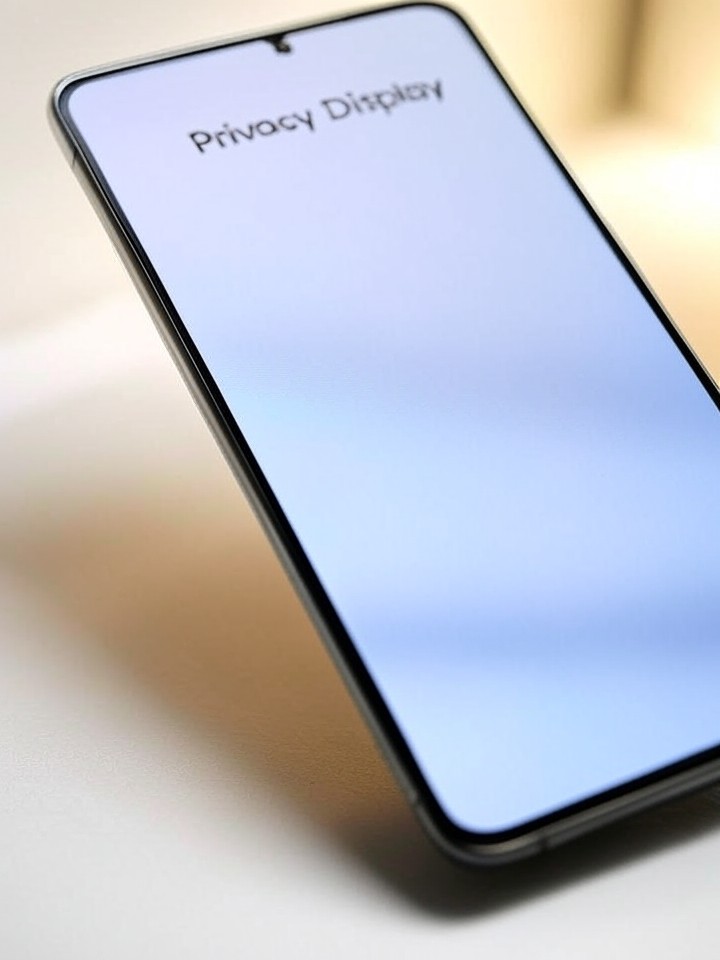
Samsung’s Stealthy Screens: Revolutionizing Privacy in the Smartphone Arena
In an era where personal data is as valuable as currency, Samsung is poised to elevate smartphone security with its latest innovation: an advanced privacy display set to debut across the entire Galaxy S26 lineup. This feature, dubbed “Privacy Display,” promises to shield users’ screens from prying eyes in public settings, using cutting-edge technology to restrict visibility from side angles. Leaks and reports from various tech outlets suggest this isn’t just a gimmick but a significant step forward in mobile privacy, potentially setting a new standard for the industry.
The technology behind Privacy Display appears to leverage AI-driven mechanisms to dynamically adjust the screen’s viewing angles. According to insights from Digital Trends, Samsung may integrate this across all models—including the base Galaxy S26, S26+, and S26 Ultra—making it a universal feature rather than an exclusive perk for premium variants. This move democratizes privacy protection, addressing a common pain point for users who handle sensitive information on the go, from banking apps to confidential emails.
Early leaks indicate that the display works by narrowing the effective viewing cone, rendering the screen illegible from oblique perspectives while maintaining clarity for the direct user. This is achieved through a combination of hardware and software tweaks, possibly involving specialized OLED panels that can modulate light emission. Industry insiders speculate that this could involve micro-louver technology or AI-optimized polarization filters, drawing parallels to privacy screens used in laptops but miniaturized for mobile devices.
Unveiling the Tech: How Privacy Display Works
Delving deeper, reports from Android Central describe animations and demos that show the screen “hiding itself from snoops,” with visual effects that blur or darken content when viewed from the side. This isn’t merely a static filter; it’s adaptive, potentially using the device’s sensors to detect environmental factors like ambient light or even the presence of nearby faces via the front-facing camera.
Samsung’s approach builds on existing privacy features in the market, but with a twist of AI integration. For instance, while some devices offer software-based dimming or color inversion for privacy, the Galaxy S26’s version is hardware-accelerated, ensuring minimal impact on battery life and performance. Posts on X from tech leakers like Ice Universe highlight code references to “Flex Magic Pixel,” suggesting a flexible pixel array that can alter its properties on demand.
Moreover, this feature aligns with broader trends in consumer electronics, where privacy is becoming a key differentiator. As data breaches make headlines, users are increasingly wary of visual hacking—whereby shoulder surfers glimpse sensitive info. Samsung’s innovation could mitigate such risks, especially in crowded environments like subways or cafes, without requiring users to hunch over their phones or apply cumbersome physical screen protectors.
From Leaks to Reality: Timeline and Expectations
The buzz around Privacy Display began intensifying in late 2025, with initial leaks surfacing on platforms like X. Users and analysts alike expressed excitement over posts detailing potential specs, such as integration with One UI 8.5, Samsung’s upcoming software skin. One notable post from a reliable leaker described it as a “smart privacy screen that sounds like magic,” pointing to its seamless activation through settings menus.
Corroborating this, PhoneArena reported that while the Ultra model might boast additional enhancements like faster charging, the privacy feature is slated for the whole series. This inclusivity is a strategic play by Samsung, aiming to boost appeal across price points and counter competition from rivals like Apple, whose iPhones have yet to introduce comparable built-in privacy tech.
Anticipation is high for the official unveiling, expected in February 2026, based on Samsung’s traditional launch cycle. Recent web searches reveal ongoing discussions, with sites like SamMobile confirming that all three models could feature it, potentially using advanced M14 OLED panels for superior brightness and efficiency.
Industry Implications: Beyond the Galaxy
For industry insiders, the rollout of Privacy Display raises questions about supply chain impacts and technological ripple effects. Samsung Display, the company’s panel-making arm, is likely at the forefront, innovating on OLED tech to enable these privacy capabilities. This could involve proprietary advancements in pixel structure, allowing for angle-specific light control without compromising color accuracy or refresh rates.
Competitors are watching closely. If successful, this feature might pressure other manufacturers to follow suit, accelerating the adoption of privacy-enhancing displays industry-wide. Think tanks and analysts predict that by 2027, such tech could become standard in flagship devices, much like fingerprint sensors did a decade ago.
Furthermore, there’s potential for ecosystem integration. Imagine Privacy Display syncing with Samsung’s Galaxy ecosystem, automatically activating in public Wi-Fi zones or when certain apps are open. Leaks from Geeky Gadgets mention AI integration, suggesting machine learning algorithms that learn user habits to optimize privacy modes.
Challenges and Criticisms: Not Without Hurdles
However, no innovation is without its challenges. Critics on X have pointed out potential drawbacks, such as reduced screen sharing capabilities—imagine trying to show a photo to a friend only for the display to obscure it from their angle. Samsung will need to provide intuitive toggles to disable the feature temporarily.
Battery consumption is another concern. While reports suggest efficiency, early prototypes might drain power faster due to constant AI processing. Gadget Hacks notes that the tech blocks side-view snooping effectively, but real-world testing will be crucial to assess trade-offs in visibility under various lighting conditions.
Privacy advocates applaud the move but caution that it’s not a panacea. Visual privacy doesn’t address digital threats like malware or network eavesdropping. Samsung must pair this with robust software security to offer comprehensive protection.
Evolution of Display Tech: A Historical Perspective
To appreciate Privacy Display’s significance, consider the evolution of smartphone screens. From the early days of resistive touchscreens to today’s foldable AMOLEDs, displays have been a battleground for innovation. Samsung has long led in this area, introducing features like curved edges and high refresh rates.
This new privacy tech builds on that legacy, incorporating elements from enterprise solutions where data security is paramount. For instance, banks and government agencies already use similar filters on monitors; miniaturizing this for mobiles represents a technical feat.
Looking ahead, insiders speculate on expansions, such as variable privacy levels or integration with AR glasses. Posts on X from users like Debayan Roy discuss complementary upgrades, including QHD+ 144Hz panels and anti-reflective coatings, which could enhance the overall viewing experience.
Market Reception and Consumer Sentiment
Consumer sentiment, gauged from X posts and forums, is overwhelmingly positive. Enthusiasts praise it as a “game-changer” for public use, with one post exclaiming, “No other phone has that.” This echoes broader demands for better privacy in tech, amid scandals involving data misuse.
Pricing strategies will be key. Android Authority leaks show animations of the feature in action, building hype that could justify premium pricing. Yet, making it available on base models might attract budget-conscious buyers seeking advanced features.
Samsung’s marketing will likely emphasize real-world scenarios, positioning the Galaxy S26 as the go-to device for professionals and privacy-conscious users. Partnerships with security firms could further bolster its credentials.
Technical Deep Dive: Under the Hood
Technically, the Privacy Display may employ a dual-layer OLED setup, where one layer handles standard emission and another modulates viewing angles. AI algorithms, powered by the Exynos 2600 or Snapdragon 8 Gen 5 chips, could predict and adjust based on user behavior.
Efficiency is paramount; reports indicate up to 2600 nits of brightness without excessive power draw. This ties into Samsung’s push for sustainable tech, reducing the need for aftermarket privacy films that add bulk and waste.
Integration with other features, like improved ISPs for cameras, suggests a holistic upgrade. As noted in X posts, the series might include better anti-reflective tech, minimizing glare and enhancing privacy in bright environments.
Global Rollout and Regulatory Considerations
Globally, the feature’s reception could vary. In regions with strict data protection laws like the EU, it might be hailed as a compliance aid. Conversely, in markets with less emphasis on privacy, it could be seen as an unnecessary frill.
Samsung must navigate patents and potential litigation; similar tech exists in patents from other firms. Ensuring exclusivity could involve proprietary AI models trained on vast datasets.
Pre-order perks, as hinted in recent news, might include bundles with privacy-focused accessories, sweetening the deal for early adopters.
Future Horizons: What’s Next for Privacy Tech
Looking beyond the S26, this could pave the way for more advanced iterations, like context-aware privacy that activates based on location data. Imagine a phone that senses a crowded train and automatically enables the shield.
Industry-wide, it might spur research into quantum-dot displays or even holographic privacy barriers. Samsung’s investment here underscores its commitment to leading in display innovation.
Ultimately, as smartphones become extensions of our digital selves, features like Privacy Display ensure that our private worlds remain just that—private. With the Galaxy S26 on the horizon, Samsung is not just selling a phone; it’s offering peace of mind in an increasingly watchful world.


 WebProNews is an iEntry Publication