
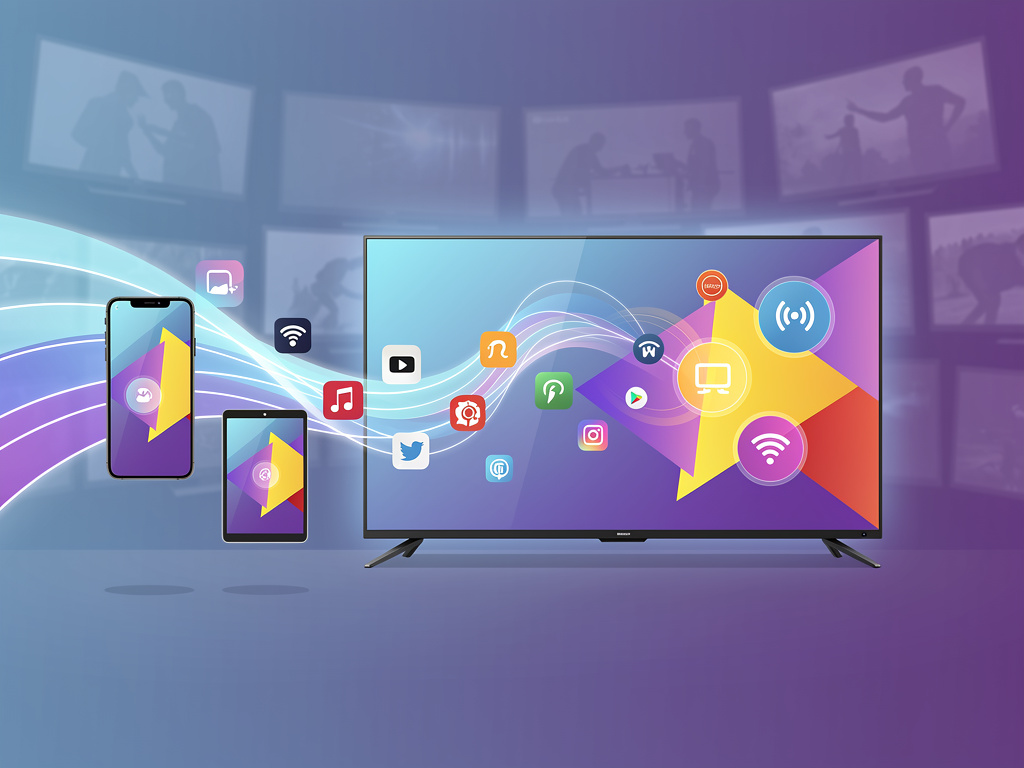
For years, if you owned a Samsung smart TV and wanted to cast something from your phone, you were stuck with Samsung’s own protocols or AirPlay. Google Cast — the underlying technology behind Chromecast — was conspicuously absent. That’s now changing, and the implications ripple far beyond a simple feature addition.
Samsung announced that its smart TVs will support Google Cast natively, a move that ends one of the longest-standing holdouts in the connected television market. According to Android Central, Samsung TVs running the Tizen operating system will gain the ability to receive Google Cast streams directly, allowing Android users to tap the familiar cast icon in supported apps and send video, music, and other content straight to their Samsung screens without additional hardware.
This is a big deal. Samsung is the world’s largest television manufacturer by market share, commanding roughly 30% of global TV shipments in recent years. The absence of Google Cast on Samsung sets meant that tens of millions of households either bought a separate Chromecast dongle, used Samsung’s SmartThings app as a workaround, or simply didn’t cast at all. That friction is about to disappear.
The timing isn’t accidental. Samsung has been gradually loosening its grip on proprietary software integration as competition from TV makers like TCL, Hisense, and LG has intensified. TCL and Hisense both ship models running Google TV, which comes with Cast built in. LG’s webOS platform added AirPlay years ago and has been expanding its own casting capabilities. Samsung, despite its dominant market position, was increasingly the outlier — the premium brand that made Android users jump through hoops to do something basic.
Google Cast works differently than screen mirroring. When you cast, the TV itself pulls the content stream directly from the internet rather than relaying it through your phone. Your phone acts as a remote control. The result is better video quality, lower battery drain on the mobile device, and the ability to keep using your phone for other tasks while content plays. It’s the same technology that powered the original Chromecast dongle when Google launched it in 2013 for $35, a device that arguably did more to popularize streaming on televisions than any product outside of Roku.
So why did Samsung resist for so long? Control. Samsung has spent years building its own smart TV platform, first with Tizen and more recently with the rebranded Samsung Smart TV interface. The company operates Samsung TV Plus, a free ad-supported streaming service that comes preloaded on every Samsung television. It runs its own app store. It sells advertising on its home screen. Every element of the Samsung TV experience is designed to keep users within Samsung’s orbit, generating data and ad revenue along the way. Allowing Google Cast meant ceding a degree of that control — letting Google’s infrastructure sit between the user and the content.
But the calculus has shifted. The smart TV business model now depends less on hardware margins and more on software and services revenue. Samsung reportedly generates billions annually from its TV platform through advertising and content partnerships. Adding Google Cast doesn’t necessarily threaten that revenue stream. Users still land on Samsung’s home screen when they turn on the TV. They still see Samsung TV Plus channels. They still encounter Samsung’s ad placements. What changes is that an Android user can now more easily push a YouTube video or Spotify playlist to the screen — which, if anything, increases the TV’s utility and makes Samsung sets more attractive to the enormous global Android user base.
And that user base is enormous. Android holds roughly 72% of the global smartphone market, according to StatCounter. For Samsung to ignore the casting preferences of nearly three-quarters of smartphone users was always a calculated risk. It appears the company has concluded the risk now outweighs the benefit of keeping Google at arm’s length.
The integration also arrives as Google has been quietly winding down the standalone Chromecast hardware line. Google discontinued the Chromecast with Google TV (HD) and its 4K sibling, replacing them with the Google TV Streamer, a more expensive device positioned as a smart home hub rather than a simple casting dongle. The affordable Chromecast that once sat behind millions of TVs is gone. Google’s strategy has pivoted toward embedding Cast directly into third-party televisions and displays, making native TV integration more important than ever for the Cast protocol’s survival and reach.
For consumers, the practical impact is straightforward. A Samsung TV owner with an Android phone will be able to open YouTube, Netflix, Spotify, or hundreds of other Cast-enabled apps, tap the cast icon, and send content to the TV. No dongle. No fumbling with Samsung’s SmartThings app. No switching inputs. According to Android Central, the rollout will cover recent Samsung TV models, though the exact model years and any firmware update requirements weren’t fully detailed at the time of announcement.
There’s a competitive dimension worth watching. Roku, Amazon Fire TV, and Apple TV all have their own casting or mirroring solutions. Apple’s AirPlay has been available on Samsung TVs since 2019, giving iPhone users an easy casting path. The addition of Google Cast now gives Android users equivalent functionality. Samsung, in effect, becomes the Switzerland of casting — supporting both major mobile platforms natively. That’s a selling point no other major TV operating system can claim quite as cleanly, since Google TV doesn’t support AirPlay and Roku’s casting capabilities remain more limited.
The move also has implications for the smart home. Google Cast isn’t just for video and music. It supports casting photos, presentations, and even some smart home camera feeds. Samsung has been aggressively pushing its SmartThings platform as a home automation hub, and there’s a question of how Google Cast integration will coexist with — or potentially conflict with — SmartThings functionality. Samsung will likely keep the two systems separate, using SmartThings for device control and Google Cast purely for media streaming. But the mere presence of Google’s protocol on Samsung hardware opens the door for deeper interoperability down the line.
Industry analysts have noted that the TV operating system wars are entering a new phase. Samsung, LG, and now companies like Comcast (with its recently announced universal TV OS) are all competing to be the default software layer on televisions. In this fight, feature parity matters. If a consumer walks into a Best Buy and compares a Samsung TV to a Hisense running Google TV, the Samsung set can no longer be dismissed for lacking basic Android casting. That competitive gap just closed.
Not everyone is celebrating without reservation. Some Samsung loyalists on forums and social media have raised questions about data sharing — specifically, what information Google will collect through Cast interactions on Samsung TVs. Google Cast requires communication with Google’s servers to initiate and manage streams. Samsung’s privacy policy and Google’s privacy policy will both apply in some form, creating a layered data collection scenario that privacy-conscious users may want to examine. Neither company has provided granular detail on this front yet.
There’s also the question of execution. Software integrations between rival tech giants don’t always go smoothly. Apple’s AirPlay on Samsung TVs, for instance, has been criticized by some users for inconsistent performance, dropped connections, and slow initial setup. If Google Cast on Samsung suffers similar teething problems, it could undermine the goodwill the announcement has generated. Samsung and Google will need to ensure the implementation is reliable from day one — or risk turning a positive story into a customer service headache.
Still, the strategic logic is sound. Samsung gets to sell more TVs to Android households. Google gets Cast embedded in the world’s most popular TV brand without manufacturing hardware. Consumers get a feature they’ve wanted for years. The losers, if any, are the makers of standalone streaming dongles and sticks — devices that become incrementally less necessary every time a major TV brand adds native casting support.
The broader trend is clear. The era of the external streaming dongle is fading. Roku, Amazon, and Google all started by selling small, inexpensive devices that plugged into TVs and made them smart. Now, virtually every TV sold is already smart, and the software platforms are competing to be pre-installed rather than plugged in. Samsung’s embrace of Google Cast is another step in that consolidation. The TV itself is the platform. Everything else is just a remote.
Samsung hasn’t disclosed a precise global rollout timeline, but based on reporting from Android Central, the feature is expected to arrive via firmware updates to eligible models. Owners of recent Samsung TVs should watch for software update notifications in the coming weeks and months.
For an industry that has spent the better part of a decade watching Samsung and Google circle each other warily in the living room, this partnership — however narrow in scope — marks a notable détente. Whether it leads to deeper collaboration or remains a limited integration will depend on how both companies weigh the competing interests of openness and control. For now, though, millions of Android users just got a reason to feel a lot better about their Samsung TV purchase.


 WebProNews is an iEntry Publication