
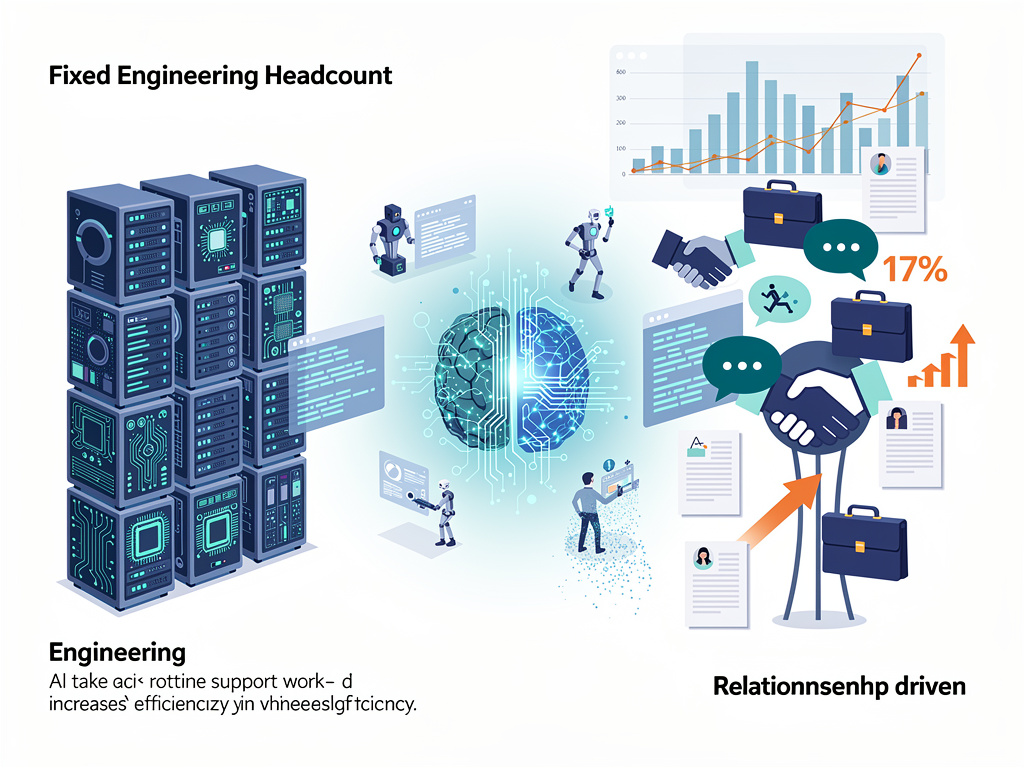
Salesforce has held its engineering ranks steady for two years. The headcount sits near 15,000. No new software engineers arrived in 2025. AI coding agents now shoulder much of the load. Yet overall staff numbers climbed anyway. The growth came from one place. Sales.
Marc Benioff draws a clear line.
The Salesforce chief executive told investors this week the company is “not hiring more engineers, we’re not hiring more GA [general and administrative roles], we’re mostly expanding only in one area.” That area belongs to Miguel Milano, chief revenue officer. “We’re mostly growing in Miguel’s area: in sales,” Benioff said on the quarterly earnings call. (Fortune, May 28, 2026)
The statement lands at a charged moment. Tech firms continue to trim white-collar payrolls. Many executives credit artificial intelligence for the savings. Benioff once pushed back against claims of mass displacement. Now his own numbers tell a more complicated story.
In late 2025 Benioff disclosed that Salesforce cut roughly 4,000 customer-support positions. The support staff dropped from 9,000 to about 5,000. “I need less heads,” he said plainly. AI agents now manage half of all customer conversations. Support costs fell 17 percent. Hundreds of displaced workers moved into sales, professional services and customer-success roles. (Fortune, September 2025)
But sales itself stays off limits. Agents can qualify leads and handle routine service. They fall short when deals require persuasion, negotiation and trust. “I think we all realize the one thing that we are doing here with you—selling and communicating—that agents are not exactly doing that,” Benioff explained. “They can qualify, they can provide service, but in sales we still scale because there are so many different parts of the market that we have to get to.”
The distinction matters. For the last couple years Salesforce kept engineering hiring mostly flat. AI tools delivered efficiencies. New coding agents accelerated the trend this year. Benioff noted the capabilities grew “even more dramatic.” Other companies report similar patterns. Amazon’s large-scale layoffs hit engineers hardest. Microsoft’s cuts followed the same pattern. Software-engineer job postings remain 49 percent below early-2020 levels, according to LinkedIn data.
Yet sales postings tell another tale. Sales representatives ranked among the fastest-growing jobs in the U.S. last year, per LinkedIn. The role outpaced most engineering categories except those tied directly to AI. Salesforce itself hired 2,000 new salespeople in 2024 to push its expanding AI offerings. Many SaaS companies plan to increase sales staff in 2026.
This split reveals limits in current AI systems. They excel at repetitive, data-heavy tasks. Complex human interaction still demands people. Benioff’s Agentforce platform crossed $1 billion in annual recurring revenue in the first quarter, according to company results reported today. The technology handles routine support at scale. It has not replaced the closer. (Salesforce Ben, May 28, 2026)
Broader data supports the nuance. Boston Consulting Group estimates 50 to 55 percent of U.S. jobs will be reshaped by AI over the next two to three years. Many workers will keep their positions but perform them differently. Entry-level white-collar roles face the sharpest pressure. Hiring for recent graduates in marketing, finance and software development slowed after ChatGPT launched. Stanford research found early-career employment growth lagged 16 percent in AI-exposed fields.
CNBC reported last week that the AI economy is rewriting entry paths for college graduates. Firms now do more with fewer junior staff. Some leaders predict deeper cuts. Microsoft AI chief Mustafa Suleyman gave white-collar automation 18 months in a recent Fortune interview. Ford’s CEO suggested AI could halve certain office functions.
Benioff rejects the apocalyptic framing. He has called blaming AI for every layoff “the lazy way out.” Companies face real pressures from high costs, post-pandemic bloat and slower growth. AI offers a convenient narrative. At Salesforce the picture mixes genuine productivity gains with targeted rebalancing. Engineers produce more per person. Support runs leaner. Sales teams expand to capture new markets opened by those same AI products.
The company spent heavily to signal confidence. It repurchased $27 billion in stock during the latest quarter. Shares still slipped on a soft revenue outlook. Investors question whether AI revenue will fully offset slower traditional growth. Benioff used the earnings call to counter skepticism. He pointed to Agentforce adoption and the human sales force needed to sell it.
Executives elsewhere echo parts of the message. They see augmentation more than replacement in many functions. Goldman Sachs deployed an AI coding tool named Devin yet still employs 12,000 human engineers. The bank expects the machine to boost output, not eliminate headcount entirely.
For professionals watching these shifts the lesson is specific. Technical skills alone may not guarantee demand. The ability to build relationships, understand buyer psychology and close business retains value. Sales has always rewarded those traits. AI appears to amplify rather than erase them, at least for now.
Benioff’s approach at Salesforce offers a case study. Cut where machines outperform. Hire where humans still win. Redeploy talent when possible. The formula produced lower support costs, steady engineering productivity and a larger sales organization. Whether it scales across industries remains unproven. Early evidence suggests the white-collar labor market is fragmenting. Some roles contract. Others adapt. A few, like enterprise sales, expand.
The coming quarters will test how many companies follow Salesforce’s lead. If Benioff is right, sales departments could become the surprising bright spot in an AI-driven reorganization of office work. Machines handle the data. People still handle the deal.


 WebProNews is an iEntry Publication