
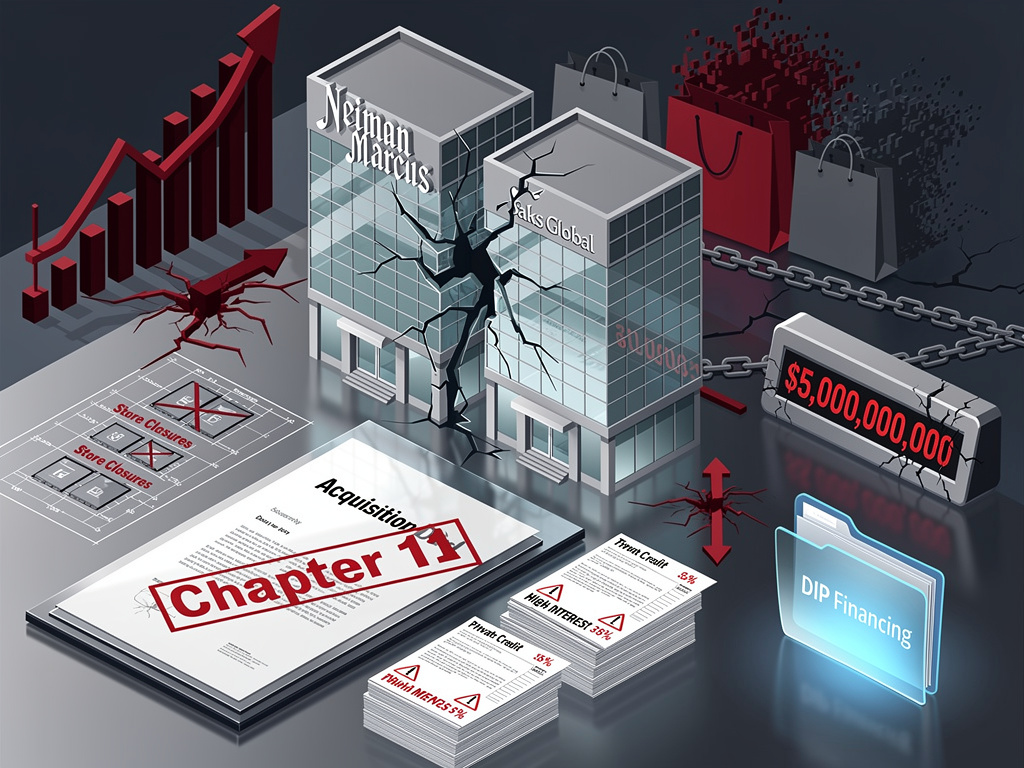
Saks Global’s bold acquisition of Neiman Marcus, completed in May 2024, was pitched as a lifeline for luxury retail amid e-commerce pressures. Instead, the $2.65 billion deal propelled the combined company into Chapter 11 bankruptcy just 20 months later, with filings in Houston federal court listing $5 billion in debt against assets and liabilities each between $1 billion and $10 billion. Secured creditors, led by private credit funds, hold $4.2 billion in claims backed by inventory, real estate, and credit card portfolios.
The filing follows a missed $100 million interest payment, triggering default on financing from firms like HPS Investment Partners and Owl Rock, now Blue Owl Capital. Payment-in-kind interest rates toggling to 13.75% ballooned costs as sales faltered. Operations continue under debtor-in-possession financing, but store closures and vendor disputes loom large. CNBC reports the merger created overlapping footprints and redundant overhead without promised synergies.
Private Equity’s Heavy Debt Legacy
Neiman Marcus entered the deal saddled with $5.5 billion in debt from prior private equity ownership by Apollo Global Management and One Equity Partners. Saks Global, backed by Hellman & Friedman and Marc Benioff’s investment vehicle, assumed this burden while issuing $2.2 billion in junk bonds. Experts call it a ‘recipe for disaster.’ Howard Shelanski, senior counsel at Davis Polk & Wardwell, told CNBC: ‘This is a value-destructive transaction from day one.’
Saks launched a $1.4 billion rights offering post-deal to refinance, but Q3 2025 comparable sales plunged 5.8%, with Neiman Marcus hit hardest. Luxury demand softened as aspirational buyers retreated amid economic uncertainty post-2024 election. Reuters notes the collapse as one of the largest retail failures since the pandemic.
Saks Global operates 40 Saks stores, 66 Neiman Marcus locations, and Bergdorf Goodman, but redundancies in markets like Dallas and New York eroded efficiencies. Vendor payments lagged, straining supplier relations.
Consumer Shift Hits High-End Hard
Luxury sales dropped 4% year-over-year in Q4 2025, per Wall Street Journal analysis, with Neiman Marcus underperforming further. Bain & Company data shows global luxury growth stalled at 2% in 2025, as middle-income shoppers pivoted to value brands. Gen Z and millennials fueled 85% of resale growth, per ThredUp’s 2025 report, favoring platforms over department stores.
Post-merger, Saks Global cut staff and announced closures, but digital sales at 25% of revenue trailed rivals like Farfetch. Saksoff5th.com grew 20% year-over-year, highlighting off-price strength amid core brand weakness. Wall Street Journal attributes declines to inventory overhang and trading down.
On X, analysts reacted swiftly. Retail Dive posted: ‘Saks-Neiman deal doomed by debt, no real synergies,’ capturing industry sentiment.
Courtroom Battles and Restructuring Path
Judge Christopher Lopez, who oversaw Neiman Marcus’s 2020 bankruptcy, presides again in Texas court. Saks seeks $500 million in DIP financing from Apollo and others to fund operations. An ad-hoc lender group negotiates terms, while unsecured creditors including vendors face steep haircuts.
Landlords like Simon Property Group and Brookfield Properties brace for lease rejections. The plan targets underperforming Neiman Marcus stores for closure, aiming for an optimized footprint in 6-12 months. Bloomberg details creditor claims exceeding $10 billion in some estimates.
Saks Global’s 10 million loyalty members and off-price banner offer reorganization anchors, but private equity’s dividend recapitalizations drew scrutiny. Apollo’s history with Neiman since 2013 amplified risks.
Broader Retail Reckoning Unfolds
This filing echoes Sears, Brooks Brothers, and Forever 21 bankruptcies, per CNBC archives, underscoring department stores’ struggles against Amazon, Shein, and Temu. Coresight Research forecasts 20% of U.S. malls closing by 2030. McKinsey notes 40% of luxury buyers now shop online exclusively.
Saks Global’s plight questions consolidation viability in luxury. New York Times explores customer impacts, confirming stores remain open. Fox Business highlights the $2.7 billion deal’s debt trigger.
Industry insiders on X, including CNBC posts, emphasize high-cost debt’s role. As proceedings advance, luxury retail’s debt-dependent model faces transformation pressures.


 WebProNews is an iEntry Publication