
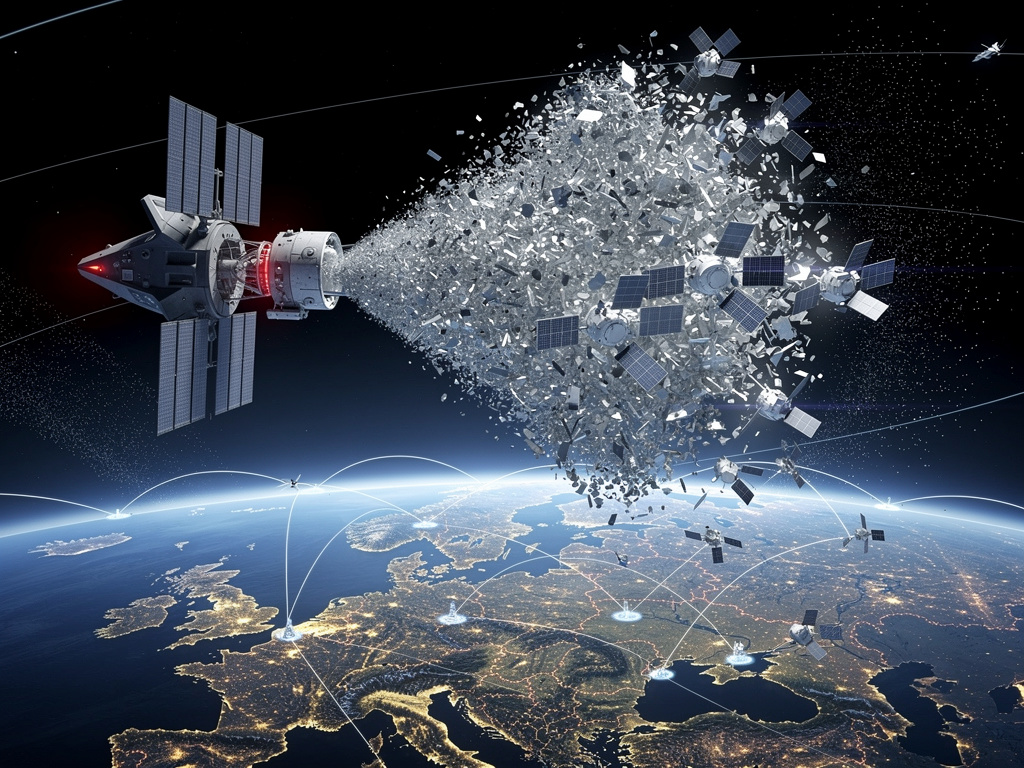
Shrapnel Shadows Over Starlink: Russia’s Suspected Orbital Assault on Musk’s Satellite Empire
In the escalating arena of space-based warfare, recent intelligence reports have unveiled a chilling development: Russia is allegedly engineering a sophisticated anti-satellite weapon aimed squarely at Elon Musk’s Starlink constellation. According to findings from two NATO-nation intelligence services, shared with the Associated Press, this “zone-effect” weapon could unleash clouds of high-density shrapnel into low Earth orbit, potentially disabling swaths of satellites in a single strike. The revelations, detailed in an AP News article, underscore Moscow’s intent to counter Western technological advantages that have proven pivotal in conflicts like the Ukraine war. Starlink, with its network of thousands of small satellites providing global broadband, has become a linchpin for Ukrainian forces, enabling real-time communications and drone operations amid Russian jamming efforts.
The weapon’s design, as described in the intelligence, involves deploying hundreds of thousands of pellets to create a destructive debris field. This approach differs from traditional kinetic kill vehicles, which target individual satellites, by aiming for area denial—flooding orbital paths with hazards that could cascade into broader disruptions. Experts warn that such a system risks the Kessler syndrome, where debris collisions generate more fragments, rendering orbits unusable. The timing of these suspicions aligns with heightened tensions, as Starlink’s role in Ukraine has drawn ire from Russian officials, who view it as an extension of U.S. military support.
Drawing from the provided link on MSN, which aggregates a Newsweek report, the development is seen as a direct response to Starlink’s battlefield impact. Ukrainian commanders have lauded the system for maintaining connectivity where traditional networks fail, allowing precise targeting and coordination. The MSN piece, referencing Newsweek, notes that Russia has previously tested anti-satellite capabilities, including a 2021 missile test that destroyed one of its own satellites, creating thousands of debris pieces that endangered the International Space Station.
The Geopolitical Orbit of Starlink’s Rise
Starlink’s ascent has transformed the dynamics of modern warfare and global communications. Launched by SpaceX in 2019, the constellation now boasts over 6,000 satellites, with plans for tens of thousands more. Its low-latency internet has not only bridged digital divides in remote areas but also provided resilient infrastructure in conflict zones. In Ukraine, following Russia’s 2022 invasion, Elon Musk activated Starlink services at the request of Ukrainian officials, donating terminals and subsidizing operations. This move, while humanitarian in framing, positioned SpaceX as a de facto player in international security.
Intelligence assessments suggest Russia’s weapon program is part of a broader strategy to neutralize such asymmetric advantages. Posts on X, formerly Twitter, highlight ongoing debates about Starlink’s dual-use nature. For instance, users have noted how Russian forces reportedly acquired Starlink terminals through black-market channels, using them to bolster their own operations despite Musk’s efforts to restrict access. This irony underscores the challenges of controlling space-based technologies in wartime.
Further insights from web searches reveal that NATO allies, including those in Europe and North America, are closely monitoring these developments. An article in The Independent details how the suspected weapon could specifically target the orbital altitudes where Starlink operates, around 550 kilometers above Earth. The report emphasizes the “zone-effect” mechanism, which intelligence sources believe could affect multiple satellites simultaneously, amplifying its strategic value.
Technological Underpinnings and Risks
Delving into the technical aspects, the proposed Russian weapon likely builds on existing anti-satellite (ASAT) technologies. Russia has a history of such systems, including the Nudol missile and co-orbital satellites capable of rendezvous and potential sabotage. The shrapnel-based approach, however, represents an evolution toward non-kinetic, area-denial tactics. By dispersing dense pellets—possibly made of tungsten or similar materials—the weapon could create a persistent hazard zone, forcing satellites to maneuver evasively or risk perforation.
Industry insiders point out that Starlink’s design offers some resilience: its satellites are small, numerous, and equipped with autonomous collision-avoidance systems. Yet, a large-scale debris event could overwhelm these safeguards. According to a report in Newsweek, the intelligence indicates Russia’s motivation stems from Starlink’s aid to Ukraine, where it has enabled drone swarms and artillery spotting, tipping the scales in key battles.
The potential for collateral damage is immense. Other satellite operators, including those for GPS, weather monitoring, and commercial broadband, share similar orbits. An attack could disrupt global supply chains, financial systems, and emergency services. ABC News, in its coverage, quotes experts warning of “catastrophic collateral damage,” as seen in this ABC News story. The piece highlights how such a weapon might violate international treaties like the Outer Space Treaty, which prohibits placing weapons of mass destruction in orbit, though interpretations vary.
Strategic Implications for Space Dominance
Russia’s alleged pursuit reflects a wider contest for space superiority among superpowers. The U.S., China, and Russia have all invested heavily in ASAT capabilities, viewing space as the ultimate high ground. China’s 2007 ASAT test, which destroyed a defunct satellite, created long-lasting debris, drawing international condemnation. Similarly, Russia’s efforts signal a willingness to escalate, potentially deterring Western involvement in proxy conflicts.
For SpaceX, this threat amplifies the militarization of its commercial ventures. Musk has publicly acknowledged the risks, tweeting about Starlink’s role in Ukraine while navigating geopolitical pressures. X posts from users like military analysts discuss how Russia’s development could prompt countermeasures, such as hardened satellite designs or international coalitions to protect orbital assets.
A deeper look at web-sourced news, including from Hindustan Times, reveals that Ukrainian intelligence chief Kyrylo Budanov has reported Russian use of Starlink terminals, complicating enforcement. This dual usage blurs lines between civilian and military tech, raising questions about export controls and sanctions.
Responses from Stakeholders and Future Trajectories
In response, NATO and U.S. officials are likely ramping up space defense initiatives. The U.S. Space Force, established in 2019, focuses on protecting assets like Starlink, which has secured Pentagon contracts for military-grade services. Industry experts suggest that diversifying satellite constellations and developing rapid replacement capabilities could mitigate risks. SpaceX’s Starship program, aimed at mass satellite deployment, might accelerate in light of these threats.
International diplomacy plays a crucial role. Calls for new arms control agreements in space have grown, though progress is stymied by mutual distrust. An article in U.S. News & World Report notes that while the intelligence is based on signals and human sources, it lacks direct evidence of deployment, leaving room for diplomatic maneuvering.
Musk himself has been vocal, using X to remind that without Starlink, Ukrainian lines might collapse, as echoed in various posts. This positions him as a pivotal figure, blending entrepreneurship with statecraft. Critics argue that reliance on private entities like SpaceX introduces vulnerabilities, as corporate decisions can sway national security.
Broader Ramifications for Global Tech and Security
The suspected Russian weapon highlights the fragility of our increasingly space-dependent world. From agriculture to navigation, disruptions could have far-reaching effects. Economists estimate that a major orbital incident could cost trillions in lost productivity. In the context of the Ukraine conflict, where Starlink has been described as a “game-changer” by Ukrainian officials, Russia’s move seeks to level the playing field.
Looking ahead, advancements in laser-based defenses or electromagnetic pulse weapons could emerge as counters. Collaborative efforts, such as those under the Artemis Accords, aim to establish norms for responsible space behavior. Yet, with Russia’s isolation from Western partnerships, escalation remains a concern.
X sentiment, drawn from recent posts, shows a mix of alarm and speculation. Users debate the ethics of Musk’s involvement, with some praising his innovation and others decrying the privatization of warfare. As one post noted, Starlink’s integration into Estonian combat vehicles exemplifies its military evolution.
Evolving Defenses and International Tensions
To counter such threats, SpaceX is investing in satellite resilience, including propulsion for debris avoidance. Partnerships with governments could lead to classified enhancements, like encrypted communications resistant to jamming. The intelligence reports, as covered in The Economic Times, suggest Russia’s program is in advanced stages, possibly tested in simulations.
The human element cannot be overlooked. Intelligence gathering involves risks, with sources potentially exposed in volatile regions. This cat-and-mouse game in space mirrors Cold War dynamics, but with commercial players like Musk adding unpredictability.
Ultimately, these developments force a reevaluation of space as a domain of competition. As nations and companies navigate this new frontier, the balance between innovation and security hangs in the balance, with Starlink at the epicenter of a potential orbital showdown. The intelligence underscores the need for vigilance, as the stars above become the next battleground.


 WebProNews is an iEntry Publication