
Colin Angle spent decades building machines that cleaned floors without complaint. Now the former iRobot chief wants to create one that simply refuses to deceive.
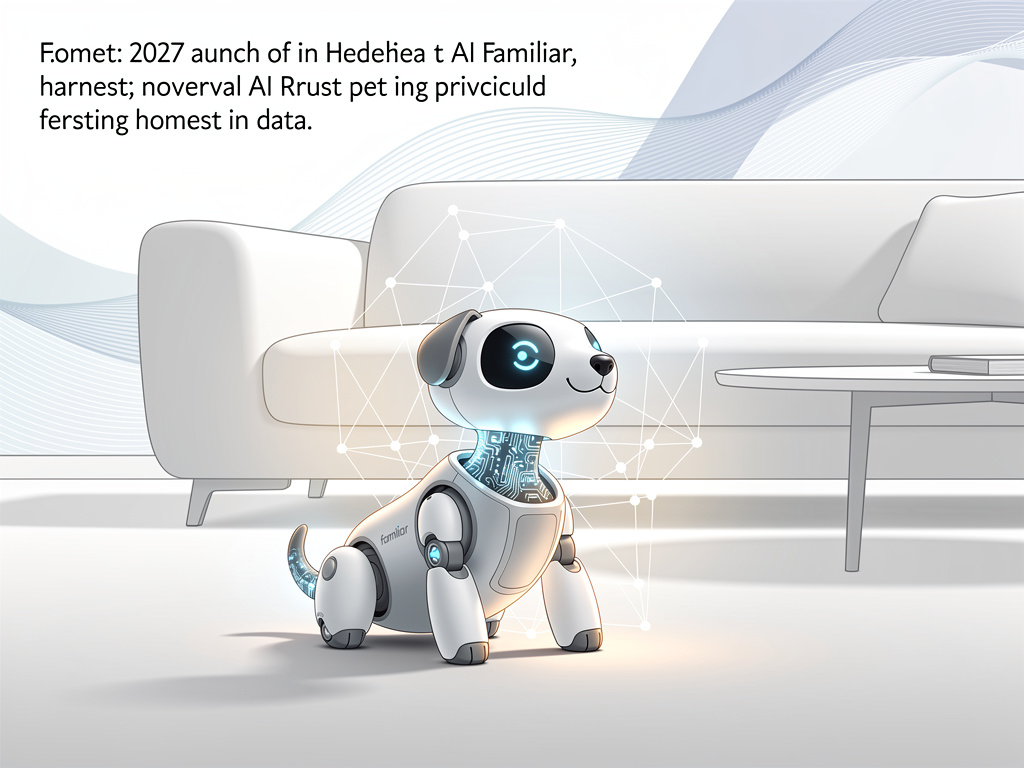
The result is the Familiar. A plush, four-legged robot the size of a bulldog. It boasts doe-like eyes, bear-cub ears and a touch-sensitive coat. Unveiled this week at the WSJ Future of Everything conference, the device marks a sharp turn from vacuum robots toward emotional machines. AP News reported how Angle, who helped sell 50 million Roombas, now bets households will embrace a robotic pet that follows routines, reads moods and never utters a false word.
The Shift From Chores to Connection
Angle left iRobot in 2024. He co-founded Familiar Machines & Magic with longtime colleagues Ira Renfrew and Chris Jones. Their first product skips the humanoid form that dominates many AI projects. It rejects speech entirely. The Familiar communicates through purrs, meows, tail wags and expressive movements of eyebrows, ears and eyes. The Verge detailed how this design choice sidesteps the hallucination problems that plague large language models. “By design, it will avoid giving factual advice about things that maybe it shouldn’t be giving factual advice about,” Angle told reporters.
The robot runs on an Nvidia Jetson Orin chip. It carries a custom small multimodal model trained for social reasoning. Vision, audio, language and memory combine on-device. No cloud streaming occurs. Privacy stays intact. Latency drops. The machine learns household rhythms in real time. It might nudge someone off the couch for a walk. Or lean in during a yoga session. Or simply sit nearby while its owner reads. Behaviors shown in early videos include high-fives, gentle hugs and curious peeks around corners.
Twenty-three degrees of freedom bring the body to life. Four sturdy legs provide balance at a slow human walking pace. The Familiar cannot climb stairs. It stays away from water. Those limits keep expectations grounded. Yet the soft fur invites touch. The expressive face triggers affection. Angle insists the form remains deliberately abstract. “We chose a form factor that’s not a human, not a dog, not a cat, because we wanted to steer away from all of those preconceptions,” he explained to AP. The goal? Create a creature people want to hug rather than a gadget they eventually ignore.
Previous companion robots often failed to sustain interest. Sony’s Aibo delighted for a while but remained a toy at heart. Jibo and Vector faded after the novelty wore off. Angle and his team studied those missteps. They focused on long-term bonding. The Familiar develops a distinct personality over months. It remembers patterns. It adapts. And it never lies. Real pets can’t speak, so they never mislead with words. This robot follows the same honest path. Its nonverbal cues stay consistent with what its sensors detect. No fabricated stories. No overly optimistic predictions.
Angle has waited years for this moment. “Finally, I get to do what I originally set out to do,” he said. “It’s not just about building cool animatronics. Now is finally the time where the tech exists — if properly and responsibly used — to start creating Familiars.” The Gizmodo article captured his confidence that interest already exceeds early Roomba reactions.
Advances in generative AI made the project possible. Angle noted he “couldn’t have done this six months ago.” The model optimizes for emotional intelligence rather than encyclopedic knowledge. It understands context from microphones and cameras. It responds with body language that feels alive. “For some definition of alive, it’s alive,” Angle observed. The machine passes what he calls the plate-of-glass test. Interaction feels physical, not like another screen.
Market timing feels urgent. Loneliness rates climb across age groups. Retirees who once owned dogs or cats now hesitate over vet bills, allergies and eventual loss. Families juggle work and childcare. The Familiar offers companionship without those burdens. It costs roughly what pet ownership demands over time, though exact pricing awaits. Launch targets 2027. Prototypes shown this week were partly tele-operated. Full autonomy comes later.
Critics already raise familiar questions. Will owners form unhealthy attachments? Does a robot that reads emotions invade privacy even if data stays local? Can any machine truly replace the unpredictable joy of a living animal? Angle confronts those doubts directly. He positions the Familiar as a supportive presence, not a substitute. It encourages activity. It fights screen addiction by dragging people into the real world. One demo showed it interrupting doomscrolling to suggest bedtime. Another depicted an elderly woman taking a companionable stroll.
The name itself carries weight. In folklore, a familiar serves as a magical helper and confidant. Angle’s version updates that idea for the AI era. It offers consistency real pets sometimes lack. No chewed shoes. No midnight barking. Just steady, truthful presence. Yet the design team worked hard to avoid uncanny valley traps. The abstract bear-owl-retriever look helps. So does the luxurious coat that begs to be stroked.
Technical decisions reflect hard lessons from iRobot’s past. Early Roombas were simple but effective. They mapped rooms gradually. They improved with each generation. The Familiar builds on that incremental approach but shifts focus from utility to affect. Its AI model emphasizes social reasoning above all. Memory of past interactions shapes future behavior. Over time the robot might learn that its owner feels calmer after a short play session. It initiates accordingly. No spoken promises. Only actions and sounds that match internal state.
Industry observers note the broader trend. Home robotics moves beyond tasks toward relationships. Companies experiment with eldercare assistants and child entertainment bots. Few combine physical embodiment, on-device intelligence and deliberate nonverbal honesty the way Familiar Machines & Magic attempts. The startup’s name signals ambition. Magic implies wonder. The machines must deliver connection that feels genuine.
Angle carries decades of experience. He co-founded iRobot in 1990. The company turned robotics from laboratory curiosity into household staple. Roomba proved people would accept autonomous devices if they solved real problems. The new venture tackles a deeper need. “I want to feel like the machine I’m building actually cares about me,” he told the Wall Street Journal.
Success remains uncertain. Hardware costs for expressive faces, durable fur and powerful edge AI add up. Battery life must support hours of independent movement. Software updates will need to refine social behaviors without breaking personality continuity. And consumers must overcome skepticism about yet another expensive gadget that demands charging and occasional maintenance.
Still. Early reactions suggest something different this time. People at the conference reportedly responded with affection rather than curiosity alone. They reached out to pet the prototype. They smiled at its stretches and greetings. The robot extends an invitation. It doesn’t demand attention like a screen. It waits, watches and gently engages.
Angle believes the next era of robotics centers on sustained human connection. Not dexterity. Not raw intelligence. Connection. The Familiar represents his bet that consumers crave truthful companions in an age of digital noise and isolation. A machine that cannot lie. One that learns your life and responds with care. If it works, the household robot category may never look the same.
Recent coverage highlights growing excitement mixed with healthy caution. TechRadar quoted Angle calling it “the robot I wanted to build forever.” That long wait appears over. The question now becomes whether the world stands ready to welcome these honest mechanical friends into its homes.


 WebProNews is an iEntry Publication