
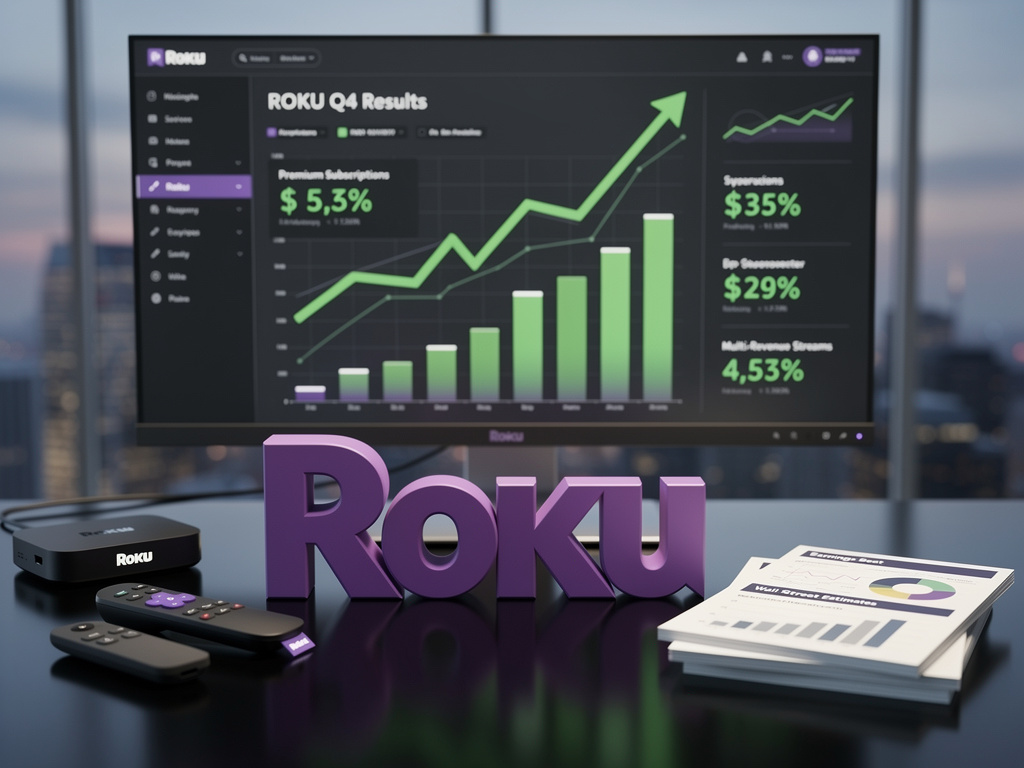
Roku Inc. delivered a thunderclap on Wall Street this week, posting fourth-quarter earnings that handily surpassed analyst expectations and sending its shares soaring in after-hours trading. The streaming platform, which has spent years navigating the turbulent waters of cord-cutting economics and intensifying competition, demonstrated that its strategic pivot toward premium subscriptions and advertising diversification is paying dividends — both figuratively and, increasingly, literally.
The company reported earnings per share that beat consensus estimates, while revenue came in above projections as well. But the headline number that captured investors’ attention was the record quarter for premium subscriptions, a metric that signals Roku is successfully converting its massive base of free and ad-supported viewers into paying customers willing to shell out for enhanced content and features, as reported by CNBC.
A Premium Play That’s Finally Gaining Traction
For years, Roku’s bull case rested on a simple but compelling thesis: the company sits at the gateway of streaming television, controlling the remote — sometimes literally — for tens of millions of households. Its platform serves as the operating system for smart TVs and streaming devices, giving it unparalleled access to viewer data and the ability to monetize attention through advertising. But the bear case was equally straightforward: Roku was too dependent on advertising revenue, which is cyclical and vulnerable to economic downturns, and it lacked the kind of recurring subscription revenue that commands premium multiples on Wall Street.
The latest earnings report suggests Roku has found an answer to that criticism. The company’s premium subscription tier, which offers an ad-free or ad-light experience along with exclusive content and enhanced features, hit a record number of subscribers during the quarter. Management indicated that the growth trajectory exceeded internal projections, with subscriber additions accelerating through the holiday season as consumers bundled streaming services and sought consolidated entertainment solutions.
The Numbers Behind the Surge
Roku’s stock jumped significantly in after-hours trading following the earnings release, reflecting the market’s enthusiasm for the results. The company’s total revenue grew at a pace that outstripped Wall Street’s expectations, driven by strength in both its platform segment — which includes advertising, content distribution, and subscription revenue — and its devices segment, which encompasses the sale of streaming players and Roku-branded televisions.
The platform segment, which is the higher-margin business and the one investors scrutinize most closely, showed particular strength. Average revenue per user, a critical metric for any platform business, increased year-over-year, suggesting that Roku is extracting more economic value from each household on its platform. Streaming hours also hit a new high, indicating that engagement — the lifeblood of any advertising-supported business — continues to deepen even as consumers face an ever-expanding menu of entertainment options.
Advertising Resilience in an Uncertain Economy
Perhaps equally important to the subscription milestone was the resilience of Roku’s advertising business. The digital advertising market has been subject to significant volatility in recent years, buffeted by macroeconomic uncertainty, shifting privacy regulations, and the migration of ad dollars from linear television to connected TV platforms. Roku, as one of the largest connected TV platforms in North America, has been a primary beneficiary of this secular shift, but it has also been exposed to the cyclical headwinds that periodically sweep through the ad market.
In the fourth quarter, Roku’s advertising revenue grew robustly, buoyed by strong demand from both brand advertisers and performance marketers. The company noted that its programmatic advertising capabilities have matured significantly, allowing advertisers to target specific audience segments with greater precision. This capability, combined with the sheer scale of Roku’s platform — which now reaches well over 80 million active accounts — makes it an increasingly essential buy for advertisers seeking to reach cord-cutters and cord-nevers who are unreachable through traditional television.
The Competitive Chessboard Intensifies
Roku’s strong quarter comes at a time when the streaming industry is undergoing rapid consolidation and strategic repositioning. Major media conglomerates including Walt Disney Co., Warner Bros. Discovery, and Comcast’s NBCUniversal have been aggressively bundling their streaming services, seeking to reduce churn and increase lifetime customer value. Meanwhile, tech giants like Amazon and Apple continue to invest heavily in their own streaming ecosystems, using content as a loss leader to drive engagement with their broader platforms.
In this environment, Roku occupies a unique and potentially advantageous position. Unlike content-first companies that must spend billions annually on programming, Roku operates primarily as a platform and aggregator, earning revenue by facilitating the distribution of other companies’ content while also building out its own ad-supported Roku Channel. This asset-light model means Roku can benefit from the content spending of its partners without bearing the full cost burden, a dynamic that has historically produced attractive margins for platform businesses in other sectors of the technology industry.
Management’s Forward-Looking Confidence
On the earnings call, Roku’s management team struck an optimistic tone about the company’s trajectory. CEO Anthony Wood emphasized that the premium subscription milestone represented a validation of the company’s long-term strategy to build multiple revenue streams atop its platform. He noted that the company’s investments in original and exclusive content for the Roku Channel are creating a flywheel effect, drawing viewers to the platform who then become targets for advertising and candidates for premium subscription upsells.
The company also provided guidance for the first quarter and full year that came in above consensus expectations, suggesting that management sees the momentum as sustainable rather than a one-time holiday-driven spike. Capital expenditure guidance was modestly increased, reflecting planned investments in content, technology infrastructure, and international expansion — areas that management believes will drive the next phase of growth.
Wall Street Reacts with Upgraded Outlooks
Analyst reactions to the earnings report were broadly positive. Several firms raised their price targets on Roku shares in the wake of the results, citing the premium subscription growth as a potential inflection point for the company’s valuation. The subscription revenue stream, because it is recurring and less susceptible to the quarter-to-quarter volatility of advertising, could justify a higher earnings multiple if growth continues at the current pace.
However, some analysts cautioned that Roku still faces meaningful risks. The company’s international expansion, while promising, remains in its early stages and will require significant investment before it begins to contribute meaningfully to the bottom line. Additionally, the competitive dynamics of the streaming industry remain fluid, and there is no guarantee that Roku’s platform position will prove as durable as the company’s supporters believe, particularly as smart TV manufacturers develop their own operating systems and content aggregation capabilities.
What This Means for the Broader Streaming Industry
Roku’s record quarter carries implications that extend well beyond its own stock price. The results suggest that the streaming industry, after years of cash-burning growth and a painful period of rationalization, may be entering a more mature phase in which profitability and sustainable business models take precedence over subscriber growth at any cost. Roku’s ability to generate record premium subscriptions while simultaneously growing its advertising business indicates that consumers are willing to pay for curated, high-quality streaming experiences — and that advertisers remain eager to reach those consumers through connected TV platforms.
For investors, the earnings report serves as a reminder that in the streaming wars, it is not always the content creators who capture the most value. Sometimes, it is the platforms that connect viewers with content — the picks-and-shovels plays of the entertainment industry — that emerge as the most compelling long-term investments. Roku’s latest quarter suggests the company is determined to prove that thesis right, one premium subscriber at a time.


 WebProNews is an iEntry Publication