
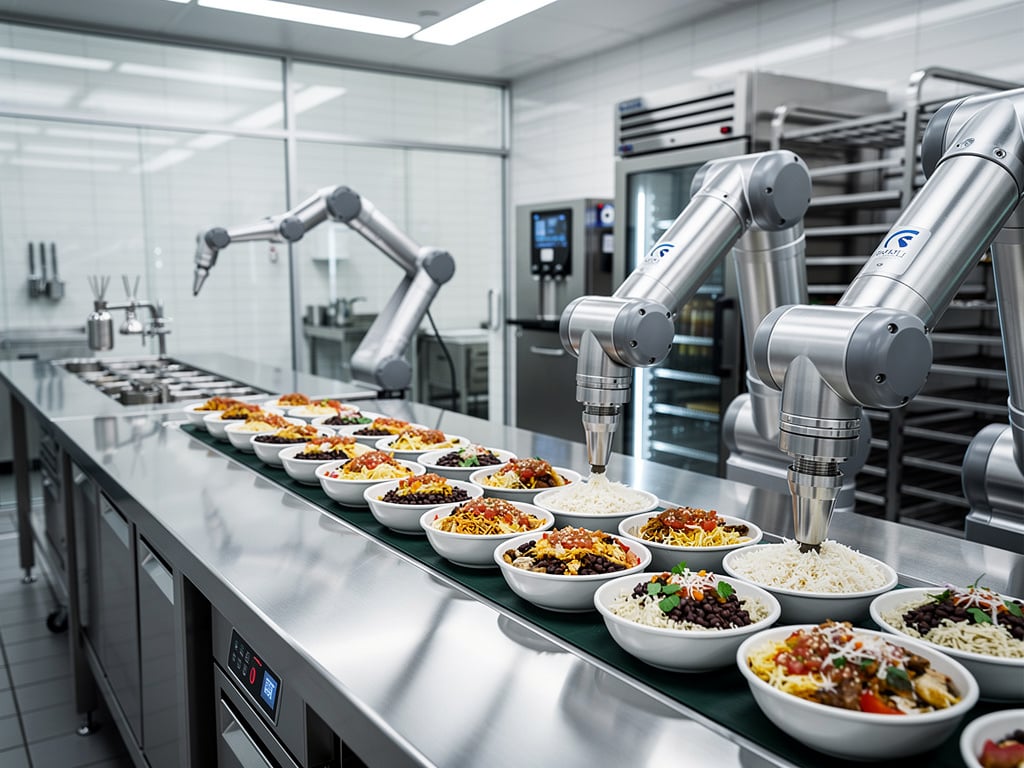
Robots have begun reshaping food service operations across the United States with a speed that surprises even longtime industry observers. One notable example comes from Marc Lore, the former Walmart executive and current owner of a robotic food production startup. According to a recent Fortune article, his company’s machines can assemble 500 burrito bowls every hour while a single human worker typically manages only 45 in the same period. This performance gap highlights how automation now delivers measurable gains in speed, consistency, and output for high-volume meal preparation.
Lore’s venture focuses on creating fully automated kitchens that operate with minimal human supervision. The systems rely on precise robotic arms, computer vision, and specialized software to handle ingredients from storage to final assembly. Each station performs specific tasks such as portioning rice, adding proteins, layering toppings, and sealing containers. Sensors track every movement to maintain exact measurements and prevent cross-contamination. The result is a steady flow of identical meals produced around the clock without fatigue or variation in quality.
The technology builds on years of advances in industrial robotics adapted specifically for food handling. Traditional factory robots work with rigid parts and predictable environments, but kitchens present unique challenges including slippery ingredients, variable textures, and strict hygiene requirements. Lore’s team addressed these by developing grippers that mimic human dexterity while incorporating food-grade materials and frequent sanitation cycles. Cameras paired with artificial intelligence identify when a component needs adjustment, such as correcting an uneven scoop of guacamole or repositioning a tortilla.
Labor shortages have accelerated adoption of these systems. Restaurants and food delivery services continue to struggle with high turnover rates and rising wages. A robotic line that matches the output of ten or more workers offers a practical solution for operators facing staffing difficulties. Beyond the numbers, automation reduces exposure to repetitive strain injuries that commonly affect kitchen staff. Employees can shift from manual assembly to roles that involve oversight, maintenance, or customer service, potentially improving job satisfaction and retention.
Cost calculations favor the robots over time. Initial investment remains substantial, covering hardware, installation, and custom programming. Yet the Fortune report indicates that operational expenses drop quickly once systems run at full capacity. Energy consumption stays lower than expected, and ingredient waste decreases because precise measurements eliminate over-portioning. Maintenance teams perform routine checks rather than constant hands-on work, further containing expenses. For large-scale operators serving thousands of meals daily, these savings accumulate rapidly.
Consistency stands out as another major advantage. Human workers naturally vary in how they measure ingredients or arrange presentations, leading to customer complaints about portion sizes or missing items. Robots follow digital recipes without deviation, ensuring every bowl contains the same amount of beans, the same distribution of salsa, and identical visual appeal. This reliability matters particularly for chains and delivery platforms where customers expect the same experience regardless of location or time of day. Data collected from each production run allows operators to refine recipes based on actual performance rather than estimates.
Public reaction to robotic food preparation shows a mix of curiosity and hesitation. Some consumers welcome the idea of fewer human errors and faster service. Others express concern about job losses or question whether food made by machines can match the appeal of handmade meals. Lore has responded by emphasizing that the technology complements rather than replaces human creativity. Chefs still develop recipes and determine flavor profiles while the robots handle repetitive execution. Marketing materials highlight this partnership, showing culinary experts working alongside mechanical systems to create new menu items.
Health and safety considerations add another layer to the discussion. Automated kitchens maintain stricter temperature controls and reduce opportunities for human-borne contaminants. Surfaces undergo automatic cleaning between batches, and enclosed systems limit exposure to airborne particles. These features align with increasing regulatory demands for food safety documentation. Digital logs capture every step of production, creating transparent records that health inspectors can review instantly. Such traceability provides reassurance to both operators and customers worried about outbreaks or recalls.
Integration with existing supply chains requires careful planning. Robots need ingredients delivered in formats compatible with their handling mechanisms, which sometimes means changing packaging or preprocessing steps. Suppliers have started adapting by offering pre-portioned components or standardized containers that load directly into dispensing units. This coordination extends upstream to farms and processing facilities, gradually influencing how food moves from field to final product. The changes ripple through the entire preparation process, encouraging greater standardization without sacrificing ingredient quality.
Education and training programs now include modules on supervising robotic systems. Culinary schools and technical colleges teach students how to monitor performance metrics, troubleshoot common errors, and update software parameters. These skills differ markedly from traditional knife work or grill management, creating new career pathways within the food industry. Workers who master both culinary knowledge and technical oversight become highly valued as hybrid specialists capable of bridging human judgment and machine precision.
Challenges remain despite the impressive production numbers. Not every menu item adapts easily to automation. Complex dishes with delicate garnishes or last-minute customizations still require human hands for optimal results. Current systems excel at high-volume, standardized offerings like burrito bowls, salads, or grain preparations but struggle with items needing fine motor skills such as folding intricate pastries or plating fine dining presentations. Future development will likely focus on expanding capabilities while recognizing that certain tasks benefit from human touch.
Energy demands and environmental impact also warrant attention. While robots reduce food waste and operate efficiently during peak hours, they require consistent power supplies and occasional replacement of components. Manufacturers work to improve battery life for mobile units and design systems that run on renewable sources where possible. The goal involves balancing productivity gains against the broader carbon footprint of automated operations. Early data suggests that when measured across the full production cycle, robotic kitchens can achieve lower overall emissions through reduced transportation of overproduced items and more efficient ingredient use.
Investment interest in food robotics has grown steadily. Venture capital firms see potential in scaling these systems beyond individual restaurants into centralized production facilities that supply entire regions. Lore’s approach combines manufacturing principles with culinary expertise, creating facilities that function more like efficient factories than traditional kitchens. This model allows for 24-hour operation in climate-controlled environments, producing meals that are packaged and shipped while still fresh. Delivery services benefit from predictable supply that matches real-time demand patterns identified through ordering data.
Customer-facing aspects continue to evolve. Some locations feature transparent windows that allow diners to watch robots at work, turning preparation into a form of entertainment. Others maintain closed facilities focused entirely on delivery and pickup to maximize efficiency. Both approaches have found receptive audiences depending on the target demographic and location. Younger consumers often express fascination with the technology while older patrons may prefer not to see the mechanical process. Operators adjust their layouts accordingly to balance transparency with comfort levels.
The pace of improvement suggests that capabilities will continue expanding. Current systems handle basic assembly well, but next generations may incorporate more sophisticated tasting mechanisms or adaptive recipes that adjust based on ingredient freshness. Machine learning algorithms already analyze customer feedback to recommend minor modifications that improve satisfaction scores. Over time these refinements could lead to personalized meal options produced at industrial speeds, combining the benefits of mass production with individual preferences.
Regulatory frameworks struggle to keep pace with technological advances. Health departments now develop specific guidelines for robotic food handling that address everything from software validation to emergency shutdown procedures. Questions about liability arise when defects occur. Is the operator responsible, the manufacturer, or the software developer? Clear answers will help build confidence among adopters and reduce hesitation. Industry groups work with policymakers to establish standards that protect public safety without stifling innovation.
Looking forward, the success of systems like those described in the Fortune piece points toward wider transformation in how food service operates. Smaller establishments may adopt modular units that fit existing spaces while large operators build entirely new facilities around automation from the ground up. The technology does not eliminate the need for human expertise but repositions it toward higher-value activities such as menu innovation, quality control, and guest experience management.
Marc Lore’s vision extends beyond simple efficiency. He sees robotic kitchens as a way to make quality meals more accessible and affordable while creating sustainable business models for operators. The dramatic difference between 500 bowls per hour and 45 produced manually demonstrates the scale of opportunity. As these systems become more common, they will influence everything from labor markets to ingredient sourcing to consumer expectations about speed and consistency. The coming years will reveal how thoroughly automation reshapes an industry long defined by human skill and tradition, but early results suggest that the changes are already well underway.


 WebProNews is an iEntry Publication