
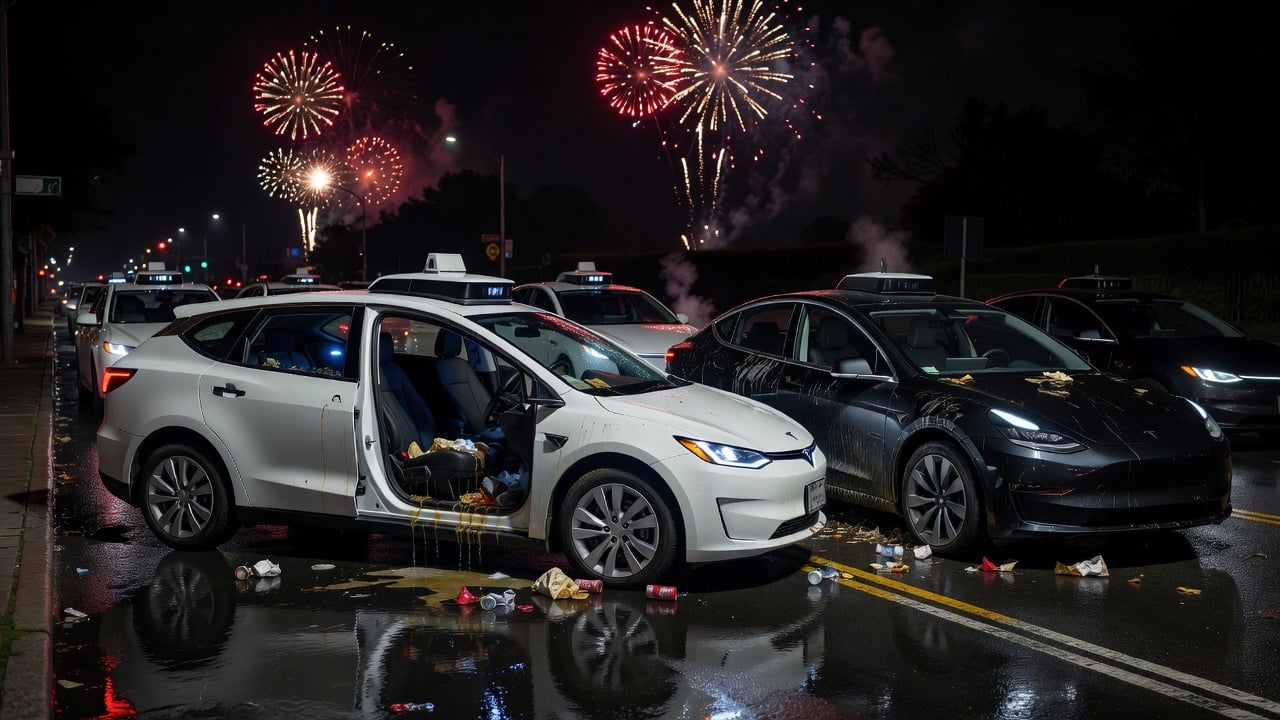
Passengers climb into a sleek Waymo vehicle in San Francisco. No driver greets them. The doors lock. And suddenly the social rules that once governed a taxi ride vanish. One rider spills an entire coffee. Another leaves half-eaten tacos smeared across the seat. A third vomits after too many drinks. The car rolls on to the next fare anyway. Cleanup falls to remote teams or the next customer. This pattern repeats daily now.
But the problems run deeper than bad manners. Recent incidents show robotaxis struggling with basic urban chaos. On July 4, 2026, a Waymo drove straight over an exploding firework in San Francisco. The blast shook the cabin violently. An adjacent Waymo caught fire. Video captured terrified passengers screaming for the vehicle to stop. ABC7 News reported the chaos that unfolded over the holiday weekend, with multiple vehicles stalling amid crowds and fireworks.
Earlier this year a power outage plunged parts of San Francisco into darkness. Traffic lights died. Intersections turned hazardous. Waymo vehicles froze at darkened signals. They treated every stop as a four-way pause yet lingered far too long. Clusters of robotaxis blocked roads. Traffic backed up for blocks. The company suspended service citywide that December 2025 night. The Guardian described scenes of hazard lights blinking uselessly while human drivers swerved around the immobile fleet.
Tesla’s approach looked different during the same blackout. Its Full Self-Driving vehicles kept moving. They treated dark intersections like cautious humans would. Elon Musk highlighted the contrast on X. Yet Tesla’s own early robotaxi tests in Texas revealed plenty of flaws. Vehicles wandered into wrong lanes. They dropped passengers in the middle of roads. Wait times stretched past 30 minutes in Dallas, Houston and Austin. Navigation errors piled up. Reuters documented these issues from public tests last June, noting that even company-selected riders captured unfiltered mistakes.
The Futurism article that sparked wider conversation laid bare the human side. Riders treat driverless cars as private lounges. They spill food, fall asleep, and leave bodily fluids. First responders in Austin invented a new dispatch category for “sleepers” during Waymo’s first nine months there. Bloomberg expanded on the trend. Its feature detailed passengers giving birth, passing out, and turning vehicles into rolling trash bins. No human driver means no immediate accountability. Bloomberg captured the shift in behavior that emerges without oversight.
And the messes aren’t trivial. One Waymo customer in May watched the vehicle drive away with luggage still in the trunk. Seconds after drop-off the car departed for its next trip. The rider chased it futilely. Similar stories surface regularly on social media. Remote operators scramble to intervene but often arrive too late. The original Futurism piece called these passengers “horrible and entitled menaces.” Strong words. Yet the evidence supports the frustration.
Safety data tells a complicated tale. Waymo reported 1,429 accidents to NHTSA between July 2021 and November 2025. That figure includes 117 injuries and two fatalities. Many incidents involved other drivers at fault. Still the sheer volume raises questions. In 2025 alone Waymo logged 137 incidents. The DAM Firm analysis of NHTSA filings shows robotaxis aren’t immune to trouble. Some crashes occurred while vehicles operated autonomously.
Tesla’s numbers look different. Its 18 reported crashes pale next to Waymo’s 697 in comparable periods. But Tesla’s fleet remains smaller and many vehicles still carry safety drivers. Direct apples-to-apples comparison proves difficult. Forbes contributor Brad Templeton examined the rivalry in detail. He noted Tesla’s vision-only system handles certain edge cases better. Waymo’s sensor-heavy approach excels in mapped cities but falters when infrastructure fails. Forbes highlighted video evidence from both camps.
Construction zones expose further weaknesses. Waymo paused freeway operations in multiple cities last May after vehicles struggled near work sites. Flooded streets triggered software recalls. Nearly 3,800 vehicles received updates following incidents in Atlanta and San Antonio. The cars slowed then drove into standing water on higher-speed roads. NHTSA mandated the fix. Smart Cities Dive tracked these operational pauses that continue to limit expansion.
Public resources bear the burden. Police, fire departments and tow operators field constant calls. Stalled robotaxis block emergency routes. Dead batteries require manual retrieval. During the December blackout Waymo’s vehicles drained power while waiting indefinitely. Municipal hearings now debate whether companies reimburse cities for extra workload. One San Francisco official told reporters the procedural gaps became obvious. Pre-coordinated plans with Waymo still failed when fireworks crowds mixed with stalled cars and overwhelmed tow services.
Yet adoption grows. Waymo now operates in 11 metros. It logs roughly 500,000 paid rides weekly. Miami launched fully driverless service in early July without a safety-monitor phase. Expansion plans target four more cities. Tesla aims for unsupervised robotaxis in Austin this year though progress lags. Zoox and others test quietly. The technology improves incrementally. Each fix addresses yesterday’s failure while tomorrow’s surprise waits.
Passenger behavior evolves too. What starts as spilled coffee escalates. Some treat rides like hotel rooms, demanding refunds for minor inconveniences. Others ignore basic courtesy. The absence of eye contact with a driver removes social pressure. Researchers note similar patterns in other unmanned services. But robotaxis operate in public streets. Their failures affect everyone.
Industry insiders watch closely. Regulators demand more transparency. NHTSA investigations continue. Cities weigh bans versus incentives. The promise of safer roads clashes with visible shortcomings. One thing seems clear. The messy human element won’t disappear simply because the driver does. Companies must design not only for technical perfection but for the entitled rider who climbs aboard expecting magic.
So far neither Waymo nor Tesla has solved it. Blackouts expose caution limits. Fireworks reveal sensory gaps. Bad passengers highlight oversight voids. The race continues. Data accumulates. Headlines follow each new incident. And the vehicles keep rolling. Carrying both progress and its unpleasant byproducts.


 WebProNews is an iEntry Publication