
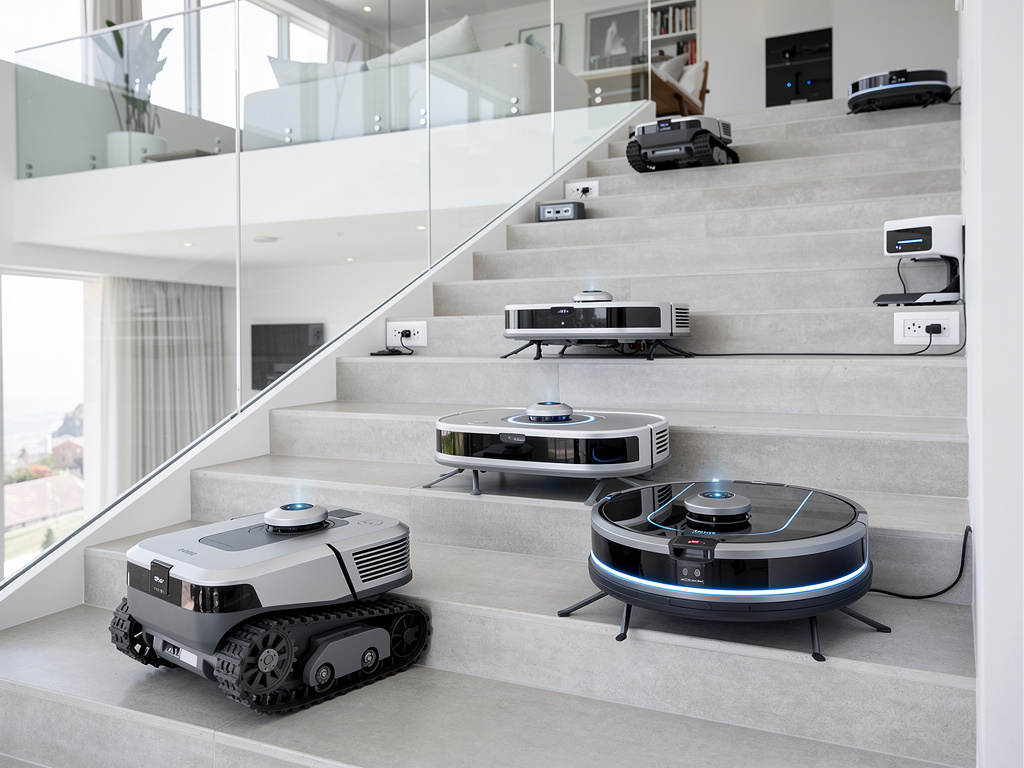
Conquering the Heights: How Robot Vacuums Are Finally Mastering Stairs
In the ever-evolving world of home automation, robot vacuums have long been hailed as liberators from the drudgery of floor cleaning. Yet, for all their sophistication in mapping rooms and dodging furniture, one persistent barrier has confined them to single levels: stairs. That may be changing rapidly, as recent teasers and prototypes suggest a new era where these devices can traverse multi-story homes autonomously. A recent post from Android Authority highlights Roborock’s intriguing CES 2026 teaser, showing a robot vacuum confronting a staircase, hinting at breakthrough capabilities that could redefine household chores.
This development isn’t isolated. Over the past year, several manufacturers have pushed the boundaries of robotic mobility. At IFA 2025, brands like Dreame, Eufy, and MOVA unveiled prototypes that tackle stairs with innovative mechanisms. For instance, Dreame’s CyberX employs a bionic QuadTrack system with extendable tank-like tracks that grip and climb steps, allowing the vacuum to ascend and descend without human intervention. This addresses a core limitation that has forced users in multi-level homes to manually relocate their devices between floors.
The push for stair-climbing technology stems from consumer demand for truly hands-off cleaning solutions. Industry insiders note that while traditional robot vacuums excel on flat surfaces, their cliff sensors—designed to prevent falls—ironically prevent them from navigating elevation changes. Innovations are now overriding these safeguards with advanced sensors and mechanical adaptations, enabling safe stair traversal.
Prototypes Leading the Charge
Eufy’s MarsWalker, demonstrated at IFA 2025, takes a modular approach. It’s essentially a stair-climbing platform that carries the vacuum between floors, using omnidirectional wheels and precise laser mapping to ensure stability. Posts on X from users like Lukas Ziegler have generated buzz, describing how such systems could eliminate the need for multiple vacuums per level, potentially saving consumers hundreds of dollars.
Meanwhile, MIGO’s Ascender, expected to launch soon, features a square body with specialized climbing mechanisms capable of handling stairs up to 8.7 inches high. According to reports from Technori, this model integrates powerful suction with stair navigation, making it a game-changer for multi-story residences. The technology builds on earlier attempts, like threshold-climbing features in models such as the Dreame X50 Ultra, which can manage small ledges but fall short on full staircases.
These advancements rely on a combination of hardware and software. Lasers for 3D environmental scanning, as detailed in coverage from Vacuum Wars, allow robots to assess stair dimensions in real-time. AI algorithms then dictate the climbing sequence, adjusting speed and grip to prevent slips. This level of precision is crucial, as any misstep could damage the device or the home.
Sensor Evolution and Safety Measures
At the heart of these innovations are enhanced sensor suites. Traditional cliff sensors use infrared to detect drops, but new systems incorporate LiDAR and cameras for comprehensive 3D mapping. Dreame’s blog on their official site explains how these sensors work in tandem with cliff detection to enable controlled descents, turning a potential hazard into a navigable path.
Safety remains paramount. Prototypes include fail-safes like automatic pauses if instability is detected, and some even feature extendable arms or tracks that lock onto steps. Industry experts, drawing from demonstrations at events like IFA, emphasize that these features must undergo rigorous testing to meet consumer safety standards, especially in homes with pets or children.
Beyond climbing, these vacuums are integrating other smart features. Mopping capabilities, self-emptying docks, and app-controlled zoning are becoming standard, as noted in a Gizmodo piece on the IFA showcases. The convergence of these technologies points to a future where a single device handles an entire home’s cleaning needs.
Market Implications and Consumer Adoption
The market for robot vacuums is booming, with projections indicating significant growth as more households adopt smart devices. A report from Future Timeline on Dreame’s CyberX underscores how stair-climbing could capture a larger share of the multi-story home segment, which comprises a substantial portion of global housing.
Challenges persist, however. Cost is a major factor; these advanced models are priced at premiums, often exceeding $1,000. Reliability in diverse stair configurations—spiral, carpeted, or uneven—remains a hurdle. Recent X posts reflect mixed sentiments, with some users excited about the convenience while others question durability based on early prototypes.
Competitive dynamics are heating up. Roborock’s teaser, as covered in the Android Authority article, positions them as a contender alongside Dreame and Eufy. At CES 2026, expected reveals could accelerate adoption, with analysts predicting that stair-climbing will become a must-have feature by 2027.
Technological Underpinnings Explored
Diving deeper into the mechanics, the QuadTrack system in Dreame’s offering mimics biological locomotion, using flexible tracks that adapt to step contours. This is a step up from earlier wheel-based designs, which struggled with grip. Vacuum Wars’ analysis highlights how such innovations stem from robotics research in mobility, borrowing from fields like search-and-rescue drones.
Software plays an equally vital role. Machine learning algorithms train on vast datasets of stair types, enabling predictive navigation. For example, the system might slow down on steeper inclines or adjust vacuum power to avoid scattering debris during climbs.
Integration with home ecosystems is another frontier. These vacuums could sync with smart assistants like Alexa or Google Home, scheduling multi-floor cleanings based on user routines. Insights from TechRadar on IFA demos suggest that seamless connectivity will be key to user satisfaction.
Challenges in Real-World Application
Not all homes are created equal, and stair-climbing tech must account for variability. Carpeted stairs pose friction issues, while narrow treads could challenge wider-bodied robots. Prototypes like MOVA’s address this with adjustable modules, but scaling to mass production requires overcoming manufacturing complexities.
Energy consumption is another concern. Climbing demands more power, potentially shortening battery life. Innovations in efficient motors and regenerative braking—similar to electric vehicles—are being explored to mitigate this, as per discussions in recent tech forums.
User feedback from early adopters, shared on platforms like X, indicates enthusiasm tempered by practicality. One post described the Ascender’s ability to handle pet hair across levels as revolutionary, but called for improvements in noise levels during climbs.
Future Horizons in Home Robotics
Looking ahead, the fusion of stair-climbing with other robotics could extend beyond vacuums. Imagine devices that also scrub walls or clean windows, leveraging similar mobility tech. The Yanko Design coverage of Dreame’s debut envisions a holistic home maintenance ecosystem.
Regulatory aspects will influence rollout. Safety certifications from bodies like UL are essential, ensuring devices don’t pose fire or tipping risks. As more brands enter the fray, standards may emerge to guide development.
Economically, this could democratize advanced cleaning for urban dwellers in apartments or townhouses. With global urbanization, the demand for compact, versatile robots is set to rise, potentially disrupting traditional vacuum markets.
Innovators and Industry Shifts
Key players like Roborock are leveraging their expertise in AI-driven navigation to tackle stairs. Their CES teaser, building on years of incremental improvements, signals a strategic pivot toward comprehensive home coverage.
Comparisons to past breakthroughs, such as the introduction of self-emptying bases, suggest stair-climbing could similarly boost sales. Vacuum Wars notes that threshold-climbing advancements paved the way, with models now surmounting 6 cm barriers routinely.
Collaboration between tech giants and startups is accelerating progress. Partnerships for sensor tech, as seen in Eufy’s integrations, could lead to faster iterations and cost reductions.
Societal Impact and Broader Trends
On a broader scale, these technologies reflect a shift toward labor-saving devices in an aging population. In regions like Europe and Asia, where multi-story living is common, adoption could be swift.
Environmental considerations are gaining traction. Energy-efficient designs reduce carbon footprints, aligning with sustainable living trends. Future models might incorporate recycled materials, further appealing to eco-conscious consumers.
Ultimately, as robot vacuums conquer stairs, they symbolize the maturation of home robotics, promising a future where mundane tasks are fully automated, freeing time for more meaningful pursuits. With CES 2026 on the horizon, the industry watches closely for the next leap.


 WebProNews is an iEntry Publication