
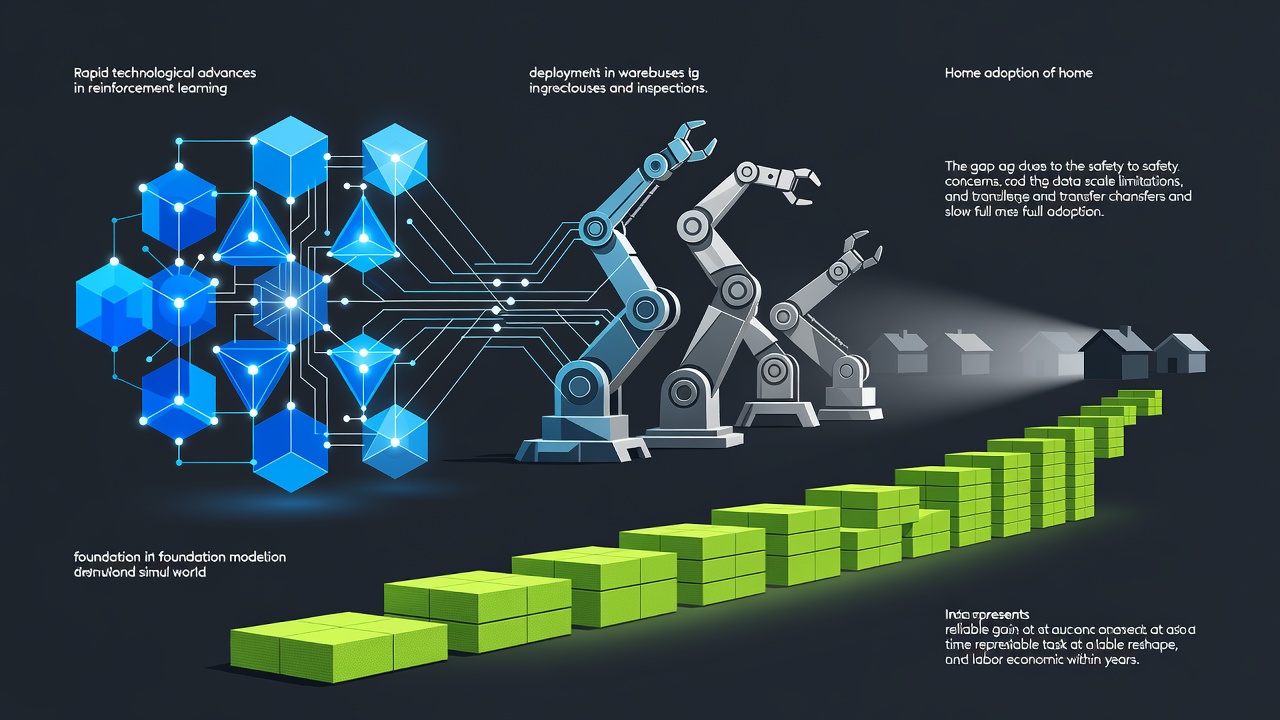
Robots have long handled the dirty, dull and dangerous jobs. Yet something shifted in recent years. Advances in artificial intelligence now point toward machines that tackle sequences of unpredictable tasks without constant human guidance. The change arrives not from one breakthrough but from the steady stacking of data, models and hardware improvements.
From Narrow Tasks to Broader Capabilities
Industrial robots once followed rigid scripts inside safety cages. Today many operate with greater independence. Boston Dynamics deploys its four-legged Spot for inspections in hazardous spots. The machine navigates slippery surfaces thanks to reinforcement learning that lets it recover balance after slips. Its wheeled cousin Stretch grabs totes in warehouses run by DHL and others. These systems show autonomy works best in controlled settings. But real-world messiness changes everything.
Ars Technica examined this shift in a feature published Tuesday. Experts there describe autonomy as a moving target. ISO standards define it as a machine performing tasks based on its current state and sensed data without outside help. Matt Malchano, vice president of software at Boston Dynamics, captured the evolution. “When I started maybe about 15 years ago… the goal was to just get a robot to navigate from point A to point B,” he said. “And now, when we think of autonomy, we think of this huge space of tasks.” (Ars Technica)
Sergey Levine, professor at UC Berkeley and cofounder of Physical Intelligence, stressed the data requirement. “The key to making modern machine learning systems work is to get enough of a critical mass of data so that we see generalization,” Levine explained. “You can either have something that is kind of OK but not amazing at everything or something that’s extremely good at one thing… We really want something that’s extremely good at all things.” The company he helps lead trains a single foundation model that recombines skills across commands and robot types. Success hinges on scale. Without enough varied examples, robots falter when conditions drift even slightly.
Jonathan Hurst, cofounder of Agility Robotics, put the difficulty in perspective. “It’s dramatically harder to have an embodied AI; it’s 10 times harder to have an embodied AI,” he told the publication. Agility’s Digit humanoid currently moves totes in warehouses for GXO, Toyota, Schaeffler and Mercado Libre. Amazon tests it too. Yet deployments keep robots inside work cells separated from people. Safety remains paramount. Hurst noted that true autonomy will eventually mean deciding how to respond when handed a baby. That day sits far off.
Recent industry reports reinforce the pattern. The International Federation of Robotics highlighted agentic AI as a top trend for 2026. This hybrid combines analytical AI for decisions with generative AI for adaptability. The result aims at machines that handle complex environments on their own. (IFR)
Epoch AI assessed current robot performance in February. Navigation succeeds commercially in food delivery and warehouse transport. Manipulation works in structured warehouse picking but stalls in homes or multi-step jobs. Transfer to new objects or settings stays rare. Most systems require task-specific fine-tuning. That bottleneck limits scale. (Epoch AI)
Progress shows in simulation and hardware too. NVIDIA supports benchmarks such as RoboLab for testing generalist policies. University of Maryland researchers, backed by NVIDIA grants, build AI humanoids for household chores. Their systems blend generative AI with sequential decision-making. FieldAI supplies embodied software that works across robot types and recently partnered with Boston Dynamics for dynamic sites. These moves suggest the software layer may prove as decisive as the hardware.
Tesla pursues its Optimus humanoid to manage unsafe or repetitive work. The company applies vision and planning techniques refined in its vehicle fleet. Figure AI targets warehouses and factories with foundation models paired to physical manipulation. Physical Intelligence, Skild AI and others chase a single brain that transfers across bodies and tasks. Venture money flows. Analysts watch for the moment when one model delivers consistent results outside the lab.
Yet gaps persist. Training demands enormous data. Teleoperation by humans costs money and time. Simulations omit real physics quirks. World models that predict outcomes burn compute. Reinforcement learning can suffer catastrophic forgetting when new skills overwrite old ones. And safety incidents linger in memory. A 1979 case in which a Ford robot killed worker Robert Williams still informs standards. Surgical systems from Intuitive delegate most decisions to doctors. Bhushan Patel, principal technical program manager there, said the issue centers on how much control passes to the machine. “The question is not whether the robot is autonomous or not,” he observed. “The question is how much decision-making and action execution we are delegating to machine versus human.” Only a few FDA-cleared systems approach level three autonomy.
Dipam Patel, a Purdue PhD student working with the US Army, offered a blunt standard. “The robot should be able to do everything on its own without any external dependencies. Only then can we push towards general-purpose robots.” His view echoes the long road ahead. Agility aims to ship Digit v5, its first cooperatively safe AI-enabled humanoid, within the next 12 months. Hyundai trains Atlas humanoids at a metaplant for possible 2028 deployment in electric-vehicle production. Timelines stretch. Full home deployment that handles children or fragile objects could take decades.
Economics will decide adoption speed. One human supervising ten robots slashes costs below human labor. Recent reinforcement learning work shared on X improved recovery from mid-task errors. Success rates on 16-step missions rose from 38 percent to 71 percent. The gain matters because real deployments meet surprises. Robots that self-correct reduce supervision needs. That shifts the math. Companies such as BMW and Tesla see compound returns. A purchased robot holds value years later. Wages rise.
Investment and research accelerate. The AI boom draws robotics PhDs at record rates. Conferences like AUTONOMOUS 2026 in San Francisco gather founders focused on foundation models, sim-to-real gaps and compute stacks. BCG analysts describe physical AI as systems that maintain causal world models, predict results and reason under uncertainty. Level five reasoning, where robots pursue complex goals over time, still sits in the aspirational column. (BCG)
National security analysts note parallel advances. Google DeepMind’s Robotic Transformer 2 handles novel scenarios. NVIDIA’s Isaac GR00T foundation model targets generalized humanoid skills with fast and slow thinking modes. China aims to lead in humanoids by 2027. Market forecasts reach tens of billions within a decade. The UK launched a £52 million robotics adoption program earlier this year.
Form factors vary. Humanoids suit many roles but not all. Some jobs need small arms for tight apartments. Others require giant machines for farms. The best shape matches the work. That flexibility could widen deployment faster than pure bipedal designs.
Challenges remain formidable. Unstructured homes differ sharply from factory floors. Error recovery, long-horizon planning and safe interaction with people demand further gains. Regulatory standards evolve. Public acceptance hinges on proven reliability. Unions at Hyundai raised concerns during earlier Atlas tests.
Still the momentum builds. What once looked like science fiction now appears as incremental engineering problems. Robots already inspect bridges, move packages and scout crops. Next they may stock retail shelves, deliver inside buildings or assist in hospitals. Each successful niche funds the next capability jump.
Researchers and executives agree on one point. General-purpose autonomy will arrive gradually. No single demo will mark the transition. Instead a thousand small improvements compound until the machines simply work. When that happens the definition of labor changes. And the factories, warehouses and eventually homes that welcome these new workers will look different. The only certainty is that the machines are learning faster than before.


 WebProNews is an iEntry Publication