
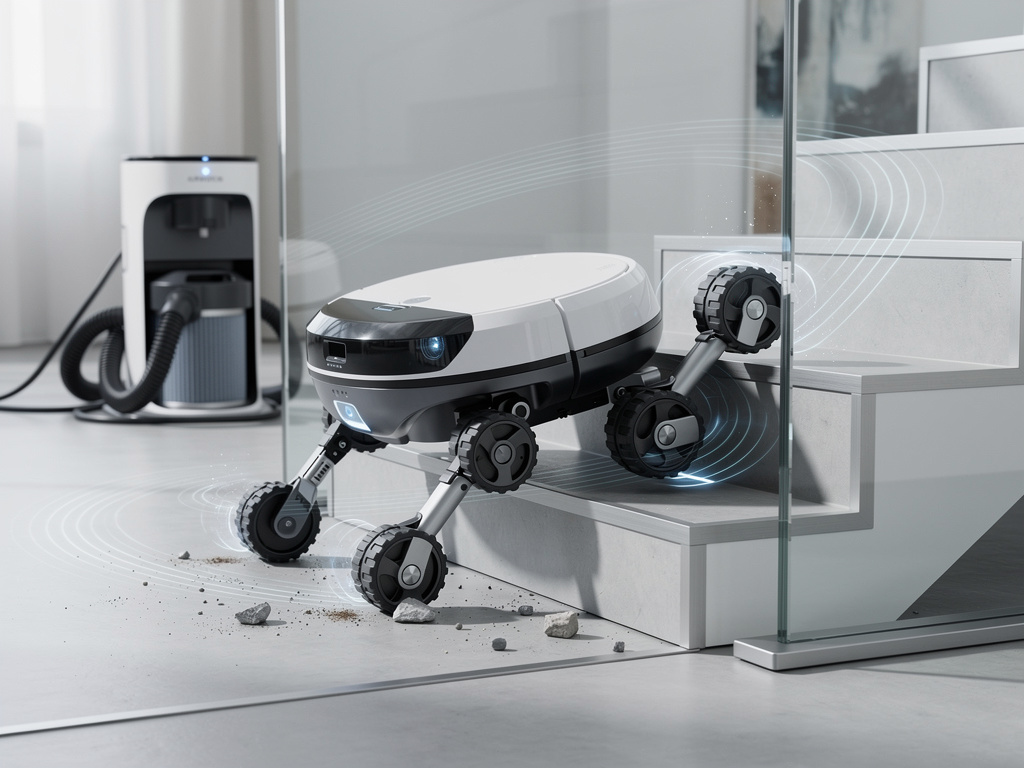
Legs Up on the Competition: Roborock’s Stair-Conquering Robot Vacuum Redefines Household Robotics
In the bustling halls of CES 2026, where gadgets vie for attention amid a sea of innovation, one device stole the spotlight with an almost whimsical twist: a robot vacuum equipped with articulating legs. Roborock, the Chinese robotics firm that’s rapidly ascended in the smart home sector, unveiled its Saros Rover, a prototype that promises to banish the longstanding frustrations of traditional robot vacuums. No longer confined to single floors or thwarted by thresholds and stairs, this machine represents a bold leap in mobility, blending wheeled navigation with legged agility to tackle multi-level homes seamlessly.
The Saros Rover’s design centers on a hybrid wheel-leg system, allowing it to roll smoothly across flat surfaces while deploying extendable legs to climb obstacles like stairs or ledges. According to reports from the event, the device can ascend and descend steps while maintaining its cleaning functions, effectively vacuuming or mopping each tread as it goes. This isn’t just a gimmick; it’s a direct assault on the “no-go zones” that have plagued robot vacuum users for years—those areas marked off-limits due to navigation limitations, such as elevated rooms or uneven terrain.
Engineers at Roborock have integrated advanced AI to control the legs independently, enabling the robot to assess its environment in real time and adjust its posture for stability. Demonstrations at CES showed the Saros Rover dodging toys, hopping over cables, and even performing a playful “dance” to showcase its dexterity, as noted in coverage from CNET. This level of adaptability could transform how consumers interact with automated cleaning, turning what was once a floor-bound helper into a truly versatile household companion.
Breaking Barriers in Home Automation
Industry observers point out that robot vacuums have evolved significantly since their inception in the early 2000s, but mobility has remained a stubborn hurdle. Traditional models rely on wheels and sensors like LiDAR or cameras to map spaces, yet they falter on anything beyond a flat plane. Roborock’s approach draws inspiration from broader robotics trends, where legged systems—seen in experimental bots from companies like Boston Dynamics—offer superior traversal in complex environments.
The Saros Rover builds on Roborock’s existing lineup, which includes models like the S8 and Q series known for high suction power and self-emptying docks. But this new entrant introduces mechanical innovations that could set a new standard. For instance, the legs are designed with articulated joints that allow for precise movements, ensuring the vacuum remains level even on inclines. This feature not only enhances cleaning efficiency but also minimizes the risk of tipping, a common issue with earlier attempts at stair-climbing robots.
Feedback from CES attendees, as shared in posts on X (formerly Twitter), highlights the excitement around eliminating no-go zones. Users expressed relief at the prospect of a single device handling entire homes without manual intervention, with one post noting how it could “finally make robot vacs practical for split-level houses.” Such sentiment underscores a shift in consumer expectations, pushing manufacturers toward more holistic solutions.
Technological Underpinnings and AI Integration
At the heart of the Saros Rover is a sophisticated sensor suite, including upgraded LiDAR and RGB cameras capable of identifying over 70 types of obstacles, an evolution from Roborock’s previous models like the V20. This allows the robot to not just avoid hazards but actively engage with them—climbing over or around as needed. The integration of AI algorithms processes environmental data on the fly, deciding when to deploy legs or switch to wheeled mode for energy efficiency.
Roborock’s engineers have also incorporated self-cleaning mechanisms, such as vibrating mops and auto-refilling stations, ensuring the device maintains hygiene without constant user oversight. In a detailed preview, The Verge described how the legs’ wheel-leg hybrid enables seamless transitions, with no announced price or release date yet, but hints of a 2026 launch. This ambiguity fuels speculation about production challenges, including battery life and durability in real-world settings.
Comparisons to competitors like iRobot’s Roomba or Dyson’s offerings reveal Roborock’s edge in affordability and feature density. While others have experimented with lifting mechanisms or separate modules for stairs, none have embedded legs directly into the vacuum body. This integrated design could reduce costs over time, making advanced robotics accessible to a wider market.
Market Implications and Competitive Pressures
The unveiling comes at a pivotal moment for the smart home industry, where sales of robot vacuums have surged post-pandemic, driven by demand for hands-off chores. Roborock, backed by investors including Xiaomi, has captured significant market share through aggressive pricing and rapid iteration. Data from industry reports suggest the global robot vacuum market could exceed $10 billion by 2030, with innovations like the Saros Rover potentially accelerating growth by addressing pain points in adoption.
Critics, however, question the practicality. Will the added complexity of legs increase failure rates or maintenance needs? Early prototypes at CES demonstrated reliability, but long-term testing in diverse home environments will be crucial. As reported by ZDNET, hands-on sessions revealed impressive stability, with the robot conquering stairs without hesitation, though questions linger about performance on carpeted steps or in cluttered spaces.
Roborock’s broader CES showcase, including new flagships like the F25 ACE Pro with JetFoaming technology, signals a strategic push beyond vacuums into full robotics ecosystems. This includes robotic lawn mowers and adaptive chassis systems, positioning the company as a multifaceted player in home automation.
Innovation Beyond Cleaning: Broader Robotic Horizons
Delving deeper, the Saros Rover’s technology draws from advancements in biomechanics and machine learning. The legs mimic insect-like locomotion for low-profile stability, as seen in unrelated projects like multi-legged robots from Ground Control Robotics mentioned in X discussions. This cross-pollination could influence fields outside cleaning, such as delivery bots or assistive devices for the elderly.
Roborock’s investment in autonomy is evident in features like real-time self-cleaning mops and AI-driven path optimization. In a comparison guide from Vacuum Wars, the Saros series stands out for its potential to integrate with smart home platforms, allowing voice commands or app-based scheduling that adapts to user habits.
Consumer reactions on X emphasize the fun factor, with videos of the robot “dancing” going viral, amassing thousands of views. This buzz could drive pre-orders once available, but Roborock must navigate regulatory hurdles, ensuring safety standards for legged devices in homes with children or pets.
Challenges and Future Prospects
Despite the hype, scaling production poses risks. Materials for durable, lightweight legs must balance cost and performance, potentially drawing from aerospace-grade composites. Battery technology will be key, as climbing demands more power than flat navigation; Roborock hints at efficient motors to mitigate this.
Looking ahead, the Saros Rover could inspire rivals to accelerate their own mobility innovations. For instance, if successful, it might prompt integrations with home elevators or modular designs for customizable appendages. As detailed in a Mashable article on CES announcements, Mashable praised the surge in suction and mopping precision, suggesting this model eclipses last year’s novelties like grabby arms.
Industry insiders speculate that partnerships with tech giants could enhance the Rover’s capabilities, perhaps incorporating AR mapping or voice AI from collaborators. This would elevate it from a cleaning tool to a smart home sentinel, monitoring air quality or detecting anomalies while patrolling.
Pushing Boundaries in Everyday Tech
The Saros Rover exemplifies how incremental improvements can culminate in transformative products. By addressing multi-floor limitations, Roborock is not just selling a vacuum but a vision of effortless living. Early adopters, drawn from tech-savvy demographics, may pave the way for mainstream acceptance, much like how smartphones evolved from novelties to necessities.
In terms of ecosystem expansion, Roborock’s foray into legged robotics aligns with global trends toward versatile machines. Bloomberg’s coverage of the stair-climbing model, Bloomberg, highlighted its conceptual appeal in selling home robots to ordinary consumers, potentially opening doors to companion bots for daily tasks.
As CES 2026 wraps up, the Saros Rover leaves a lasting impression, signaling that the future of home cleaning involves more than suction—it’s about mobility, intelligence, and integration. For Roborock, this could mark the beginning of a new era, where robots don’t just clean floors but navigate the complexities of human habitats with grace.
From Prototype to Household Staple
Transitioning from concept to market will require rigorous testing, but the foundation is solid. The wheel-leg mechanism, praised in T3’s enthusiastic review as a favorite CES launch, T3, demonstrates real-world potential by making no-go zones obsolete.
Competitive analysis shows Roborock gaining ground on established brands through such bold moves. With features like 22,000Pa suction and heated mops from related models, the Rover builds on a proven pedigree.
Ultimately, this innovation could redefine expectations, encouraging users to rethink what’s possible in automated cleaning. As more details emerge, the Saros Rover stands poised to climb not just stairs, but to the forefront of the robotics field.


 WebProNews is an iEntry Publication