
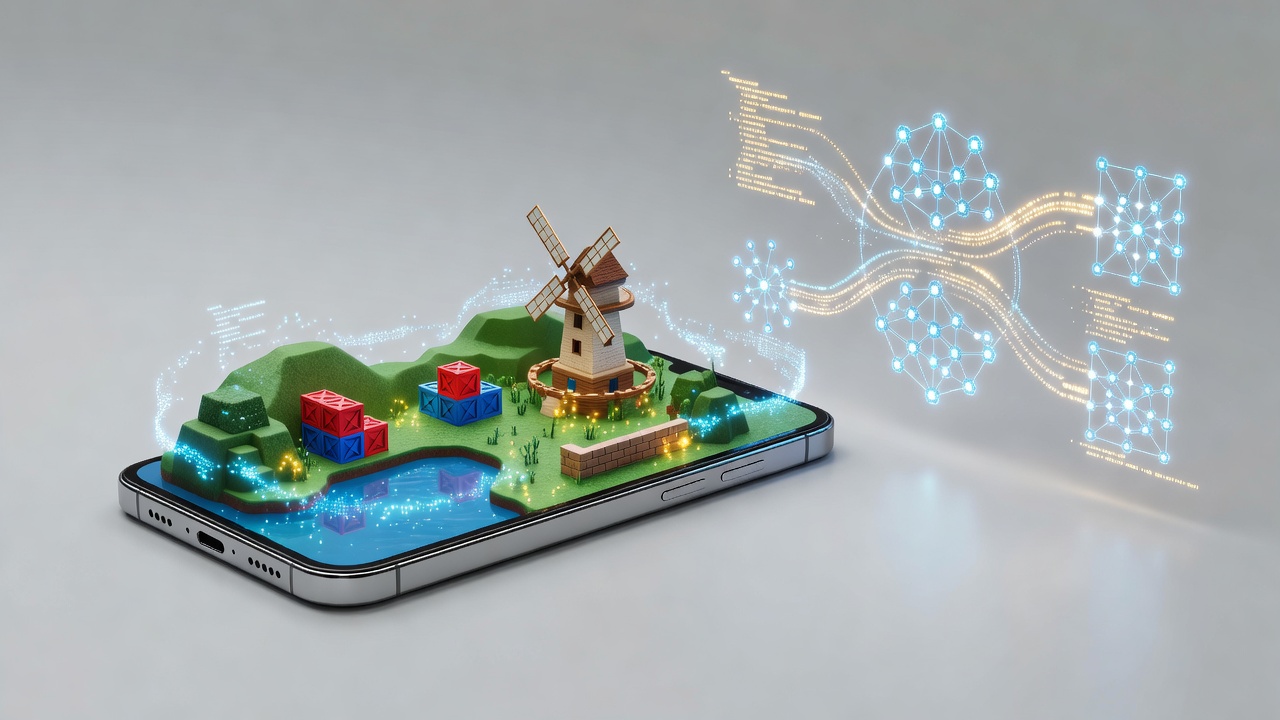
Roblox has introduced a new artificial intelligence system that allows users to create mobile games directly from their phones. The company announced the feature during its annual developers conference, positioning the tool as a way to lower barriers for aspiring creators who want to build experiences without access to a computer.
The system, called Roblox Create, relies on a series of prompts that users type into a mobile interface. According to details shared in a report from The Verge, the process begins with a simple description such as “a racing game set in a cyberpunk city.” The AI then generates a basic scene complete with roads, buildings, and simple vehicle models. Users can continue refining the project by adding instructions like “add collectible power-ups that give the car a speed boost” or “make the track twist through neon-lit alleys at night.” Each command updates the environment in real time, letting creators see changes immediately on their device screens.
This approach marks a significant expansion of Roblox’s existing AI tools, which previously required desktop software and more technical knowledge. By bringing creation to phones, the company hopes to attract millions of younger players who primarily interact with Roblox through mobile devices. Internal data cited in the announcement shows that more than half of daily active users access the platform from smartphones or tablets, yet the vast majority of published experiences still originate from Windows or Mac computers. Roblox Create aims to close that gap.
The technology builds on large language models trained specifically on Roblox’s vast library of user-generated content. These models understand the platform’s proprietary scripting language called Luau, which allows the generated games to include functional mechanics rather than just static scenes. When a user requests a working door, for example, the system can produce both the visual asset and the script that makes the door swing open when a character approaches. The integration of physics, collision detection, and basic player controls happens automatically, reducing the need for manual coding.
Early demonstrations shown during the conference revealed several example projects. One creator built a simple endless runner by typing descriptions of obstacles, power-ups, and background elements. Another constructed a basic multiplayer battle arena with spawning points and health bars. While the resulting games lacked the polish of popular titles like Adopt Me or Brookhaven, they functioned well enough to be published and played by others within minutes of creation. The speed of iteration appeared impressive, with complex changes taking only seconds to process on the cloud servers powering the feature.
Roblox has implemented several guardrails to maintain platform standards. The AI refuses requests for violent or inappropriate content, and all generated experiences must pass through the company’s existing moderation system before becoming publicly available. Creators retain ownership of anything they build, though Roblox maintains the right to use the data to improve its models. This balance between accessibility and responsibility reflects the company’s long-standing approach to user-generated content.
The mobile creation tools include several specialized interfaces designed for touch screens. A visual editing mode lets users drag and resize objects with their fingers, while a companion voice input option allows creators to speak commands instead of typing them. These additions address the limitations of small screens and on-screen keyboards, making the experience more approachable for children and teenagers who form Roblox’s core audience.
Education teams at Roblox see strong potential for classroom use. Teachers can now assign game design projects that students complete entirely on school-issued tablets. The company has prepared lesson plans that guide beginners through building simple platformers, puzzle games, and interactive stories. By removing the requirement for expensive laptops, Roblox hopes to expand its reach into underfunded school districts where computer access remains limited.
Professional developers have expressed mixed reactions to the announcement. Some worry that an influx of AI-generated experiences could further saturate the platform with low-quality games, making it harder for hand-crafted titles to gain visibility. Others see the tools as a way to rapidly prototype ideas before investing significant time in traditional development. Several studios have already begun experimenting with the system to mock up level layouts and test gameplay concepts on mobile devices before transferring the projects to desktop workstations for final refinement.
The underlying AI models draw from years of accumulated Roblox data. Engineers fed the systems millions of published games, scripts, and user feedback scores to help the technology understand what makes an experience engaging. This training process taught the AI to suggest popular mechanics like checkpoints in racing games or health regeneration zones in battle arenas. The models also learned common mistakes that new creators make, allowing them to offer gentle corrections when users request features that might break gameplay.
Performance considerations played a major role in development. Because the system runs on cloud infrastructure, even older smartphones can generate complex scenes without draining batteries or overheating devices. The actual game logic executes on Roblox’s servers during the creation phase, then gets optimized for mobile hardware when published. This architecture ensures that experiences created on phones run smoothly for all players regardless of their device specifications.
Privacy protections form another key component of the rollout. Roblox has stated that individual user prompts will not be used to train future models without explicit consent. The company also limits the retention of creation data to prevent potential misuse. These measures address growing concerns about how AI companies handle user information, particularly when the users include large numbers of minors.
Looking ahead, Roblox plans to expand the capabilities of its mobile creation suite. Future updates will add support for more complex animations, advanced lighting effects, and custom audio generation. The company also intends to integrate the tools more deeply with its existing desktop creation software, allowing seamless transitions between phone and computer workflows. A creator could start a project on their phone during a commute, then open it on a laptop at home to add detailed models and sophisticated scripts.
The announcement fits into a broader industry trend of making development tools more accessible. Other platforms have introduced similar AI-assisted creation features, though few match Roblox’s scale or focus on mobile-first design. By targeting the device where most young people already play, Roblox positions itself to capture the next generation of game makers who might never have considered traditional development paths.
Early user testing has shown promising results. Children as young as nine have successfully built simple games using the system, often creating experiences that reflect their personal interests. One group of students designed a virtual pet care simulator after describing their own pets and favorite activities. Another built a skateboarding game inspired by local parks in their neighborhood. These examples demonstrate how lowering technical barriers can unlock creative expression across diverse backgrounds.
Technical limitations still exist. The AI sometimes struggles with precise spatial relationships or complex multiplayer interactions. Generated scripts occasionally contain logical errors that require manual fixes, though the system provides helpful suggestions for resolving common issues. Roblox acknowledges these constraints and has committed to regular improvements based on user feedback.
The company has also prepared extensive documentation and tutorial content to help new creators make the most of the tools. Video guides demonstrate best practices for writing effective prompts, while community forums offer spaces for sharing tips and troubleshooting problems. This support infrastructure will prove essential as millions of new creators begin experimenting with the feature.
Monetization options remain unchanged for games built with the AI tools. Creators can still sell in-experience items, game passes, and premium access through Roblox’s existing economy. The company hopes that lowering creation barriers will ultimately increase the total number of viable experiences, creating more opportunities for talented developers to earn real income from their work.
As Roblox continues refining its artificial intelligence systems, the mobile creation feature represents an early step toward more intuitive game development. The ability to build functional experiences from natural language descriptions could transform how people think about creating digital worlds. While professional-quality results still require skill and iteration, the new tools bring the possibility of game making within reach for anyone with a smartphone and an idea.
The coming months will reveal how effectively Roblox integrates this technology into its broader platform strategy. Success will depend not only on the quality of generated content but also on how well the company helps new creators develop their skills beyond initial experiments. If the system can nurture genuine creativity while maintaining platform quality, it may significantly expand the pool of active developers and enrich the overall Roblox experience for millions of players worldwide.


 WebProNews is an iEntry Publication