
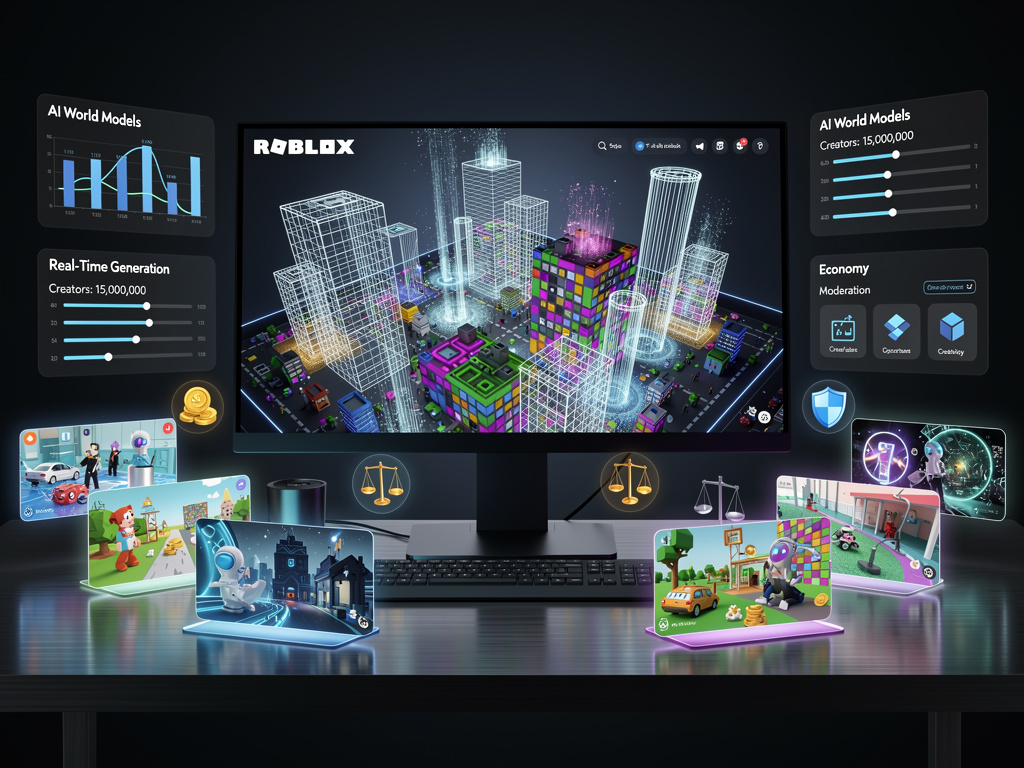
Roblox Corporation is accelerating its ambitious push into artificial intelligence with new tools that could fundamentally reshape how millions of creators build virtual experiences on its platform. The gaming giant recently unveiled plans to integrate AI-powered world models and real-time generation capabilities that promise to transform simple text prompts into fully realized 3D environments, marking one of the most significant technological shifts in the company’s two-decade history.
The announcement comes as the gaming industry faces mounting pressure to democratize content creation while managing the astronomical costs of developing increasingly complex virtual worlds. Roblox’s approach—leveraging AI to empower its 15 million creators rather than replacing them—represents a calculated bet that generative technology can solve one of gaming’s most persistent challenges: the bottleneck between creative vision and technical execution.
According to The Verge, Roblox is developing what it calls “real-time dreaming” capabilities, where AI models can generate and modify 3D environments on the fly based on natural language descriptions. This technology builds upon the company’s existing AI infrastructure, which already powers features like code completion and material generation, but represents a quantum leap in sophistication and ambition.
“We’re moving from tools that assist creation to tools that can understand intent and manifest entire worlds,” explained Roblox Chief Technology Officer Daniel Sturman in a recent developer conference. The company’s 4D creation tools—referring to the three spatial dimensions plus time-based modifications—allow creators to describe not just static scenes but dynamic, evolving environments that respond to player actions and narrative progression.
The Technical Architecture Behind Virtual Dreams
The underlying technology relies on what researchers call “world models”—AI systems trained to understand the physics, aesthetics, and logical consistency of 3D spaces. Unlike image generators that produce flat pictures, these models must comprehend spatial relationships, lighting dynamics, material properties, and how objects interact within a game engine’s constraints. Roblox has reportedly invested hundreds of millions of dollars in training these models on its vast library of user-generated content, creating what amounts to a neural network that “thinks” in interactive 3D.
The technical challenges are formidable. Real-time generation requires processing speeds that were impossible just two years ago, demanding both algorithmic innovation and significant computational infrastructure. Roblox’s solution involves a hybrid approach: pre-computing common elements while generating unique details on demand, similar to how streaming services buffer video content. This allows the AI to maintain consistency across large environments while still responding instantaneously to creator inputs.
Industry analysts note that Roblox’s timing coincides with broader advances in transformer-based architectures and diffusion models, the same technologies powering tools like DALL-E and Midjourney. However, adapting these systems for real-time, interactive 3D environments presents unique obstacles. “Image generation can take seconds or minutes per frame,” explained Dr. Sarah Chen, an AI researcher at Stanford University who studies game development tools. “Gaming demands 60 frames per second with zero latency. That’s not just an incremental challenge—it’s a different problem entirely.”
Economic Implications for the Creator Economy
The financial stakes extend far beyond Roblox’s platform. The company paid out over $740 million to creators in 2023, according to its annual financial disclosures, making it one of the largest digital creator economies globally. AI-powered creation tools could dramatically expand this ecosystem by lowering the technical barriers that currently prevent many aspiring developers from monetizing their ideas.
However, the technology also raises uncomfortable questions about the value of technical skills in game development. Professional 3D modelers, environment artists, and level designers have spent years mastering tools like Blender and Unity. If AI can generate comparable results from text prompts, what happens to these specialized roles? Some industry veterans worry about a race to the bottom, where human craftsmanship becomes economically unviable against automated alternatives.
Roblox executives argue their tools will augment rather than replace human creativity. “The bottleneck has never been ideas—it’s been execution,” said Sturman. “We’re not eliminating the need for creative vision, taste, and iterative refinement. We’re just removing the thousands of hours of technical grunt work that stand between concept and reality.” The company points to its existing AI code-completion features, which haven’t reduced the number of developers on the platform but have enabled them to build more ambitious projects.
Competitive Pressures and Industry Response
Roblox’s AI push doesn’t exist in a vacuum. Epic Games, creator of Fortnite and the Unreal Engine, has invested heavily in similar technologies through its acquisition of Sketchfab and partnerships with AI research labs. Unity Technologies, the other major game engine provider, recently announced its own suite of AI-powered development tools. Even tech giants like Microsoft and Google have launched initiatives to bring generative AI to game development, viewing it as a strategic frontier in the broader AI arms race.
The competition reflects a fundamental shift in how the industry thinks about content creation. Traditional game development follows a waterfall model: concept art, 3D modeling, texturing, lighting, and programming happen in sequence, each step requiring specialized expertise. AI-powered tools promise a more fluid, iterative process where creators can rapidly prototype ideas, test them with real users, and refine based on feedback—all within hours rather than months.
This acceleration could have profound implications for gaming’s economic model. Currently, major titles require teams of hundreds and budgets exceeding $200 million, limiting production to a handful of well-capitalized studios. If AI can reduce these costs by even 50%, it could enable a new generation of mid-budget games and experimental projects that would never have received traditional funding. Some analysts predict this could trigger a renaissance similar to the indie game boom of the 2010s, when digital distribution platforms like Steam democratized game publishing.
Ethical Considerations and Content Moderation Challenges
The same capabilities that enable rapid creation also create significant moderation challenges. Roblox already struggles with inappropriate content on its platform, which serves millions of children and teenagers. AI-generated worlds could exponentially increase the volume of content requiring review, potentially faster than human moderators or even automated systems can process. The company has indicated it’s developing AI-powered moderation tools to work in tandem with its creation systems, but critics question whether any technical solution can adequately protect young users.
There are also thorny questions about intellectual property and training data. Roblox’s AI models are trained on user-generated content created over two decades. While the company’s terms of service grant it broad rights to this material, the ethical implications of using millions of creators’ work to train systems that might eventually compete with them remain contested. Similar debates have erupted around image generators trained on artists’ work without explicit consent or compensation.
Legal experts suggest the regulatory environment could shift rapidly. The European Union’s AI Act and proposed legislation in California both contemplate stricter requirements for AI systems that generate content, particularly when minors are involved. Roblox’s global reach means it must navigate a patchwork of emerging regulations, each with different requirements for transparency, safety, and accountability.
The Technical Road Ahead
Despite the ambitious vision, significant technical hurdles remain. Current AI models struggle with consistency across large environments—a castle generated from one angle might look different from another perspective. They also have difficulty with complex mechanical systems, like vehicles or interactive puzzles, that require precise physical behaviors. Roblox’s engineers are working on what they call “coherence systems” that maintain logical consistency as AI-generated worlds expand and evolve.
Performance optimization presents another challenge. Running sophisticated AI models requires substantial computational resources, potentially limiting these features to users with high-end hardware. Roblox is exploring cloud-based solutions where the heavy processing happens on remote servers, with only the final rendered results streamed to users’ devices. This approach, similar to cloud gaming services like GeForce Now, could democratize access but introduces latency concerns and ongoing operational costs.
The company has not announced a firm timeline for releasing these features to its full creator base. Initial rollouts will likely be limited to select developers in controlled beta programs, allowing Roblox to identify issues before broader deployment. Industry observers expect a gradual release over 18 to 24 months, with simpler features like AI-assisted object placement arriving first, followed by more ambitious world-generation capabilities.
Implications for the Future of Interactive Entertainment
Looking beyond immediate technical challenges, Roblox’s AI initiatives hint at a future where the boundaries between creator and player blur entirely. If generating worlds becomes as simple as describing them, players could potentially modify their environments in real-time, creating personalized experiences that adapt to individual preferences and play styles. This vision of “infinite content” has long been a holy grail for game developers, promising unlimited replayability and engagement.
However, some designers worry this approach could homogenize gaming experiences. Much of what makes memorable games special is the intentional design—the carefully crafted difficulty curves, the deliberate pacing, the artistic vision that guides every element. AI-generated content, optimized for engagement metrics and user preferences, might produce experiences that are satisfying in the moment but lack the distinctive character that elevates games to art.
The broader implications extend to how we think about creativity itself in an age of artificial intelligence. If machines can generate compelling virtual worlds from simple descriptions, what remains uniquely human in the creative process? Roblox’s answer seems to be curation, taste, and the ability to recognize and refine what works. The tools may change, but the fundamental human capacity to imagine, evaluate, and iterate remains central. Whether that vision proves accurate will depend not just on technological capability but on how creators and players choose to use these powerful new tools in the years ahead.


 WebProNews is an iEntry Publication