
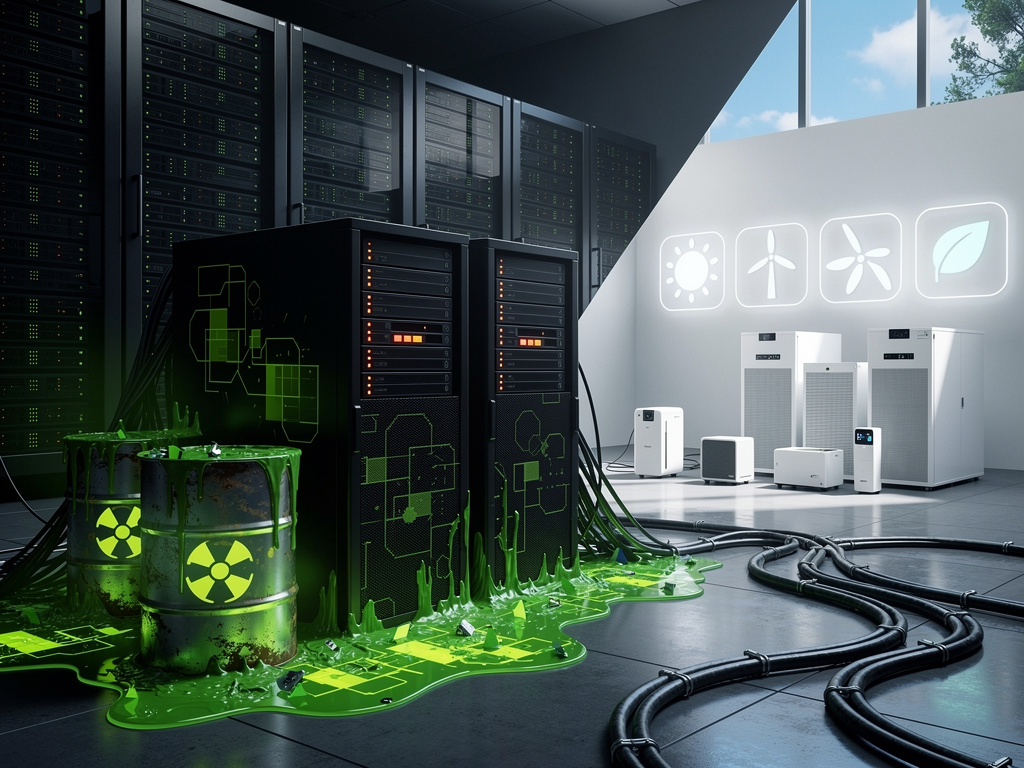
In the waning days of 2025, a seemingly innocuous image uploaded to Imgur sparked a firestorm across programming circles and beyond. The post at Imgur, depicting what appears to be a scathing critique from Rob Pike—co-creator of the Go programming language and a veteran of Bell Labs—lambasts the generative AI boom as little more than “nuclear waste” in the tech ecosystem. Pike, known for his no-nonsense approach to software design, reportedly unleashed a tirade against the hype surrounding tools like large language models, arguing they prioritize spectacle over substance. This image, quickly shared and debated on platforms like Reddit’s r/programming subreddit—where a related thread was swiftly removed by moderators, as noted in a post dated December 26, 2025—highlights a growing schism in the industry. While AI evangelists tout transformative potential, skeptics like Pike warn of overinflated promises leading to inefficient systems and ethical quagmires.
Pike’s commentary, echoed in discussions on Hacker News, positions generative AI as a resource hog that devours energy and compute without delivering proportional value. He draws parallels to historical tech bubbles, suggesting that the current frenzy mirrors the dot-com era’s excesses, where flashy demos masked underlying flaws. Industry insiders point out that Pike’s views aren’t isolated; they resonate with a broader pushback against AI’s unchecked expansion. For instance, posts on X from users like Bimsara Ranasinghe highlight “Agentic AI” as a 2025 advancement, where autonomous systems handle complex tasks, but Pike counters that such agents often rely on brittle, opaque models prone to hallucination and bias.
This divide comes at a pivotal moment. As 2025 draws to a close, the tech sector grapples with the fallout from AI’s rapid integration into everything from enterprise software to consumer gadgets. According to a recent analysis in Núcleo, AI’s impacts dominated headlines, with stories on data centers and open-source battles underscoring the year’s themes. Pike’s “nuclear” metaphor isn’t hyperbole—it’s a call to reevaluate how generative technologies strain global resources, from electricity grids to talent pools.
Shifting Foundations in AI Infrastructure
The backlash Pike embodies isn’t just philosophical; it’s rooted in tangible shifts observed throughout 2025. Cloud providers like Microsoft, Amazon, and Google ramped up monetization of AI infrastructure, moving beyond subsidies to charge premiums for access to high-powered GPUs. An X post from investor Oguz O., under the handle @thexcapitalist, predicted this trend early in the year, noting that giants such as $MSFT and $AMZN would dominate by capitalizing on developer lock-in. This monetization wave has forced smaller players to adapt or perish, with many startups pivoting to edge computing to bypass costly cloud dependencies.
Energy consumption emerged as a flashpoint, aligning with Pike’s warnings. Data centers ballooned to meet AI demands, consuming power equivalent to small nations. A report in ThisDay Live details how AI, alongside broadband expansions, redefined the ICT sector in regions like Africa, where infrastructure upgrades struggled to keep pace. Pike’s critique extends here, arguing that generative models exacerbate this by generating vast amounts of low-value output—think endless iterations of mediocre code or art—without advancing core innovation.
Meanwhile, the rise of AI agents, as forecasted in an ET NOW video recap of 2025 tech milestones, promised automation in strategic planning. Yet, insiders whisper that these agents often falter in real-world scenarios, echoing Pike’s point about their unreliability. On X, Miles Deutscher emphasized agents’ potential in DeFi and on-chain trading, predicting billion-dollar market caps, but Pike’s nuclear analogy suggests such optimism ignores the fallout: increased cyber vulnerabilities and a dilution of human expertise.
The Human Element Amid Automation
Pike’s outburst also spotlights the human cost of AI’s ascent. In 2025, hiring practices in tech firms reflected a tightening belt, with a focus on specialized roles over generalist AI wranglers. A Mastodon thread from @h4ckernews mirrored Hacker News sentiments, discussing how open-source AI efforts aimed to counter proprietary dominance, yet Pike argues this democratizes mediocrity rather than excellence. He advocates for a return to fundamentals—clean, efficient code over AI-assisted bloat.
This perspective gains traction in vertical AI applications, where domain-specific models thrived. An X update from Dharmendra outlined successes in healthcare and finance, where tailored AI outperformed generalist generative tools. However, Pike cautions that even these wins come at a price: over-reliance on proprietary data sets, as seen in the “thin-wrapper cleanse” of startups that merely repackaged OpenAI’s tech without adding value. Publications like Wired (via Daily AI Wire News on X) reflected on this in their year-end review, noting the explosion of AI data centers and the geopolitical tensions they fueled, including U.S.-China rivalries over open-source tech.
Broader industry trends in 2025 amplified these concerns. Robotics and quantum computing, flagged in an X thread by TW – The Wealthy Trader as high-growth areas, intersect with AI in ways Pike deems problematic. Quantum systems could accelerate AI training, but they also magnify energy demands, potentially creating “nuclear” inefficiencies on a grander scale. Energy sectors, too, adapted, with AI optimizing grids but straining them through constant computational loads.
Emerging Alliances and Regulatory Pressures
As Pike’s views circulated via that viral Imgur image, they influenced alliances forming across the sector. Tech pioneers pushed for disciplined maturity, as described in a post from The Pioneer on X, where AI transitioned from hype to infrastructure constrained by compute and cost. This maturity manifested in integrations with IoT, blockchain, and 5G, as per SA News Channel’s trend analysis on X, enabling real-time decision-making but raising Pike’s flagged issues of scalability and ethics.
Regulatory scrutiny intensified, with governments eyeing AI’s environmental footprint. In Europe and the U.S., policies aimed at curbing data center sprawl echoed Pike’s resource critiques. A Bored Panda compilation of intriguing 2025 pics, while lighthearted, included visuals of shaved alpacas as metaphors for stripped-down tech—perhaps a nod to calls for leaner AI models over bloated generative ones.
On the innovation front, startups experimented with sensor-laden devices to gather real-world data, as predicted in an X post by Just Another Pod Guy. This “mad dash” for datapoints addresses AI’s hunger for training material, but Pike warns it risks privacy invasions and further entrenches flawed systems. His nuclear metaphor extends to potential meltdowns: imagine agents mishandling critical tasks in healthcare or transportation, leading to real-world harm.
Innovation’s Path Forward in a Post-Hype Era
Pike’s intervention, amplified through forums like Reddit and Hacker News, urges a recalibration. Rather than generative AI’s probabilistic outputs, he champions deterministic, reliable engineering—hallmarks of his work on Go and Unix. This resonates in 2025’s emphasis on hybrid models, blending AI with human oversight, as seen in creative fields where tools aid but don’t replace artists.
Global news, such as O Globo’s feature on performer Milla Fernandez’s experiences with AI in entertainment, illustrates the double-edged sword: success breeds dependency and personal tolls. Similarly, Regional Paulista’s cartoonish take on unbelievable 2025 news captures the absurdity Pike decries—AI reshaping everything from memes to market caps, yet often delivering superficial gains.
Looking ahead, Pike’s critique could steer the industry toward sustainable paths. X discussions from users like Bimsara Ranasinghe list advancements like agentic AI and vertical integrations, but tempered by Pike’s warnings, they suggest a future where tech prioritizes efficiency over excess. As 2025 data from BuzzFeed’s viral photo roundups show, the year’s humor often masked deeper anxieties about AI’s role, from cyber risks to trillion-dollar valuations.
Balancing Promise with Pragmatism
The Imgur image’s ripple effects underscore a maturing dialogue. Pike isn’t dismissing AI outright; he’s demanding accountability. In energy and robotics, as TW – The Wealthy Trader’s watchlist suggests, growth potentials abound—up to 1,000% in some stocks—but only if grounded in robust foundations.
Critics argue Pike’s views overlook generative AI’s breakthroughs in drug discovery and climate modeling. Yet, his nuclear framing highlights risks: unchecked expansion could lead to systemic failures, much like overhyped tech of yore.
Ultimately, 2025’s tech narrative, woven through sources like ET NOW and ThisDay Live, reveals a sector at crossroads. Pike’s explosive take, immortalized in that Imgur post, serves as a rallying cry for insiders to build resilient, meaningful systems amid the generative frenzy. As debates rage on platforms from X to Mastodon, the industry must heed such voices to avoid self-inflicted fallout.


 WebProNews is an iEntry Publication