
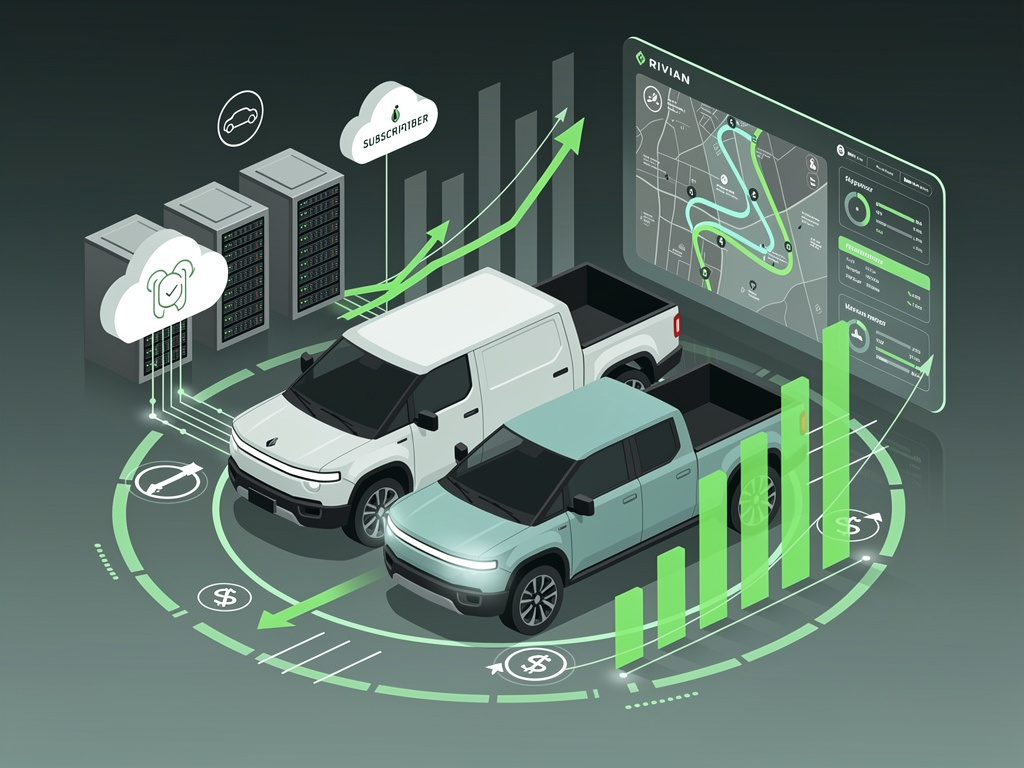
For much of its early public life, Rivian Automotive was a company defined by ambitious promises, staggering cash burn, and the persistent question of whether it could survive long enough to fulfill its potential. By mid-2024, the outlook was grim: production targets had been missed, losses were mounting into the billions, and Wall Street’s patience was wearing thin. But as the dust settled on 2025, a remarkable transformation had taken shape — one driven not by the trucks and SUVs rolling off its assembly lines in Normal, Illinois, but by the software running inside them.
Rivian’s pivot toward software-driven revenue streams has become one of the most closely watched case studies in the electric vehicle industry, offering a blueprint for how next-generation automakers can diversify beyond hardware margins that remain stubbornly thin. The story, as reported by TechCrunch, is one of strategic reinvention under pressure — and it carries implications that extend well beyond a single company’s balance sheet.
From Hardware Headaches to Software Gold
Rivian’s financial trajectory through 2023 and 2024 was defined by the brutal economics of vehicle manufacturing at scale. The company was spending heavily to ramp production of its R1T pickup truck and R1S SUV while simultaneously developing its next-generation R2 platform. Gross margins were deeply negative, and the company was burning through its cash reserves at an alarming rate. By the end of 2024, Rivian had posted cumulative losses well in excess of $20 billion since its founding, and analysts were openly debating whether the company would need another major capital infusion to survive.
The turning point, according to the TechCrunch report, came when Rivian’s leadership made a deliberate and aggressive bet on monetizing its vertically integrated software stack. Unlike legacy automakers that rely heavily on third-party suppliers for infotainment, driver-assistance, and fleet management systems, Rivian had built much of its software architecture in-house from the ground up. This decision, initially viewed as an expensive indulgence for a cash-strapped startup, turned out to be the company’s most valuable strategic asset.
The Subscription Engine That Changed the Math
Central to Rivian’s software strategy was the expansion of its subscription-based services. The company rolled out tiered software packages that included advanced driver-assistance features, enhanced navigation and route planning, over-the-air performance upgrades, and connected vehicle services for both consumer and commercial customers. These recurring revenue streams began contributing meaningfully to the top line in the second half of 2025, fundamentally altering the company’s unit economics.
The impact was most pronounced in Rivian’s commercial division, where its partnership with Amazon — which holds a significant stake in the company — provided a captive fleet of electric delivery vans. Rivian developed fleet management software that offered real-time diagnostics, predictive maintenance scheduling, route optimization, and energy management tools. Amazon’s deployment of tens of thousands of Rivian-built electric delivery vehicles created a massive installed base for these software services, generating high-margin recurring revenue that helped offset the thin margins on the vehicles themselves.
A Lesson From Tesla’s Playbook, Executed Differently
The parallels to Tesla’s approach are obvious but imperfect. Tesla pioneered the concept of over-the-air software updates and subscription-based features in the automotive industry, most notably with its Full Self-Driving (FSD) package, which it has sold for as much as $15,000 or offered as a monthly subscription. But Tesla’s software revenue has always been secondary to its vehicle sales and energy business. Rivian, by contrast, found itself in a position where software revenue was not a luxury but a necessity — a lifeline that kept the company solvent while it worked to achieve manufacturing scale and positive gross margins on its vehicles.
Industry analysts have noted that Rivian’s approach also differs from Tesla’s in its emphasis on the commercial and fleet segment. While Tesla has focused primarily on consumer-facing software features, Rivian’s commercial software platform addresses a market with enormous potential: the electrification of last-mile delivery and commercial logistics. This segment is expected to grow significantly over the coming decade as companies face increasing regulatory pressure and consumer demand to decarbonize their supply chains.
Wall Street Takes Notice
The financial markets responded to Rivian’s software-driven turnaround with cautious optimism. After trading well below its IPO price for much of 2023 and 2024, Rivian’s stock began to recover in the latter half of 2025 as quarterly earnings reports showed improving gross margins and growing software revenue. Several analysts upgraded the stock, citing the company’s demonstrated ability to generate high-margin recurring revenue alongside its vehicle sales.
The broader investment community has been paying close attention to the software-as-a-service (SaaS) model in automotive. Traditional automakers like General Motors, Ford, and BMW have all announced plans to generate billions in software revenue by the end of the decade, but their efforts have been hampered by legacy technology architectures, fragmented supplier relationships, and organizational cultures that are not naturally aligned with software development. Rivian’s advantage, as a company built from scratch in the software era, was that it did not have to retrofit a software strategy onto an existing hardware-centric business — it could build both in parallel.
The Volkswagen Connection and Global Ambitions
Rivian’s software capabilities also played a central role in its landmark joint venture with Volkswagen Group, which was announced in 2024. Under the terms of the deal, Volkswagen invested up to $5 billion in Rivian, with a significant portion of the partnership focused on sharing Rivian’s electrical architecture and software platform. The joint venture, which created a new entity to develop next-generation software-defined vehicle architectures, was a validation of Rivian’s technology and a crucial source of capital at a time when the company desperately needed it.
The Volkswagen partnership underscored a broader industry trend: the recognition that software-defined vehicles represent the future of the automotive industry, and that the companies capable of building and maintaining sophisticated software platforms will hold disproportionate power in the value chain. For Volkswagen, which had struggled mightily with its own in-house software unit, Cariad, the Rivian partnership offered a shortcut to capabilities that had proven elusive despite billions in investment. For Rivian, it provided financial stability and a path to global scale for its software platform.
Challenges That Remain on the Road Ahead
Despite the progress, Rivian’s transformation is far from complete. The company still faces significant challenges, including the need to ramp production of its more affordable R2 vehicle, which is critical to achieving the volume necessary for long-term profitability. Manufacturing at scale remains a formidable challenge for any automaker, and Rivian’s production numbers, while improving, still lag far behind those of Tesla and legacy competitors.
There are also questions about the sustainability of software revenue growth. As more automakers develop their own software capabilities — or acquire them through partnerships and acquisitions — the competitive environment for automotive software services will intensify. Rivian will need to continue innovating and expanding its software offerings to maintain its edge, particularly as Chinese EV makers with sophisticated software platforms begin to enter Western markets in greater numbers.
What Rivian’s Reinvention Means for the Industry
Rivian’s story is significant not just for what it says about one company’s survival, but for what it reveals about the shifting economics of the automotive industry. The traditional model — in which automakers generate the bulk of their profits from vehicle sales and aftermarket parts — is giving way to a new paradigm in which software and services represent an increasingly important share of total revenue and profit. Companies that can master both the hardware and software dimensions of the modern vehicle will be best positioned to thrive; those that cannot may find themselves relegated to the role of commodity manufacturers.
For Rivian, the software pivot was born of necessity. The company did not have the luxury of waiting for vehicle margins to improve on their own; it needed a new source of high-margin revenue to bridge the gap between its current financial reality and its long-term ambitions. That it found one in its own software stack is a testament to the foresight of its early technology investments — and a warning to competitors who underestimate the value of owning their own software destiny.
As the electric vehicle sector continues to mature and consolidate, Rivian’s experience in 2025 will likely be studied as a pivotal moment — the year a company that many had written off found its footing not by building more trucks, but by writing better code.


 WebProNews is an iEntry Publication