
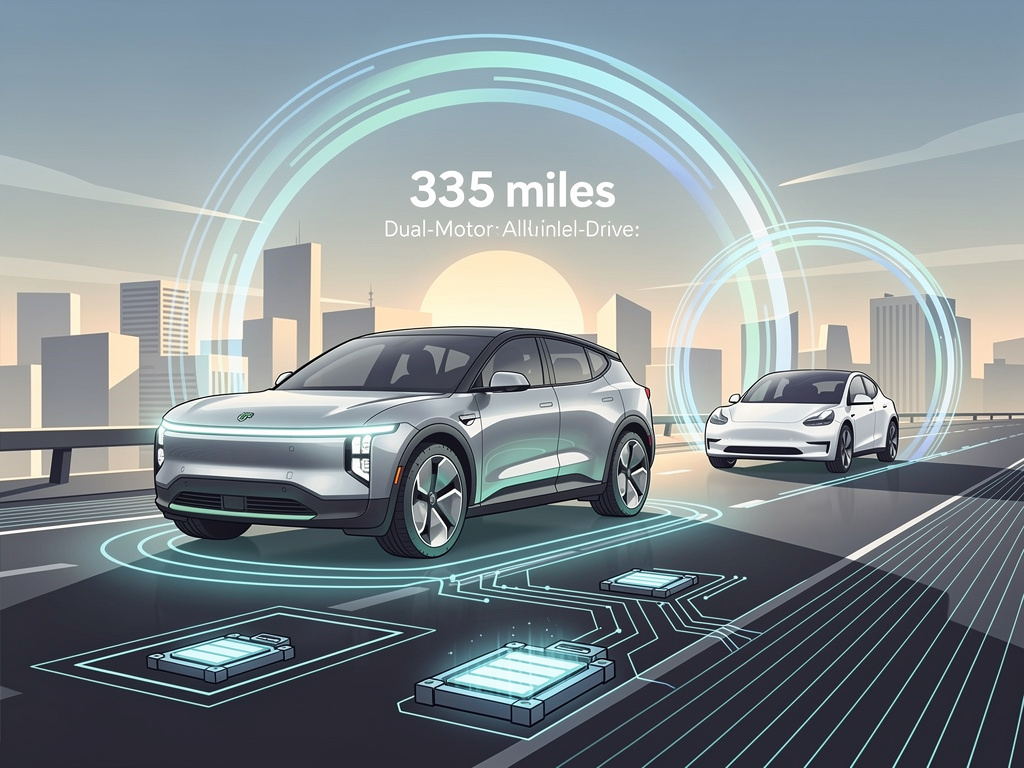
An EPA certification document wasn’t supposed to go public yet. But it did. And what it revealed about Rivian’s upcoming R2 SUV has sent a jolt through the electric vehicle industry: 335 miles of range on a single charge, a number that positions the midsize crossover squarely against Tesla’s Model Y — and arguably above it.
The leaked filing, first reported by Ars Technica, shows the dual-motor, all-wheel-drive R2 earning an official EPA-estimated range of 335 miles. That figure surpasses the current Tesla Model Y Long Range All-Wheel Drive, which carries an EPA rating of 311 miles. It also edges past the rear-wheel-drive Model Y Long Range, rated at 320 miles. For a company that has struggled with profitability and production scale, this is more than a spec-sheet victory. It’s a signal that Rivian’s engineering investments are producing tangible, competitive results at a price point that matters.
The R2 is expected to start at approximately $45,000 — significantly less than Rivian’s R1S and R1T, which begin around $70,000. That price target plants it firmly in the heart of the mass-market EV segment, where Tesla has reigned with relatively little serious competition from American automakers. Rivian CEO RJ Scaringe has described the R2 as the vehicle that will determine whether his company survives or fails. The stakes, in other words, could not be higher.
Inside the Numbers: What the EPA Filing Actually Shows
The certification documents reveal more than just headline range. The R2’s combined energy consumption is listed at 100 MPGe, with a city rating of 107 MPGe and a highway figure of 93 MPGe. Those efficiency numbers are competitive, though not class-leading. Tesla’s Model Y Long Range AWD achieves 115 MPGe combined. But range, not efficiency, is what most buyers fixate on, and 335 miles gives Rivian a meaningful marketing edge.
The battery pack is an 85 kWh unit — usable capacity, not gross. Rivian has been developing its own battery technology in-house, and the R2 will be built on the company’s new platform at its Normal, Illinois factory before eventually expanding production to a second plant in Georgia. The smaller pack relative to the R1 line (which uses configurations up to around 135 kWh) reflects both the R2’s smaller footprint and genuine improvements in energy density and vehicle efficiency.
One detail that matters enormously for real-world owners: the R2 supports DC fast charging. Rivian has confirmed compatibility with Tesla’s North American Charging Standard (NACS) connector, giving R2 buyers access to the extensive Tesla Supercharger network. That alone eliminates what was once a significant competitive disadvantage for non-Tesla EVs.
The leaked documents also indicate a curb weight of roughly 4,600 pounds. Heavy by sedan standards, but typical for an electric crossover of this size. Rivian has used a structural battery pack design that integrates the cells into the vehicle’s floor, contributing to both rigidity and a lower center of gravity.
So what does 335 miles actually mean in practice? EPA estimates are conducted under controlled conditions. Real-world range depends on speed, temperature, terrain, climate control usage, and driving style. Most EV owners report achieving 70-85% of EPA-rated range under typical mixed-driving conditions. That would put the R2’s practical range somewhere between 235 and 285 miles — still more than sufficient for the vast majority of daily use cases and most road trips with a single charging stop.
But the psychological threshold matters. Buyers shopping in this segment want to see a number starting with 3. Rivian delivers that. Tesla delivers that. Most of their competitors don’t — at least not at comparable price points with all-wheel drive.
The Competitive Battlefield: Who Gets Hurt
The R2 doesn’t exist in a vacuum. Its arrival, expected in the first half of 2026 for initial deliveries, coincides with an increasingly crowded field. The Chevrolet Equinox EV starts lower, around $33,000, but offers less range (up to 319 miles for the rear-drive variant) and a less premium interior. The Hyundai Ioniq 5, refreshed for 2025, offers up to 303 miles of range with its larger battery. The Ford Mustang Mach-E sits at around 312 miles for its extended-range model.
None of those vehicles combine 335 miles of range with standard all-wheel drive and a brand identity built around adventure and outdoor capability. That’s where Rivian’s positioning becomes interesting. The company isn’t just selling an electric crossover — it’s selling a lifestyle brand at a price point that suddenly makes it accessible to a much broader audience.
Tesla, naturally, remains the elephant in the room. The Model Y is the best-selling vehicle on earth — not just the best-selling EV, the best-selling vehicle, period. Rivian won’t dethrone it overnight. But a 335-mile R2 at $45,000 gives Tesla a reason to pay attention. Elon Musk’s company has historically responded to competitive pressure with price cuts, and the R2’s specs could accelerate that dynamic.
There’s also the matter of brand perception. Tesla’s image has become polarizing, driven in part by Musk’s political activities and his role leading the Department of Government Efficiency under the Trump administration. Some prospective Tesla buyers have publicly stated they’re looking for alternatives. Rivian, with its outdoor-focused branding and generally positive consumer sentiment, stands to benefit from that shift. Whether that translates into actual sales volume remains to be seen.
Rivian’s reservation numbers for the R2 have been strong. The company reported over 100,000 reservations within days of the vehicle’s unveiling in March 2024. That figure has reportedly grown since, though Rivian hasn’t released an updated count recently. Reservations, of course, are not orders. They require only a small refundable deposit. But the level of interest suggests genuine demand.
Production capacity is the real question. Rivian produced approximately 57,000 vehicles in 2024, all R1-series trucks and SUVs. The company has been retooling its Normal factory to accommodate the R2 on a new production line, and has targeted an annual capacity of 215,000 units once fully ramped. Achieving that would represent a nearly fourfold increase — an enormous operational challenge for a company that has historically struggled with manufacturing execution.
Rivian’s cash position has improved following a joint venture with Volkswagen Group, announced in 2024, which brought in up to $5.8 billion in investment. That partnership focuses on shared electrical architecture and software platforms, and it has given Rivian a financial runway that many EV startups lack. VW’s investment isn’t charity — the German automaker gets access to Rivian’s software stack, which is widely regarded as among the best in the industry.
Still, Rivian has never posted a profitable quarter. The company’s gross margins turned positive only recently, and net profitability remains years away by most analyst estimates. The R2’s lower price point means thinner margins per vehicle, making volume absolutely essential. If the Normal factory ramp goes smoothly, the math could work. If it doesn’t, Rivian burns cash at a rate that even VW’s billions can’t sustain indefinitely.
What Comes Next
The leaked EPA certification is, in one sense, just a number on a government document. But in the EV market, where range anxiety still drives purchasing decisions for many consumers, it carries outsized significance. Rivian now has a concrete, verified data point to put in its advertising, on its website, and in every conversation with a potential buyer. Three hundred thirty-five miles. Dual-motor all-wheel drive. Under $50,000.
That’s a compelling pitch.
The company is expected to formally announce the R2’s EPA ratings in the coming weeks, likely alongside updated pricing and configuration details. A single-motor, rear-wheel-drive variant is also anticipated, which could push range even higher — potentially past 350 miles — while bringing the starting price closer to $40,000. That model would compete even more directly with the Equinox EV and base Model Y.
Rivian has also hinted at a smaller, more affordable model called the R3, built on the same platform. If the R2 succeeds, the R3 could follow within two years, targeting a sub-$35,000 price point. But that’s getting ahead of the story. For now, the R2 is the vehicle that matters.
And based on what this leaked filing shows, Rivian has built something that deserves to be taken seriously — not just as an aspirational startup product, but as a genuine mainstream contender. The hard part, as always, is building it at scale, on time, and without the quality issues that plagued the R1’s early production. The specs are there. The demand appears to be there. Execution is the only remaining variable — and it’s the one that will determine everything.


 WebProNews is an iEntry Publication