
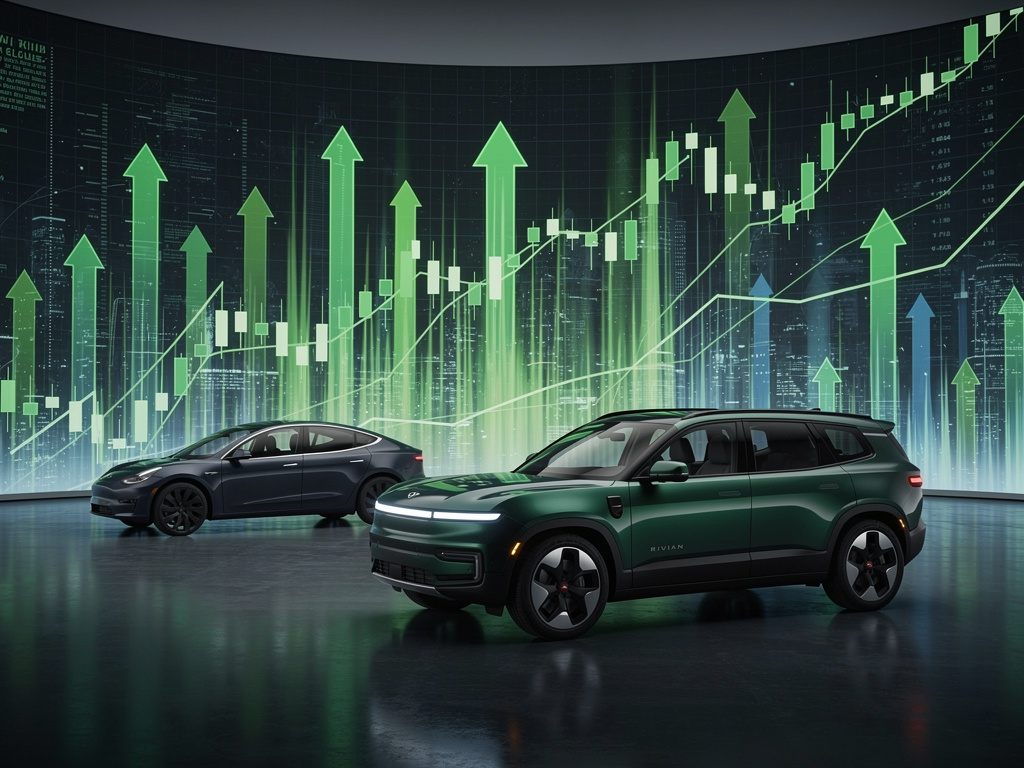
Rivian Automotive Inc. shares surged dramatically following a wave of analyst upgrades, signaling a pivotal moment for the electric vehicle maker as it prepares to launch the R2 — a midsize SUV squarely aimed at Tesla’s best-selling Model Y. The stock jumped more than 10% before Friday’s market open, buoyed by a combination of better-than-expected fourth-quarter earnings, a clearer path to profitability, and mounting enthusiasm for a vehicle that could fundamentally alter Rivian’s trajectory from niche adventure-brand to mainstream contender.
The upgrades came fast and furious. According to Investor’s Business Daily, multiple Wall Street firms raised their ratings on Rivian stock, with analysts pointing to the company’s improving cost structure, disciplined capital allocation, and the strategic importance of the R2 platform. The confluence of positive catalysts represents a stark departure from the skepticism that had dogged Rivian for much of the past two years, during which the stock lost more than 80% of its value from its post-IPO highs.
A Quarter That Changed the Narrative
Rivian’s fourth-quarter results, while still showing losses, demonstrated meaningful progress on several fronts that had long concerned investors. The company reported improved gross margins, a critical metric for an EV startup burning through cash to scale production. Management reiterated its commitment to achieving positive gross profit margins in 2024, a milestone that would mark a significant turning point in the company’s financial story. Revenue came in ahead of consensus expectations, and the company’s guidance suggested that operational efficiencies at its Normal, Illinois manufacturing plant are beginning to take hold.
Perhaps more importantly, Rivian’s cash position remained robust enough to fund its ambitious expansion plans without immediately resorting to dilutive equity raises — a persistent fear among shareholders. The company ended the quarter with approximately $9.4 billion in cash and equivalents, providing a substantial runway to reach the R2 launch. CEO RJ Scaringe has repeatedly emphasized that capital discipline would be paramount, and the quarterly results appeared to validate that commitment. Analysts at several firms noted that Rivian’s burn rate had decelerated more quickly than anticipated, giving the company additional financial flexibility.
The R2: Rivian’s Make-or-Break Vehicle
At the heart of the analyst optimism sits the R2, a compact SUV expected to start at roughly $45,000 — approximately half the price of Rivian’s current R1S SUV. The vehicle, unveiled to considerable fanfare in early 2024, is designed to compete directly with the Tesla Model Y, which has become the world’s best-selling vehicle regardless of powertrain. The R2 represents Rivian’s clearest attempt yet to move beyond its premium adventure niche and capture a slice of the mass-market EV segment, where volumes are exponentially larger.
As reported by Investor’s Business Daily, the attention surrounding the R2 has intensified as Rivian moves closer to production, which is expected to begin in 2026 at a new facility in Georgia. The vehicle will ride on Rivian’s next-generation platform, which promises significantly lower manufacturing costs per unit — a necessity if the company hopes to achieve profitability at the R2’s lower price point. Analysts have noted that the R2’s bill of materials is expected to be substantially reduced compared to the R1 platform, thanks to a simplified electrical architecture, fewer unique components, and lessons learned from scaling the R1 line.
Wall Street’s Shifting Calculus
The cluster of upgrades reflects a broader reassessment of Rivian’s risk-reward profile. For much of 2023 and early 2024, the bear case on Rivian centered on three primary concerns: unsustainable cash burn, uncertain demand beyond early adopters, and the competitive threat from both Tesla and legacy automakers flooding the market with electric models. The Q4 results and R2 progress have, at minimum, partially addressed each of these concerns.
Several analysts raised their price targets alongside their rating upgrades. The bull case now rests on Rivian’s ability to execute a complex manufacturing ramp at its Georgia plant while simultaneously maintaining quality and controlling costs. It is worth noting that Tesla itself struggled mightily with production ramps — the so-called “production hell” that nearly bankrupted the company during the Model 3 launch. Rivian will need to navigate similar challenges, but it does so with the benefit of hindsight and a management team that has already weathered one major production scale-up with the R1 line.
The Tesla Factor: Model Y Refresh Adds Urgency
The competitive dynamics between Rivian and Tesla are growing more complex. Tesla recently launched a refreshed Model Y, known internally as “Juniper,” which features updated styling, improved range, and enhanced interior technology. The refresh has reinvigorated demand for Tesla’s volume leader at a time when the broader EV market has shown signs of softening growth. For Rivian, the timing of the R2 launch means it will be competing against a relatively fresh Model Y rather than an aging one — raising the stakes for the R2’s design, technology, and value proposition.
Yet Rivian may benefit from a factor that has nothing to do with vehicle specifications: brand perception. Tesla CEO Elon Musk’s increasingly polarizing public persona and political activities have created an opening for competitors. Reports from multiple outlets have documented a notable uptick in Tesla trade-ins and defections to rival brands, with some buyers citing Musk’s behavior as a motivating factor. Rivian, with its outdoorsy, community-oriented brand identity, could be well-positioned to capture disaffected Tesla owners — particularly in the coastal and urban markets that represent the core of EV adoption.
The Georgia Plant: Rivian’s $5 Billion Bet
Central to the R2 story is Rivian’s massive manufacturing facility under construction near Atlanta, Georgia. The plant, which has received significant support from state and local incentives, is designed to be a state-of-the-art production hub capable of producing up to 400,000 vehicles annually at full capacity. The facility will incorporate manufacturing innovations that Rivian has developed since opening its Normal, Illinois plant, including more automated assembly processes and a more efficient paint shop.
The Georgia investment also carries political dimensions. The plant has become a talking point in broader discussions about domestic EV manufacturing and the Inflation Reduction Act’s impact on automotive investment. Rivian’s vehicles are assembled in the United States, which qualifies them for federal EV tax credits — a meaningful competitive advantage at the R2’s target price point, where a $7,500 credit could reduce the effective purchase price to under $40,000. This price positioning would place the R2 in direct competition not only with the Model Y but also with popular internal combustion crossovers, potentially expanding Rivian’s addressable market well beyond current EV buyers.
Risks Remain, But the Trajectory Has Shifted
For all the optimism, significant risks remain. Rivian has yet to demonstrate that it can profitably manufacture vehicles at scale — a challenge that has humbled far larger and better-capitalized companies. The EV market, while growing, has entered a more competitive phase in which pricing pressure is intense and consumer adoption has slowed in some segments. Rivian’s commercial van business with Amazon, while providing steady revenue, has also faced questions about its long-term economics and whether Amazon might eventually diversify its fleet suppliers.
Supply chain vulnerabilities also loom. Battery costs, while declining, remain the single largest component of EV manufacturing costs, and Rivian’s ability to secure favorable cell supply agreements will be critical to the R2’s profitability. The company has struck partnerships with multiple battery suppliers, but the global race for battery materials and manufacturing capacity means that supply disruptions remain a persistent concern for all EV makers.
A Defining Chapter for the EV Upstart
What makes the current moment so compelling for Rivian watchers is the convergence of financial progress, product momentum, and market opportunity. The company has survived the brutal shakeout that claimed or severely wounded several EV startups, including Lordstown Motors, Fisker, and Arrival. Rivian’s survival — and its improving financial trajectory — sets it apart from the pack and lends credibility to its ambitious growth plans.
The analyst upgrades, as detailed by Investor’s Business Daily, reflect a growing consensus that Rivian has crossed an important threshold: from existential risk to execution risk. The former is a question of survival; the latter is a question of degree. For investors, that distinction is everything. If Rivian can deliver the R2 on time, on budget, and with the quality and features to genuinely compete with the Model Y, the company’s stock — still trading well below its IPO price — could have substantial room to run. If it stumbles, the window of opportunity may narrow quickly in a market that is becoming less forgiving of missteps by the quarter.
Either way, Rivian’s next 18 months will be among the most consequential in the young company’s history — and among the most closely watched chapters in the ongoing transformation of the American auto industry.


 WebProNews is an iEntry Publication