
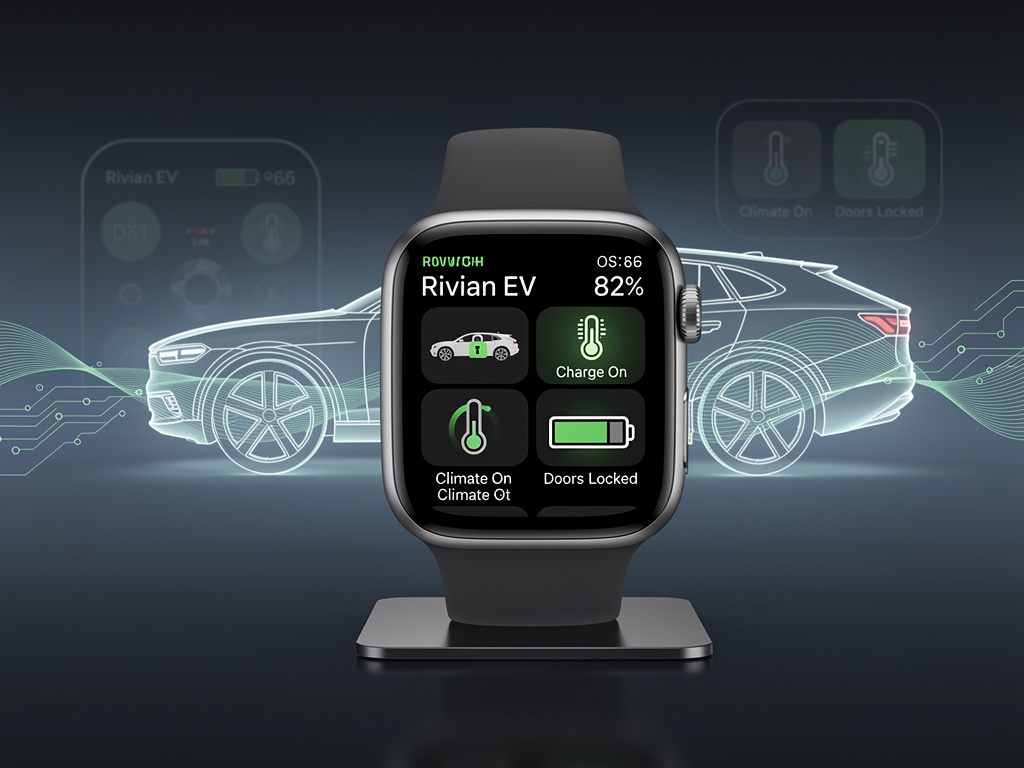
In a move that underscores how deeply the automotive and consumer technology industries have become intertwined, Rivian Automotive has announced a standalone Apple Watch app that will allow owners to control key vehicle functions directly from their wrists — no iPhone required. The feature, revealed during Apple’s Worldwide Developers Conference (WWDC) in June 2025, represents one of the most ambitious integrations yet between a wearable device and an electric vehicle, and signals Rivian’s intent to differentiate itself not just on hardware, but on the software experience surrounding its trucks and SUVs.
The announcement came as part of Apple’s broader unveiling of watchOS 26, the latest operating system for its smartwatch line. Among the headline features of the new OS is expanded support for standalone apps — applications that can operate independently of a paired iPhone. Rivian seized on this capability to build what it describes as a fully functional vehicle control interface that lives on the owner’s wrist, according to reporting by CNET.
From Novelty to Necessity: What the Rivian Apple Watch App Actually Does
The Rivian Apple Watch app is not merely a remote lock-and-unlock tool, which has become relatively common among automakers offering smartphone companion apps. Instead, Rivian is positioning the wearable app as a genuine cabin control interface. According to CNET’s reporting, owners will be able to precondition their vehicle’s cabin — adjusting climate settings, turning on seat heating or cooling, and managing other comfort features — all from the Apple Watch. This is particularly meaningful for EV owners, who frequently precondition their vehicles while plugged in to preserve battery range before departing.
The app will also allow users to check their vehicle’s charge status, lock and unlock doors, and open the frunk or trunk — functions that, while available on the Rivian smartphone app, gain new utility when accessible with a quick glance at a watch face. For runners, hikers, and outdoor enthusiasts — a demographic Rivian has aggressively courted since its founding — the ability to leave a phone behind and still interact with their vehicle is a practical advantage. Rivian’s R1T pickup and R1S SUV have been marketed heavily toward adventure-oriented buyers, and the Apple Watch app fits squarely within that brand identity.
Apple’s watchOS 26 Opens the Door for Automotive Innovation
The technical foundation for Rivian’s app lies in changes Apple introduced with watchOS 26. The updated operating system significantly expands what standalone apps can do, including improved connectivity options and richer user interface elements. Apple has been gradually loosening the Apple Watch’s dependence on the iPhone over several generations of both hardware and software, and watchOS 26 represents a meaningful leap in that trajectory.
Apple highlighted several automotive-adjacent features during WWDC 2025, including deeper integration with CarKey technology and expanded support for Ultra Wideband (UWB) communication, which enables precise spatial awareness between devices. While Apple did not specifically call out Rivian during its keynote, the EV maker was among the first third-party developers to publicly showcase a vehicle control app taking advantage of the new standalone capabilities. This positions Rivian alongside — and in some respects ahead of — legacy automakers that have been slower to embrace wearable integrations.
The Competitive Context: How Rivian Stacks Up Against Tesla, BMW, and Others
Rivian is not the first automaker to offer an Apple Watch app. Tesla has long had third-party watch apps available, though Tesla itself has not developed an official standalone Apple Watch application, relying instead on its smartphone app and the Tesla key card or phone-as-key system. BMW, Porsche, and Mercedes-Benz have offered varying degrees of Apple Watch functionality, but many of these apps have served primarily as notification extensions rather than full control interfaces.
What distinguishes Rivian’s approach, according to CNET, is the standalone nature of the application. Most existing automotive watch apps require an iPhone to be nearby and connected, essentially serving as a second screen for the phone app. Rivian’s app, by contrast, is designed to function independently over a cellular or Wi-Fi connection on Apple Watch models that support it. This is a meaningful distinction for users who want to leave their phone behind during outdoor activities — precisely the use case Rivian’s customer base is likely to encounter.
Rivian’s Software Strategy: More Than Just a Truck Company
The Apple Watch app is the latest evidence that Rivian views software as a core competitive differentiator. The company has invested heavily in its proprietary software stack, building its infotainment system, driver-assistance features, and companion app ecosystem largely in-house. This vertical integration mirrors the approach taken by Tesla and stands in contrast to many legacy automakers that rely on third-party suppliers for significant portions of their software infrastructure.
Rivian CEO RJ Scaringe has repeatedly emphasized the importance of software to the company’s long-term strategy. In previous earnings calls and public appearances, Scaringe has described Rivian as a technology company that happens to make vehicles, a framing that resonates with Silicon Valley investors but also reflects genuine strategic priorities. The Apple Watch app, while a relatively small feature in isolation, is emblematic of a broader philosophy: that the ownership experience extends well beyond the driver’s seat and that every digital touchpoint matters.
Timing and Market Implications for Rivian
The announcement comes at a critical juncture for Rivian. The company has been working to ramp production of its updated R1 vehicles and is preparing for the launch of the more affordable R2 platform, which is expected to significantly expand Rivian’s addressable market when it arrives. Demonstrating software sophistication now — before the R2 reaches customers — helps establish the brand’s technology credentials with a broader audience.
Rivian’s stock has experienced significant volatility over the past year as investors weigh the company’s cash burn rate against its growth prospects. Partnerships and integrations with major technology platforms like Apple’s can serve as positive signals to the market, suggesting that Rivian is building an ecosystem rather than simply selling vehicles. The Apple Watch app, while unlikely to move the stock on its own, contributes to a narrative of innovation that Rivian needs to maintain investor confidence during a capital-intensive scaling phase.
What This Means for the Broader Auto-Tech Relationship
The Rivian-Apple Watch integration also raises broader questions about the evolving relationship between automakers and consumer technology companies. Apple’s CarPlay platform has already become a battleground, with some automakers embracing it fully and others — most notably General Motors, which briefly attempted to phase out CarPlay before reversing course — pushing back against ceding control of the in-vehicle experience to a tech giant.
The Apple Watch represents a different dynamic. Unlike CarPlay, which occupies the vehicle’s central display, a watch app is an extension of the owner’s personal device ecosystem. Automakers that integrate well with wearables are effectively meeting customers where they already are, rather than forcing them into a proprietary digital environment. For Rivian, which has a younger, more tech-savvy customer base than most traditional automakers, this approach is a natural fit.
The Road Ahead for Wearable Vehicle Control
Industry analysts expect wearable vehicle integration to accelerate in the coming years, driven by improvements in both watch hardware and vehicle connectivity infrastructure. As 5G networks expand and vehicles become increasingly software-defined, the range of functions controllable from a wrist is likely to grow substantially. Future iterations could include navigation prompts delivered via haptic feedback, health-monitoring integrations that adjust cabin settings based on biometric data, or even voice-activated commands routed through the watch’s built-in microphone and speaker.
For now, Rivian’s standalone Apple Watch app stands as one of the most complete implementations of wearable vehicle control from any automaker. Whether it becomes a meaningful purchase driver or remains a nice-to-have feature for existing owners will depend on execution — and on whether Rivian can continue to deliver software updates that keep pace with both Apple’s evolving platform and the expectations of an increasingly demanding customer base. What is clear is that the battle for EV market share is no longer fought solely on range, price, and charging speed. It is increasingly fought on the quality and reach of the digital experience — and Rivian intends to compete on every screen, no matter how small.


 WebProNews is an iEntry Publication