
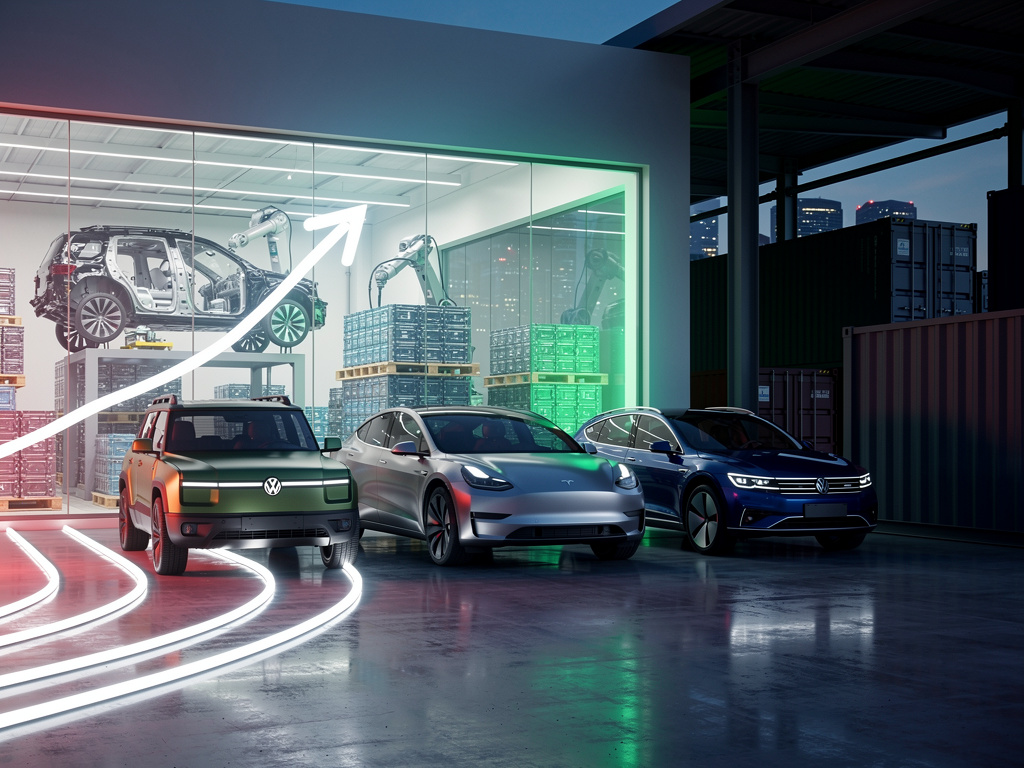
The comparison is irresistible and, for Rivian Automotive, both a blessing and a curse. Every electric vehicle company that has gone public in the last five years has been measured against Tesla’s extraordinary trajectory — from cash-burning upstart to the world’s most valuable automaker. Most have failed the test spectacularly. Lordstown Motors went bankrupt. Fisker filed for Chapter 11. Nikola became a cautionary tale wrapped in a fraud conviction.
Rivian is still standing. More than that, it’s accelerating.
But the question hovering over the Irvine, California-based automaker isn’t whether it can survive. It’s whether it can replicate something that may have been a once-in-a-generation phenomenon: Tesla’s ascent from niche manufacturer to mass-market juggernaut. A growing number of analysts and investors are starting to believe the answer might be yes — or at least something close to it.
The Financial Inflection Point
According to Yahoo Finance, the bull case for Rivian centers on a series of milestones the company is approaching that mirror Tesla’s own path roughly a decade ago. The company reported its first-ever positive gross profit in the fourth quarter of 2024 — a landmark moment that Tesla itself didn’t reach until years into its production ramp. For a company that has burned through billions since its founding in 2009, the shift from losing money on every vehicle sold to actually generating margin on hardware is significant.
The numbers tell a compelling story. Rivian delivered approximately 51,579 vehicles in 2024 and has guided for continued growth in 2025. Its R1 platform — the basis for the R1T pickup truck and R1S SUV — has undergone a significant cost-reduction overhaul. The company says material costs per vehicle have dropped meaningfully, driven by in-house component development, supplier renegotiations, and manufacturing efficiencies at its Normal, Illinois plant.
Gross margin improvement isn’t just an accounting exercise here. It’s existential. Every EV startup that has collapsed did so because it couldn’t close the gap between what it cost to build a vehicle and what customers would pay. Rivian appears to be closing that gap faster than most analysts expected even 18 months ago.
Then there’s the balance sheet. Rivian ended 2024 with roughly $7.7 billion in cash and equivalents, bolstered by a massive joint venture agreement with Volkswagen Group announced in mid-2024. That deal, potentially worth up to $5.8 billion, gives Rivian not just capital but a validation of its software and electrical architecture from one of the world’s largest automakers. VW isn’t investing in Rivian out of charity. It needs Rivian’s technology platform for its own next-generation EVs — a dynamic that echoes the early days when legacy automakers began taking Tesla’s engineering seriously.
And the Volkswagen partnership does something else. It buys time. The single greatest killer of EV startups has been the cash burn clock — the relentless countdown between available capital and profitability. Rivian’s runway now extends well into the launch window for its most important product yet.
That product is the R2.
Priced around $45,000, the R2 is Rivian’s answer to the question that has defined every aspiring Tesla competitor: Can you build a vehicle normal people can actually afford? The R1 lineup, with prices starting above $70,000, has earned critical praise and genuine customer loyalty. Consumer Reports has rated Rivian’s vehicles highly, and owner satisfaction scores rival Tesla’s own. But premium pricing limits the addressable market. The R2 is designed to change that equation entirely.
Production is slated to begin at Rivian’s new manufacturing facility in Georgia, with the first vehicles expected to roll off the line in 2026. If Rivian can execute — a big if, given the history of EV production hell — the R2 could push annual volumes toward 200,000 units or more within a few years of launch. That’s the kind of scale where unit economics start to look very different.
Why Skeptics Have a Point
For all the optimism, the Rivian-as-next-Tesla thesis has real vulnerabilities. The competitive environment in 2025 looks nothing like the one Tesla faced in 2015. Back then, Tesla’s Model S was essentially the only compelling long-range EV on the market. Today, Rivian faces competition from every direction: Tesla’s own expanded lineup, Ford’s electric F-150 Lightning, GM’s Chevrolet Equinox EV, Hyundai’s Ioniq family, and a wave of Chinese manufacturers eyeing global expansion.
Price competition is intensifying. Tesla has repeatedly cut prices across its lineup, compressing margins industry-wide and making it harder for smaller players to compete on value. The R2’s $45,000 target puts it squarely against Tesla’s Model Y, the best-selling EV on the planet. Rivian will need to offer something genuinely differentiated — in design, software, driving experience, or brand identity — to peel buyers away from Tesla’s established retail and service infrastructure.
There’s also the manufacturing question. Rivian has exactly one operational factory. Its Georgia plant is still under construction. Scaling from 50,000 vehicles a year to several hundred thousand is an enormously complex industrial challenge. Tesla’s struggles with Model 3 production — the infamous “production hell” that nearly bankrupted the company in 2018 — remain a cautionary reference point. Rivian CEO RJ Scaringe has acknowledged the difficulty publicly, but acknowledgment and execution are different things.
Wall Street remains divided. Some analysts see Rivian’s stock — which has recovered significantly from its 2022 lows but remains far below its IPO-era highs above $170 — as a compelling risk-reward opportunity. Others point to the company’s continued net losses, the capital intensity of building out a second factory, and the uncertain trajectory of EV demand growth in a market where hybrid vehicles have been gaining share.
The macro picture adds another layer of complexity. The federal EV tax credit structure remains politically contentious, and any changes to the $7,500 consumer credit could shift purchase economics overnight. Interest rates, while down from their 2023 peaks, still make vehicle financing more expensive than during the EV boom of 2021. And consumer sentiment toward EVs, while generally positive, has shown signs of plateauing in certain segments.
So what separates Rivian from the long list of EV startups that have flamed out?
Execution, mostly. The company has a real product that real customers buy and love. It has a manufacturing operation that, while still scaling, actually produces vehicles at volume. It has a technology stack that one of the world’s largest automakers has agreed to pay billions to access. And it has a management team that has, so far, hit its revised targets after some early stumbles.
The Amazon connection matters too. Amazon holds a significant stake in Rivian and has committed to purchasing 100,000 electric delivery vans — a commercial vehicle program that provides both revenue visibility and a proof point for Rivian’s platform versatility. Those vans are already on roads across the United States, delivering packages. It’s not vaporware.
The Tesla Parallel — and Its Limits
The most honest framing of Rivian’s prospects probably isn’t “the next Tesla” but rather “the company most likely to become a durable second independent EV brand in America.” That’s a less catchy headline. It’s also a more realistic goal — and still an extraordinarily valuable one if achieved.
Tesla’s market capitalization, even after its volatile swings, hovers near $1 trillion. Rivian’s sits around $17 billion. The gap reflects both the difference in scale and the market’s assessment of execution risk. But if Rivian can successfully launch the R2, ramp Georgia production, and reach sustained profitability by 2027 or 2028, the stock’s upside from current levels could be substantial. Multiple Wall Street models suggest a path to $30 billion or more in market value under optimistic-but-plausible scenarios.
The Tesla comparison is useful as a framework, but it has limits. Elon Musk built Tesla during a period of near-zero competition in the EV space, benefiting from first-mover advantages in charging infrastructure, brand awareness, and manufacturing scale that no competitor can replicate from scratch. Rivian doesn’t have those advantages. What it has is a different playbook: a focus on the adventure and outdoor lifestyle market, a premium brand identity, a software-defined vehicle architecture that has attracted a major OEM partner, and a CEO who is an engineer first and a showman never.
That last point may matter more than investors realize. The EV industry’s recent history is littered with charismatic founders who promised the moon and delivered nothing. Scaringe’s low-key, technically oriented approach has kept Rivian out of the hype cycle’s worst excesses. The company didn’t promise a million robotaxis by 2020. It didn’t claim its vehicles would appreciate in value. It built trucks and SUVs, sold them to customers, and methodically worked to reduce costs.
Boring? Maybe. But boring might be exactly what the EV industry needs right now.
The next 18 months will be decisive. The R2 launch timeline, the Georgia factory buildout, the trajectory of gross margins, and the evolution of the VW partnership will collectively determine whether Rivian joins Tesla as a permanent fixture of the American auto industry or becomes another well-funded attempt that couldn’t quite scale. The early evidence is encouraging. The road ahead is still very long.
Rivian isn’t Tesla. Not yet. But it’s closer to that trajectory than any other EV company has managed to get — and it’s still accelerating.


 WebProNews is an iEntry Publication