
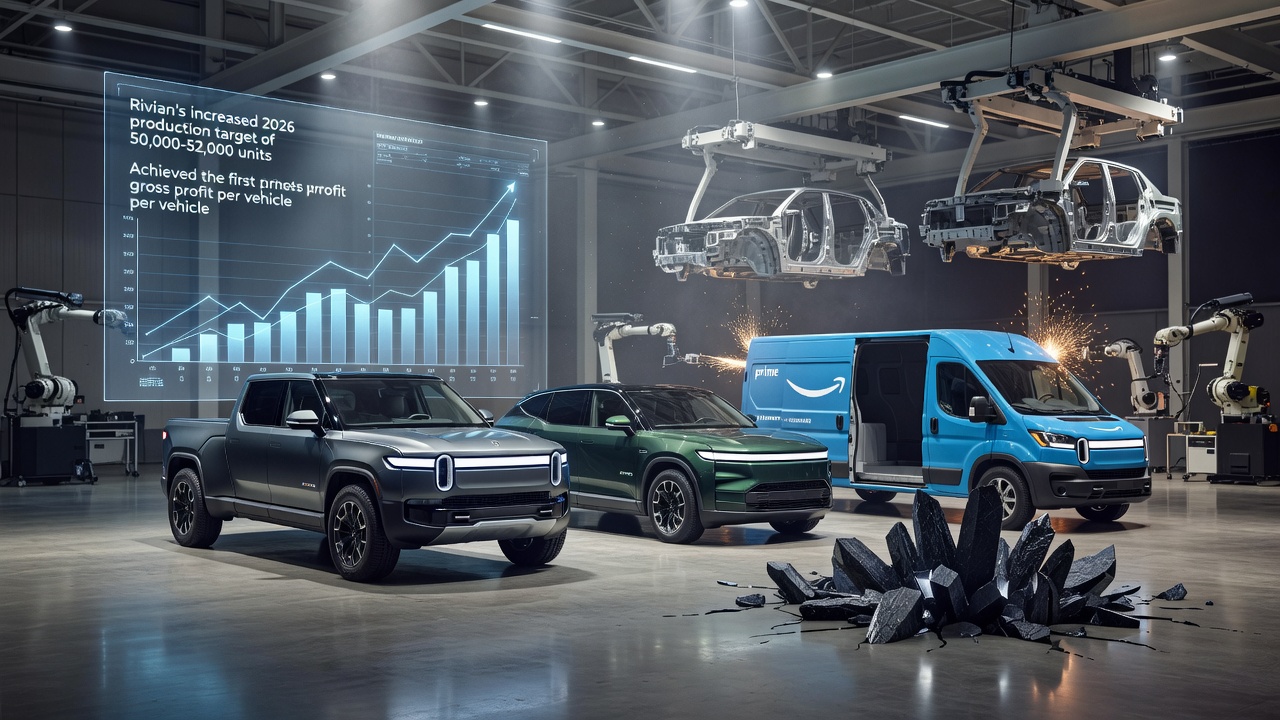
Rivian Automotive has adjusted its production targets upward for the current year while maintaining a cautious stance on profitability timelines, creating a notable contrast with Tesla’s recent market performance and strategic positioning. The electric vehicle maker now anticipates building between 50,000 and 52,000 vehicles in 2026, an increase from its previous forecast of 45,000 to 50,000 units. This revision reflects stronger-than-expected demand for its R1T pickup trucks and R1S SUVs, alongside growing contributions from its commercial van business with Amazon.
The announcement comes at a time when both companies face intense pressure to demonstrate progress toward sustainable profitability in the competitive electric vehicle sector. Rivian shares reacted positively to the updated guidance, climbing more than 8 percent in after-hours trading following the release. Investors appeared encouraged by the company’s ability to ramp up output while controlling costs more effectively than many analysts had anticipated.
According to details outlined in a Motley Fool analysis, Rivian has made meaningful strides in its manufacturing efficiency at its Normal, Illinois plant. The company reported gross profit on each vehicle sold in the first quarter of 2026, marking an important milestone after years of substantial losses on every unit produced. This achievement stems from several factors, including higher average selling prices, improved supply chain management, and the benefits of increased production volume spreading fixed costs across more vehicles.
Tesla, by comparison, has experienced a more challenging period in recent months. The company delivered 384,122 vehicles globally in the second quarter of 2026, representing a 13 percent decline from the same period a year earlier. Multiple factors contributed to this slowdown, including softening demand in key markets like Europe and China, increased competition from established automakers, and the lingering effects of price cuts implemented throughout 2025 to stimulate sales.
Despite these headwinds, Tesla maintains significant advantages in several areas. Its extensive Supercharger network continues to provide a meaningful edge in consumer convenience, particularly for long-distance travel. The company’s energy storage business has also shown remarkable growth, with Megapack deployments expanding rapidly and contributing to overall revenue diversification. Tesla’s autonomous driving technology remains at the forefront of industry development, though regulatory hurdles continue to slow the deployment of full self-driving capabilities across its fleet.
Rivian’s path forward centers on several key initiatives that could determine whether its upward trajectory proves sustainable. The company has begun initial production of its R2 model, a more affordable SUV priced around $45,000 that targets a broader consumer base than its flagship R1 vehicles. This model represents a critical step in Rivian’s strategy to move beyond the luxury segment and compete more directly with offerings from Tesla, Ford, and General Motors.
The commercial vehicle segment also holds substantial promise for Rivian. Its partnership with Amazon includes a commitment to deliver up to 100,000 electric delivery vans by 2030. As of mid-2026, Rivian had produced approximately 15,000 of these vans, with deployment rates accelerating as Amazon expands its electric fleet across major metropolitan areas. This business provides Rivian with more predictable revenue streams compared to consumer sales, which can fluctuate based on economic conditions and consumer sentiment.
Production challenges have historically plagued Rivian since its public debut in 2021. Early manufacturing issues, including parts shortages and quality control problems, resulted in significant delays and contributed to mounting losses. The company has addressed many of these concerns through targeted investments in automation and supplier relationships. Its current output rate of roughly 1,500 vehicles per week suggests the production line has achieved a level of stability that allows for consistent scaling.
Financial metrics reveal the extent of Rivian’s progress. The company reported revenue of $1.8 billion in the first half of 2026, representing a 45 percent increase from the previous year. While still operating at a net loss, the gap has narrowed considerably as production volumes rise and per-vehicle costs decline. Management has indicated that additional cost reductions are expected throughout the remainder of 2026 as new manufacturing techniques are implemented and component prices continue to moderate.
Tesla’s financial position remains considerably stronger despite its recent delivery declines. The company generated over $25 billion in automotive revenue during the first six months of 2026, supported by its massive scale and operational efficiencies developed over more than a decade of electric vehicle production. Its cash reserves exceed $30 billion, providing substantial flexibility to weather market fluctuations and invest in future technologies.
The competitive dynamics between these two companies extend beyond simple production numbers. Tesla has pursued vertical integration aggressively, manufacturing its own batteries, motors, and many other components in-house. This approach has allowed for rapid innovation cycles and cost advantages that newer entrants like Rivian struggle to match. Rivian, conversely, relies more heavily on partnerships with established suppliers, including Samsung for battery cells and various automotive parts manufacturers for chassis components.
Market reception of their respective vehicles highlights different consumer preferences. Rivian has cultivated a loyal following among buyers who prioritize distinctive design, premium materials, and off-road capabilities. The R1T in particular has earned praise for its innovative features, such as the integrated gear tunnel and adaptable bed storage systems. Tesla’s vehicles appeal to a broader audience seeking maximum range, advanced technology features, and the cachet associated with the brand’s pioneering status in the electric vehicle space.
Looking ahead, both companies face significant capital requirements to support their growth ambitions. Rivian is constructing a second manufacturing facility in Georgia that will eventually produce the R2 and R3 models. This plant, expected to begin operations in 2028, represents a $5 billion investment that will substantially increase the company’s total production capacity. Tesla continues expanding its global footprint with new factories in Mexico and updates to existing facilities in the United States, China, and Germany.
The regulatory environment adds another layer of complexity to their operations. Both Rivian and Tesla benefit from federal tax incentives for electric vehicle production and consumer purchases, though these programs face periodic political scrutiny. California’s stringent emissions standards and similar regulations in other states create favorable conditions for electric vehicle adoption, while potential changes in federal policy could alter the competitive balance.
Consumer adoption patterns suggest the electric vehicle market continues expanding, albeit at a slower pace than many analysts predicted several years ago. Range anxiety has diminished as battery technology improves and charging infrastructure grows. However, higher interest rates have made vehicle financing more expensive, dampening demand particularly among middle-income buyers who represent the largest potential market segment.
Rivian’s decision to raise its production guidance signals confidence in its ability to overcome previous operational constraints. The company has reduced its cash burn rate significantly over the past two years through careful expense management and strategic prioritization of projects. This financial discipline has helped maintain investor support despite the substantial capital needs associated with scaling an automotive business.
Tesla’s challenges appear more related to demand generation than production capacity. The company has responded by introducing new variants, such as the refreshed Model Y and upcoming Robotaxi concepts, while simultaneously expanding its artificial intelligence initiatives. The integration of artificial intelligence across its product lines, from vehicle autonomy to factory optimization, represents a core element of Tesla’s long-term strategy.
Industry observers point to several factors that could influence the relative performance of these companies in coming quarters. Battery raw material prices have stabilized after significant volatility in previous years, benefiting both manufacturers. Supply chain improvements have eased some of the pressure that hampered production during the global semiconductor shortage. Consumer financing options have begun to improve as lenders gain more experience with electric vehicle residual values.
The commercial success of Rivian’s Amazon vans could provide valuable data on real-world performance and operating costs that might influence future fleet purchases by other companies. Similarly, Tesla’s energy business growth offers insights into how vehicle manufacturers might diversify beyond transportation into broader clean energy solutions.
Both companies continue investing heavily in research and development, though their approaches differ markedly. Rivian focuses primarily on vehicle design and user experience enhancements, while Tesla spreads its innovation efforts across multiple domains including battery chemistry, software development, and robotics. These divergent strategies reflect their respective stages of development and available resources.
The coming months will likely bring additional clarity regarding the sustainability of Rivian’s improved production rates and Tesla’s ability to reverse its delivery trends. Market analysts will closely monitor quarterly reports for indications of pricing power, margin expansion, and progress toward positive cash flow from operations. The electric vehicle sector’s maturation process continues, with these two manufacturers playing distinct but equally significant roles in shaping its future direction. Consumer preferences, technological advancements, and economic conditions will ultimately determine which approaches prove most effective in building lasting businesses in this demanding industry.


 WebProNews is an iEntry Publication