
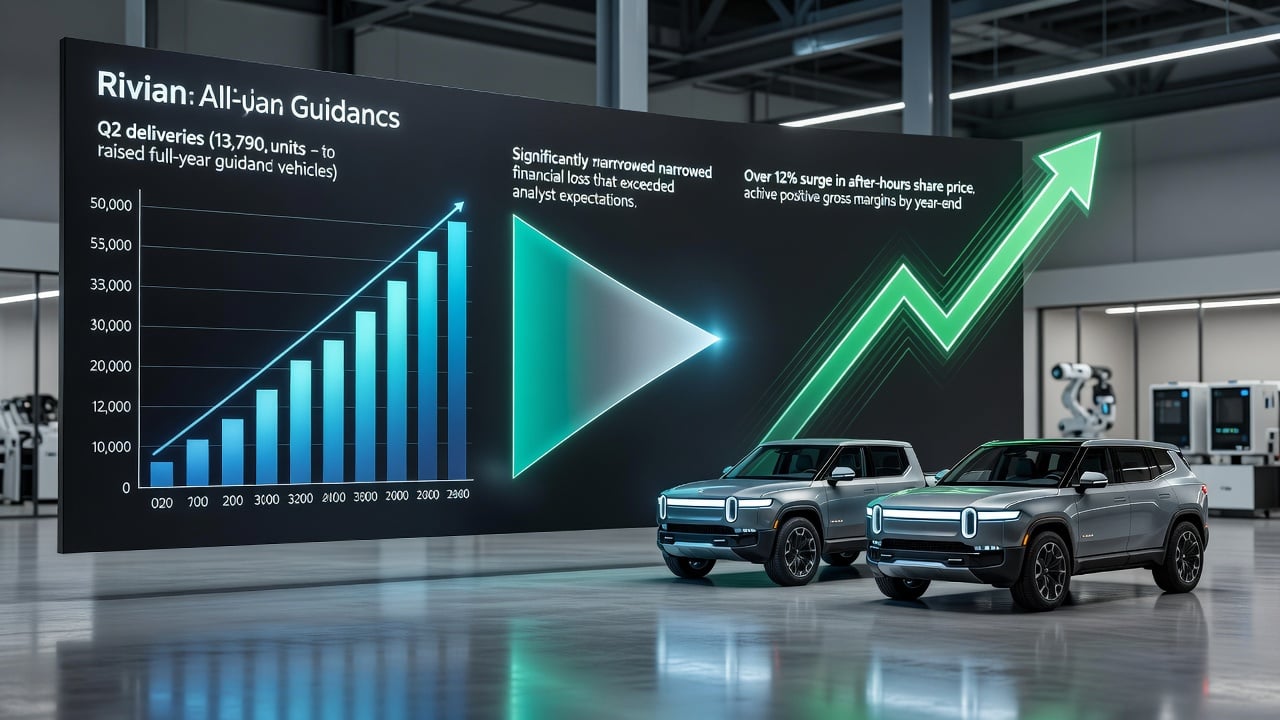
Rivian Automotive has lifted its full-year production and delivery guidance after posting stronger-than-expected second-quarter results, sending shares sharply higher in after-hours trading. The electric vehicle maker now expects to produce and deliver between 50,000 and 52,000 vehicles this year, up from the previous target range of 47,000 to 50,000 units. The revised outlook reflects continued operational improvements at its Illinois factory and better-than-anticipated demand for its R1T pickup truck and R1S sport utility vehicle.
According to the earnings report detailed on The Motley Fool, Rivian delivered 13,790 vehicles in the second quarter, a 15 percent increase from the first three months of the year. Production reached 13,981 units during the same period, demonstrating that the company has largely stabilized its manufacturing processes after earlier supply-chain disruptions. These figures represent meaningful progress for a company that delivered just under 14,000 vehicles in all of 2022.
The updated forecast comes as Rivian works through a multi-year transformation that includes tighter cost controls and the introduction of newer, more affordable models. Investors responded positively to the news, pushing the stock up more than 12 percent in extended trading. The move reflects renewed confidence that the business can achieve positive gross margins on its R1 vehicles by the end of this year, a key milestone the company has repeatedly highlighted.
Financial results for the quarter showed a narrowing loss compared with the same period a year earlier. Rivian reported an adjusted loss of $1.08 per share, which beat Wall Street expectations by a healthy margin. Total revenue climbed to $1.05 billion, driven almost entirely by vehicle sales. While the top-line figure still reflects the company’s relatively modest scale, the sequential improvement in both deliveries and average selling prices helped calm concerns about slowing momentum.
One of the more encouraging signals in the report involved commercial vehicle activity. Rivian continues to build electric delivery vans for Amazon, its largest outside investor. The partnership has provided valuable manufacturing experience and a steady revenue stream even as consumer EV demand has faced headwinds from high interest rates and economic uncertainty. Management indicated that van production is running smoothly and that further volume increases are planned for the second half of the year.
On the consumer side, Rivian has focused on improving the ownership experience through over-the-air software updates and expanded service networks. The company now operates more than two dozen service centers across the United States, with additional locations scheduled to open before year-end. These centers handle everything from routine maintenance to collision repairs, addressing a frequent criticism that early EV startups lack the infrastructure legacy automakers have spent decades building.
The decision to raise guidance also coincides with encouraging developments in the broader EV market. Federal tax credits under the Inflation Reduction Act continue to support buyer interest, particularly for vehicles assembled in North America with qualifying battery components. Rivian’s R1 models currently qualify for the full $7,500 credit when customers lease rather than purchase, a structure the company has used to its advantage in recent quarters.
Looking ahead, Rivian is preparing to launch the R2 midsize SUV and a smaller R3 model in the next two to three years. These vehicles are expected to carry starting prices around $45,000, significantly below the $70,000-plus range where the R1T and R1S currently sit. By moving downmarket, Rivian hopes to attract a much larger pool of buyers who have so far found flagship electric trucks and SUVs too expensive. The company has already broken ground on a new manufacturing facility in Georgia that will eventually produce these lower-priced models at volumes far exceeding current Illinois output.
Cost reduction remains a central theme in every earnings call. Rivian has removed hundreds of millions of dollars from its bill of materials through design changes, supplier negotiations, and vertical integration of battery cell production. The company’s own battery factory in Georgia is scheduled to begin limited output next year, which should further reduce reliance on outside cell suppliers and improve per-vehicle profitability.
Management highlighted several operational metrics that illustrate the progress. The number of vehicles produced per day has risen steadily, and downtime for retooling has decreased. Quality issues that plagued early production batches have largely been addressed, leading to fewer warranty claims and higher customer satisfaction scores. These internal improvements matter because they directly support the path to positive gross margin, which the company still projects will occur during the fourth quarter.
The balance sheet remains solid despite heavy cash consumption typical of growth-stage EV companies. Rivian ended the quarter with roughly $6.5 billion in cash and equivalents, providing a runway that extends well into 2027 under current spending plans. Additional liquidity could come from strategic partnerships or government loans tied to domestic battery production. The company has already secured commitments from multiple state and federal programs designed to accelerate the transition to electric vehicles.
Wall Street analysts have generally reacted favorably to the raised guidance, though some caution that execution risk remains high. Achieving 52,000 deliveries would represent roughly 45 percent growth over 2025’s expected total, a pace that will require flawless performance through the traditionally slower summer months and a strong holiday sales period. Any resurgence of supply-chain problems or unexpected softening in consumer demand could quickly reverse recent gains.
Still, the tone from Rivian’s leadership has grown noticeably more confident. Executives pointed to strong reservation numbers and improving conversion rates as evidence that pent-up demand exists once economic conditions stabilize. The company has also expanded its marketing efforts, including a greater presence at outdoor and adventure events where its rugged vehicle design resonates with target buyers.
Competition in the electric truck segment continues to intensify. Ford’s F-150 Lightning, General Motors’ Silverado EV, and Tesla’s Cybertruck all vie for many of the same customers. Rivian differentiates itself through superior ride quality, advanced driver-assistance features, and a focus on adventure capability that includes specialized gear for camping and overlanding. Whether that brand positioning can sustain premium pricing will become clearer as more affordable alternatives reach the market.
The second-quarter results also provided an early look at how the R1 vehicles are holding value in the used market. Data from third-party trackers show Rivian trucks and SUVs retaining value better than many other new electric models, a positive sign for long-term brand strength. Strong resale values help reduce the total cost of ownership and make the vehicles more attractive to buyers wary of rapid depreciation.
As production volumes climb, Rivian must also scale its supplier base and logistics network. The company has added several new North American vendors to reduce ocean freight exposure and shorten lead times. These moves not only cut costs but also support the company’s messaging around building an American-made product.
Employee headcount has stabilized after earlier rounds of layoffs aimed at improving efficiency. The current workforce appears well-aligned with near-term production targets, though further hiring will be needed once the Georgia plant begins meaningful output. Training programs focused on battery assembly and high-voltage systems have become central to maintaining quality as the company grows.
Investors will watch the third-quarter report closely for confirmation that the raised guidance remains achievable. Key metrics to monitor include average transaction price, warranty expense trends, and any updates on the timeline for R2 production. The market will also look for commentary on how recent tariff changes and potential shifts in federal EV policy might affect future demand.
Rivian’s ability to raise its forecast in a period of economic uncertainty stands out among pure-play EV manufacturers. While many competitors have cut production targets or delayed launches, Rivian has managed to expand output and improve financial performance simultaneously. The stock’s positive reaction suggests that at least some investors believe the company has turned a corner.
The coming months will test whether that momentum can be sustained. Success depends on consistent execution at the factory, disciplined spending, and a market environment that continues to reward electric vehicles. If Rivian can hit the upper end of its new guidance and reach positive gross margin before year-end, it will mark a significant milestone in the company’s journey from startup to scaled automaker.
The revised outlook also carries implications for the wider EV supply chain. Higher production at Rivian means increased orders for batteries, semiconductors, aluminum castings, and countless other components. Suppliers that have partnered with the company stand to benefit, while those still waiting for meaningful volume may face renewed pressure to secure contracts elsewhere.
For customers who have placed reservations, the higher production target should translate into shorter wait times. Rivian has worked hard to clear the backlog that built up during earlier production ramp phases, and current lead times for new orders have improved considerably. This matters because long delivery windows have historically caused some buyers to cancel and look at more readily available gas-powered alternatives.
Overall, the second-quarter performance and raised guidance paint a picture of a company gaining traction on multiple fronts. Manufacturing discipline, cost focus, and steady demand have combined to create the conditions for upward revision. While challenges clearly remain, particularly around bringing new models to market profitably, Rivian has demonstrated an ability to adapt and improve that was not always evident in its earlier years.
The coming year will likely prove decisive in determining whether Rivian can translate operational progress into sustainable profitability. If the company meets or exceeds its targets and successfully launches the R2 on schedule, it could establish itself as a permanent fixture in the American automotive industry rather than a short-lived experiment in electric mobility. The stock’s reaction to the latest earnings suggests that investors are increasingly willing to bet on that outcome.


 WebProNews is an iEntry Publication