
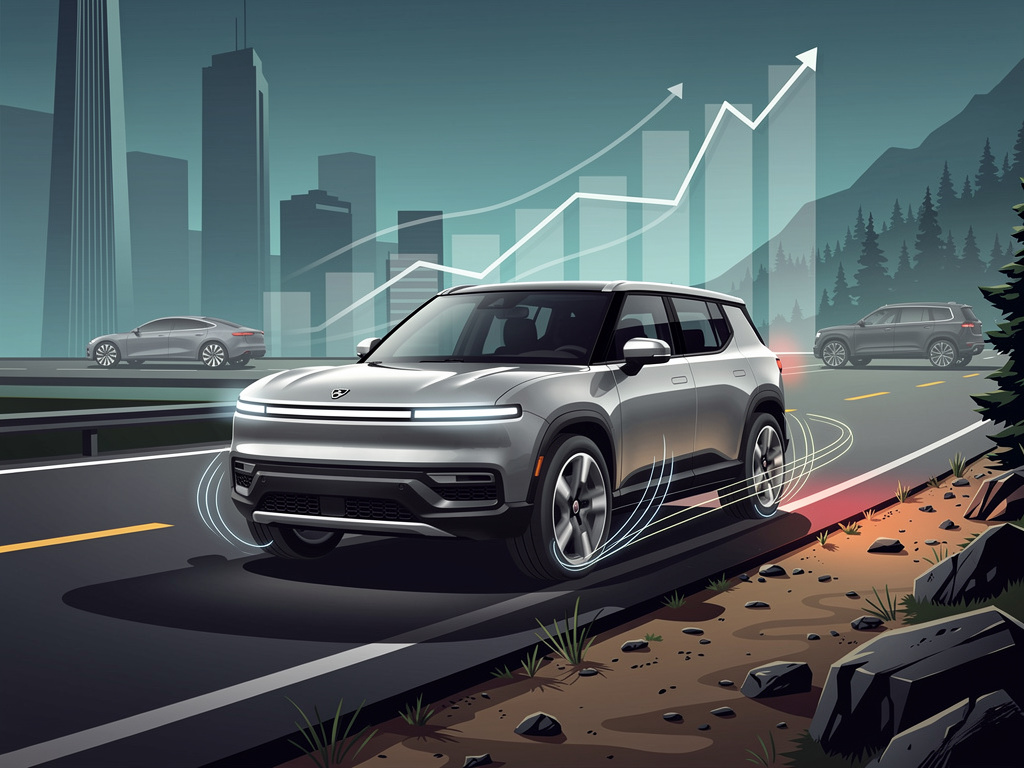
Rivian stands at a crossroads. Its R1 trucks and SUVs won praise for bold design and genuine off-road talent. Yet high prices kept sales modest and profits distant. The new R2 changes that equation. Smaller, lighter and far less expensive, this compact electric SUV aims straight at families who crave capability without the six-figure commitment.
Early drives of pre-production examples paint an encouraging picture. Tim Stevens of Engadget spent a full day with the top Performance trim and declared it Rivian’s best effort yet. “After a day of driving, I found myself liking it a lot more than the R1S,” he wrote. The verdict carries weight. Where the larger R1S feels premium but imposing, the R2 strikes a balance that feels right-sized for daily use and weekend escapes alike.
Size tells part of the story. The R2 measures roughly 15 inches shorter than the three-row R1S. Its footprint aligns closely with a Tesla Model Y. That alone broadens its appeal. But the real hook sits in the sticker. Rivian set the initial Performance with Launch Package at $57,990. A base model targeting $45,000 arrives later in 2027. In between come Premium variants starting around $53,990. These figures position the R2 against both premium EVs and traditional gas crossovers such as the BMW X3 or Toyota 4Runner.
Under the skin, engineers made deliberate trade-offs to hit those prices. The R2 adopts a unibody structure with a structural battery pack that contributes to torsional rigidity. It weighs about 200 pounds less than the R1S while delivering 23 percent greater stiffness, according to data shared with MotorTrend. Steel springs replace the R1’s sophisticated air suspension. Adaptive dampers remain on higher trims, though with a single valve handling both compression and rebound instead of separate controls.
Yet the driving experience doesn’t suffer. MotorTrend testers noted the R2 “wafts gently over heaves in the road” in its softest All Purpose setting. Switch to Sport and the dampers firm up without turning harsh. The ride stays composed where earlier R1 vehicles sometimes felt busy over rough pavement. Steering feels light but precise enough for confident highway work. And acceleration? The dual-motor Performance version hits 60 mph in 3.6 seconds with 656 horsepower and 609 pound-feet of torque. Even the rear-drive Standard model promises 350 horsepower.
Off-road, the R2 holds its own. Ground clearance reaches 9.6 inches. Approach and departure angles measure 25 and 26 degrees. During testing near Irvine, California, and in Utah trails, the SUV tackled steep climbs, rock sections and water crossings without drama. Open differentials and brake-based traction control replace the R1’s more advanced torque-vectoring setup. The system works. Drivers hear a wheel spin for a split second before brakes clamp down and forward progress continues. It lacks locking diffs, so serious rock crawlers may look elsewhere. For most adventure drivers, the capability feels ample.
Range estimates run from 265 miles on the entry model to more than 330 miles on the Performance variant with its 88-kilowatt-hour usable battery. DC fast charging peaks at 230 kilowatts, enough for a 10-to-80 percent top-up in under 30 minutes. Real-world testing on all-terrain tires still delivered over 300 miles in some reports, a promising sign for road-trippers.
Inside, the cabin carries familiar Rivian touches yet feels more approachable. Rear legroom and headroom measure a class-competitive 40.4 inches each. The low beltline and upright glass give commanding views outward, a trait MotorTrend compared favorably to the Tesla Model Y, which “feels like a car by comparison.” Materials avoid any budget feel. Two oversized haptic scroll wheels on the steering wheel, dubbed Haptic Halos, control volume, mirrors and drive modes with variable resistance. They occasionally lag or feel clumsy, yet they restore some physical interaction in a screen-dominated interior.
That 15.6-inch central touchscreen handles most functions. The software responds quickly thanks to a powerful Qualcomm processor. Still, gaps remain. Voice recognition is absent at launch and promised via over-the-air update. Android Auto and Apple CarPlay won’t appear either. Rivian integrates its own navigation, music and podcast apps, but the lack of phone projection feels dated. These omissions drew criticism from Stevens, who called them “archaic” even as he praised the overall execution.
Autonomy features add another layer. Standard driver aids include automatic emergency braking and lane keeping. The optional Autonomy+ package, priced at a one-time $2,500 or about $50 monthly, enables hands-free driving on mapped roads. A future lidar-equipped version with a more powerful Rivian processor targets Level 3 capability in limited conditions. Compared with Tesla’s more expensive Full Self-Driving subscription, Rivian’s approach looks competitive on paper.
Production realities loom large. Rivian began building early R2 units earlier this year and set an ambitious target of 20,000 to 25,000 deliveries in 2026, as reported by InsideEVs. Only the original Tesla Model Y ramped that fast among recent EVs. CEO RJ Scaringe has raised the Normal, Illinois, plant’s potential R2 capacity toward 175,000 units annually. Success here could stabilize the company. Failure would raise fresh questions about its future.
Recent updates show momentum. As of today, Rivian started sending order invitations to reservation holders, with first customer deliveries and demo drives beginning, the company announced on X. That timing aligns with the June 9 launch milestone reported across multiple outlets. Pricing and trim rollouts remain on track, with Performance models leading followed by Premium and then the cheaper rear-drive versions.
Analysts and journalists alike see the R2 as Rivian’s make-or-break product. Car and Driver noted a “refined ride, confident handling, and quick acceleration” in its prototype test. Edmunds echoed that the vehicle retains a “cool factor” others lack while targeting a broader audience of both EV converts and gas buyers seeking something different. The R2 doesn’t try to outdo the R1 in every metric. Instead it refines the formula, trims cost without slashing character, and delivers an SUV that feels fun on pavement and competent when the pavement ends.
Critics still flag areas for improvement. Software maturity will determine long-term satisfaction. Range on base models could prove marginal for some owners. Off-road hardware stays conservative compared with dedicated trail machines. Yet the consensus after these first drives tilts positive. The R2 drives like a Rivian. It just happens to cost less, fit in more garages, and invite more people along for the ride.
That combination could prove decisive. In a market where many EVs struggle for traction, a capable, desirable and genuinely attainable adventure vehicle stands out. Rivian bet the company on this moment. Early signs suggest the wager may pay off.


 WebProNews is an iEntry Publication