
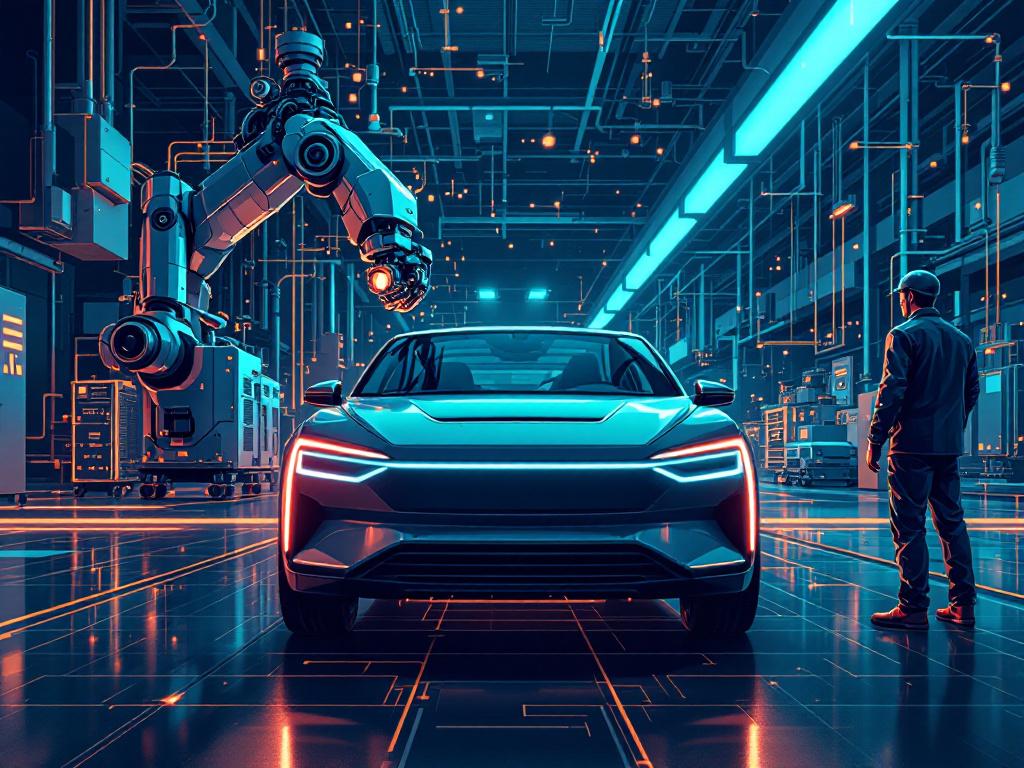
Rivian’s Robotic Gambit: Spinning Off AI to Revolutionize Factories
Electric vehicle maker Rivian Automotive Inc. is venturing beyond its core business of trucks and SUVs, launching a new spinoff company focused on artificial intelligence and robotics. This move mirrors strategies employed by industry giant Tesla Inc., signaling a broader shift among automakers toward advanced automation technologies. The new entity, dubbed Mind Robotics, aims to harness AI for industrial applications, particularly in manufacturing and operations.
Rivian, known for its adventure-oriented electric vehicles like the R1T pickup and R1S SUV, has been quietly developing these technologies internally. The decision to spin them out into a separate company allows Rivian to attract external investment and talent while keeping its primary focus on vehicle production. According to reports, Mind Robotics has already secured significant funding, positioning it as a key player in the growing field of industrial AI.
This development comes at a pivotal time for Rivian, which has faced challenges in scaling production and managing costs amid a competitive EV market. By creating Mind Robotics, Rivian not only diversifies its portfolio but also leverages its operational data to build smarter systems. Industry observers see this as a strategic pivot, potentially opening new revenue streams outside of vehicle sales.
From EV Pioneer to Tech Innovator
The origins of Mind Robotics trace back to Rivian’s efforts to optimize its own factories. The company has been integrating AI-driven robots to streamline assembly lines, reduce errors, and boost efficiency. Spinning this out allows the technology to be applied more broadly, from logistics to other manufacturing sectors. As detailed in a TechCrunch article, this is Rivian’s second spinoff this year, following the creation of a micromobility company called Also in March.
Funding for Mind Robotics is robust, with reports indicating a $115 million seed round led by investors like Eclipse. Rivian’s founder and CEO, RJ Scaringe, will serve as chairman of the new venture, ensuring close ties between the parent company and the spinoff. This structure enables Rivian to benefit from the technology’s advancements without diluting its core automotive focus.
Comparisons to Tesla are inevitable. Elon Musk’s company has long invested in robotics, from its Optimus humanoid robot to AI systems for autonomous driving and factory automation. Rivian appears to be following a similar playbook, using its EV expertise as a springboard into adjacent tech areas. Posts on X, formerly Twitter, highlight this sentiment, with users noting how automakers are increasingly viewing robotics as essential for future competitiveness.
Tesla’s Shadow and Rivian’s Edge
Tesla’s influence is evident in Rivian’s approach. Tesla has pioneered the use of AI in manufacturing, deploying robots that learn from data to improve over time. Rivian’s Mind Robotics aims to build on this by focusing on “physical AI,” where machines interact intelligently with the real world. An article from Observer describes how the spinoff will use AI-powered robots for industrial tasks, backed by substantial funding to accelerate development.
What sets Rivian apart is its emphasis on data from real-world operations. Rivian’s factories generate vast amounts of information on vehicle assembly, which Mind Robotics can use to train its AI models. This data-driven strategy could give it an advantage in creating adaptable robotic systems that evolve with user needs, unlike more rigid traditional automation.
Market analysts point out that this move helps Rivian address financial pressures. With EV demand fluctuating and competition from established players like Ford and GM intensifying, diversifying into high-growth areas like AI robotics makes sense. Recent X posts from industry watchers, such as those praising Rivian’s lead in autonomy behind Tesla, underscore the excitement around this expansion.
Funding Fuels Ambition
The $115 million seed funding for Mind Robotics is a testament to investor confidence in Rivian’s vision. Led by Eclipse, with participation from other venture firms, this capital will support research and development in AI algorithms tailored for industrial environments. As reported in eWeek, Scaringe’s role as chairman ensures strategic alignment, while the spinoff operates independently to foster innovation.
This isn’t Rivian’s first foray into spinoffs. Earlier this year, the company launched Also, focusing on electric bikes and micromobility solutions. Both moves reflect a strategy to monetize internal innovations separately, potentially valuing them higher in the venture market than if kept in-house. Rivian’s approach echoes how tech giants like Alphabet spin out moonshot projects.
Broader industry trends support this direction. Automakers are increasingly investing in AI to cut costs and improve efficiency. General Motors and others have followed Tesla’s lead, but Rivian’s focus on industrial AI could carve out a niche. X discussions often compare Rivian favorably to Tesla, noting its data advantages from a large EV fleet for AI training.
Technological Foundations and Challenges
At the heart of Mind Robotics is the concept of using Rivian’s operational data as a foundation for AI models. This includes sensor data from vehicles and factories, enabling robots to perform complex tasks like predictive maintenance or adaptive assembly. A piece from Autoblog highlights how Rivian is emulating Tesla by venturing into AI-driven robotics for industrial automation, a market projected to grow rapidly.
However, challenges abound. Developing reliable physical AI requires overcoming hurdles in machine learning, such as ensuring safety in dynamic environments. Rivian must also navigate intellectual property issues and competition from established robotics firms like Boston Dynamics or ABB. Despite these, the spinoff’s funding provides a strong start.
Integration with Rivian’s existing operations will be key. Mind Robotics’ technologies could first be deployed in Rivian’s Illinois factory, testing AI robots in real EV production. This iterative approach mirrors Tesla’s method of refining its tech through internal use before broader application.
Market Implications and Investor Sentiment
The launch of Mind Robotics has stirred investor interest, with Rivian’s stock reacting positively to the news. Analysts see this as part of a bull case for the company, especially amid margin improvements and production ramps. According to InsideEVs, the spinoff positions Rivian to venture into new areas, much like Tesla’s diversification.
On X, sentiment is bullish, with posts from users like Quincy Lee asserting Rivian’s potential as the next big player in autonomy and robotics after Tesla. This reflects a growing consensus that EV makers must expand into AI to stay relevant, especially as autonomous driving and smart manufacturing converge.
Rivian’s partnership with Volkswagen, announced earlier, could amplify these efforts. The $5 billion investment from VW includes joint software development, which might extend to robotics. X posts from sources like Morning Brew highlight this lifeline, suggesting it bolsters Rivian’s tech ambitions.
Strategic Vision and Future Horizons
RJ Scaringe’s leadership is central to this narrative. As a visionary akin to Musk, Scaringe has steered Rivian from startup to public company, raising billions despite market headwinds. Mind Robotics fits into his broader goal of transforming transportation and industry through technology.
Looking ahead, Mind Robotics could expand beyond automotive, targeting sectors like warehousing or healthcare. This scalability is a key attraction for investors, as noted in Rivian Forums discussions, which emphasize using Rivian data for foundational AI in physical businesses.
Potential risks include regulatory scrutiny on AI and robotics, particularly in safety-critical applications. Yet, Rivian’s track record in EVs provides credibility. X users often cite Rivian’s sensor tech and data collection as strengths, positioning it ahead of rivals except Tesla.
Innovation Ecosystem and Collaborative Potential
Rivian’s spinoff strategy fosters an ecosystem of innovation. By creating standalone ventures, it attracts specialized talent and partnerships. For instance, Mind Robotics could collaborate with AI firms or universities, accelerating breakthroughs in machine perception and control systems.
This model draws from Silicon Valley playbooks, where companies like Google spin out units to pursue ambitious projects. Rivian’s execution, as covered in Dataconomy, shows a commitment to reshaping industrial operations through AI.
Furthermore, the spinoff aligns with Rivian’s upcoming AI Day, teased in recent announcements. Investors are buzzing about potential reveals in autonomy, per InvestorsObserver, which could integrate robotics advancements.
Broader Industry Shifts and Rivian’s Role
The rise of AI in manufacturing signals a transformation in how goods are produced. Rivian’s entry via Mind Robotics positions it as a disruptor, challenging traditional automation providers. This could lead to more efficient, sustainable factories, reducing waste and energy use.
Comparisons to Tesla extend to valuation. While Tesla’s market cap reflects its AI prowess, Rivian’s spinoffs might unlock similar value. Yahoo Finance analysis, found in Yahoo Finance, suggests margin gains and the robotics spin-off strengthen Rivian’s investment case.
X conversations reinforce this, with users noting Rivian’s EV fleet as a data goldmine for AI, surpassing competitors like Waymo in scale. As Rivian pushes forward, Mind Robotics could define its legacy beyond electric vehicles, cementing its place in the tech-driven future of industry.


 WebProNews is an iEntry Publication