
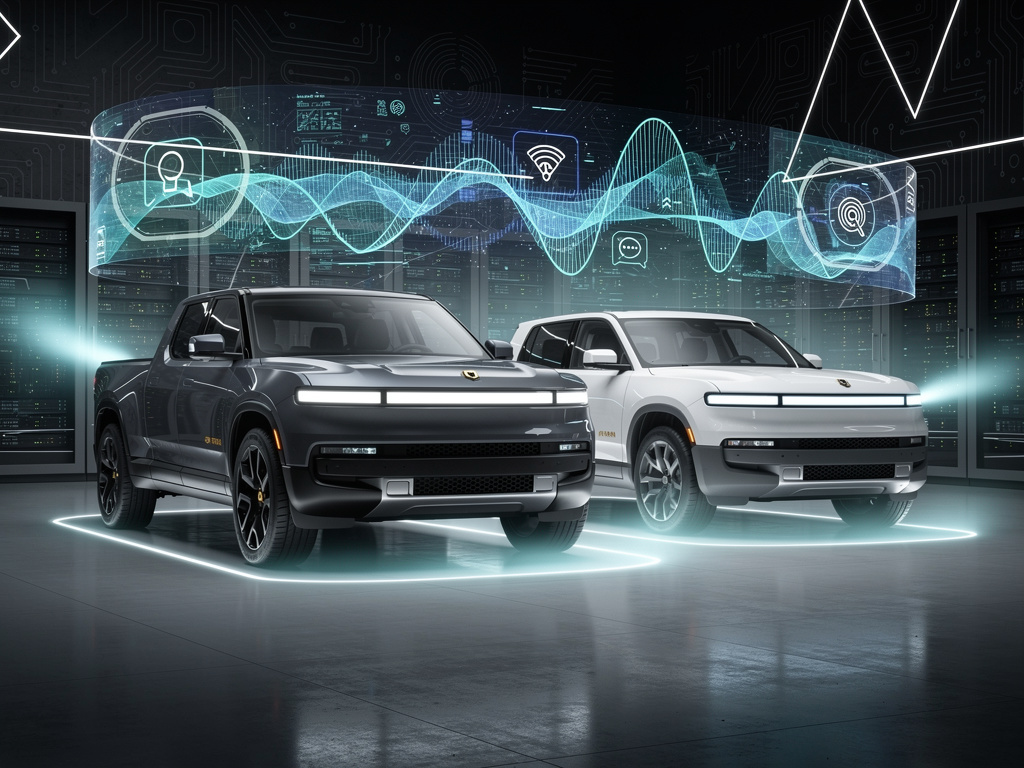
Rivian’s Ambitious Push: Forging an In-House AI Companion for Tomorrow’s Roads
Electric vehicle maker Rivian Automotive Inc. is charting a new course in the automotive sector by developing its own artificial intelligence assistant, a move that underscores the company’s drive to integrate advanced technology directly into its lineup of trucks and SUVs. This initiative, which has been underway for nearly two years, aims to enhance the in-cab experience for drivers, offering features like seamless voice-activated text messaging and potentially more sophisticated interactions. According to reports, Rivian plans to unveil more details during its AI & Autonomy Day event on December 11, a gathering that promises to shed light on how this AI will fit into the broader ecosystem of vehicle autonomy.
The development comes at a time when automakers are increasingly turning to AI to differentiate their products in a competitive market. Rivian’s chief software officer, Wassym Bensaid, has highlighted the shortcomings of existing voice systems in vehicles, noting issues like missed messages, poor support for group chats, and inconsistent emoji handling. By building its own solution, Rivian seeks to deliver a “rich experience” that aligns with its brand’s emphasis on innovation and user-centric design. This isn’t just about convenience; it’s part of a larger strategy to make vehicles more intuitive and connected, potentially integrating with Rivian’s existing software ecosystem that includes over-the-air updates and advanced driver-assistance systems.
Sources indicate that this AI assistant is being developed independently from Rivian’s multi-billion-dollar technology joint venture with Volkswagen, allowing the company to maintain control over its proprietary tech stack. The assistant is expected to debut in 2025 for models like the R1T pickup and R1S SUV, starting with basic functionalities such as text-to-speech messaging. Industry observers suggest this could evolve into a more comprehensive system, handling tasks from navigation to vehicle diagnostics, drawing on machine-learning algorithms that process real-time data from the vehicle’s sensors.
Unveiling the Tech Behind Rivian’s AI Vision
Rivian’s approach to AI development reflects a commitment to in-house expertise, as evidenced by its recruitment of talent in software and autonomy fields. The company’s vice president for autonomy and AI, James Philbin, has discussed the scalable autonomy platform in Gen 2 vehicles, which forms the foundation for higher levels of self-driving capabilities. This platform leverages machine-learning to interpret the environment, enabling features like Enhanced Highway Assist for hands-free driving on highways. Posts on X from Rivian’s official account highlight how these algorithms process the world in real time, suggesting the AI assistant will build on this to provide contextual responses, such as adjusting routes based on traffic or energy consumption.
In a conversation shared via BusinessWire, Rivian announced the AI & Autonomy Day will be livestreamed from its Palo Alto offices, offering a deep look into its progress. Attendees and viewers can expect demonstrations of hands-off driving features, which are part of Rivian’s roadmap toward “eyes-off” autonomy by 2026. This aligns with broader industry trends where AI isn’t just a gimmick but a core component of vehicle intelligence, helping to optimize everything from battery efficiency to predictive maintenance.
Comparisons to rivals like Tesla, which has long touted its Full Self-Driving suite, are inevitable. However, Rivian’s focus appears more grounded in immediate user benefits rather than fully autonomous promises. For instance, the upcoming assistant addresses pain points in current voice systems, as Bensaid explained in showroom discussions reported by various outlets. This targeted innovation could give Rivian an edge in customer satisfaction, especially among adventure-seeking owners who value seamless tech integration during off-road excursions.
Strategic Implications for Rivian’s Market Position
As Rivian ramps up production and expands its model lineup, embedding a custom AI assistant positions the company as a tech-forward player in the electric vehicle arena. Financial analysts note that such investments are crucial for long-term competitiveness, particularly as consumer expectations for smart vehicles rise. A report from Edmunds confirms the 2025 rollout, emphasizing how the assistant will handle voice text messaging to keep drivers focused on the road. This feature alone could reduce distractions, aligning with safety regulations and enhancing Rivian’s appeal to families and professionals.
The development timeline—spanning almost two years—indicates a deliberate pace, allowing Rivian to iterate based on user feedback from its existing fleet. Software updates, as detailed in Rivian’s X posts, have already introduced enhancements like Co-Steer for lane adjustments and an Energy app for trip planning. These incremental improvements suggest the AI assistant will integrate smoothly, perhaps using voice commands to access these tools without manual input. Moreover, Rivian’s partnership with NVIDIA, discussed by CEO RJ Scaringe in a podcast, underscores the use of cutting-edge hardware to power AI computations, ensuring low-latency responses even in challenging conditions.
Looking ahead, the AI & Autonomy Day could reveal how this assistant ties into Rivian’s ambitious goals for driverless technology. InsideEVs reported Scaringe’s vision of vehicles so autonomous by 2030 that owners won’t need to be present, a bold claim that hinges on AI advancements. This event, as previewed in Engadget, will likely cover hands-free features, providing a roadmap that investors and enthusiasts are eagerly awaiting. For industry insiders, this represents a pivot toward software as a revenue driver, with potential subscriptions for premium AI functionalities.
Challenges and Opportunities in AI Integration
Despite the excitement, Rivian faces hurdles in bringing its AI assistant to market. Data privacy concerns loom large, as voice assistants collect sensitive information. The company must navigate regulations like those from the National Highway Traffic Safety Administration, ensuring that AI-driven features don’t compromise safety. Additionally, competition from established players like Amazon’s Alexa or Google’s Assistant, which some automakers integrate, means Rivian must prove its in-house solution is superior in accuracy and personalization.
On the opportunity side, Rivian’s vertical integration—controlling both hardware and software—allows for tailored optimizations. For example, the AI could leverage Rivian’s proprietary battery management systems to provide real-time advice on charging schedules, as seen in recent software updates promoting smart charging. Posts on X from Rivian highlight features like Charging Schedule Recommendation, which finds cost-effective times, indicating how the assistant might expand into energy management, a key differentiator in the EV space.
Industry experts, drawing from reports like those in BizToc, suggest this development is part of Rivian’s broader investment in proprietary tech, including electric powertrains and autonomous systems. By keeping the AI separate from its Volkswagen joint venture, Rivian preserves intellectual property, potentially licensing it in the future. This strategy could bolster its valuation, especially as the company scales production amid economic pressures.
Rivian’s Broader Innovation Ecosystem
Rivian’s AI push doesn’t exist in isolation; it’s woven into a tapestry of ongoing innovations. Recent X updates from the company showcase aesthetic enhancements like the limited-edition Borealis color, inspired by natural phenomena, and special editions like the Miami Edition vehicles. These creative endeavors highlight Rivian’s brand as one that blends technology with artistry, appealing to a demographic that values both performance and style.
In terms of autonomy, Rivian’s Gen 2 vehicles already feature enhanced visualizations of surroundings, making drivers more aware of potential hazards. The AI assistant could amplify this by providing verbal alerts or suggestions, evolving from reactive to proactive assistance. Financial content from WRAL notes the company’s heavy investments in hands-free systems for 2025, positioning it to capture market share in the growing autonomous vehicle segment.
Furthermore, collaborations like the one with NVIDIA point to a future where AI enables not just convenience but transformative experiences, such as remote vehicle operation. As Scaringe envisions, by 2030, Rivian vehicles might operate independently, reshaping logistics and personal mobility. This long-term view, supported by TechCrunch’s initial reporting on the assistant’s development, suggests Rivian is betting big on AI to define its identity beyond just electric trucks.
Pioneering the Next Wave of Vehicle Intelligence
As the December 11 event approaches, anticipation builds for concrete demonstrations of the AI assistant’s capabilities. Will it support natural language processing for complex queries, like planning multi-stop adventures with charging optimization? Or integrate with smart home devices for a seamless ecosystem? These questions underscore the potential for Rivian to lead in user-focused AI, much like how Apple revolutionized personal computing.
Critics might argue that developing an in-house assistant diverts resources from core manufacturing, but proponents see it as essential for differentiation. With EV adoption accelerating, features that enhance daily usability could drive loyalty. Rivian’s software-first mindset, evident in frequent updates, positions it well to iterate on the assistant post-launch, incorporating user data to refine performance.
Ultimately, this initiative reflects Rivian’s ethos of pushing boundaries, from off-road prowess to cutting-edge tech. As the company navigates production ramps and market dynamics, its AI assistant could become a hallmark feature, blending innovation with practicality to redefine what drivers expect from their vehicles. With details emerging soon, the automotive world watches closely, eager to see how Rivian turns its two-year effort into a game-changing reality.


 WebProNews is an iEntry Publication