
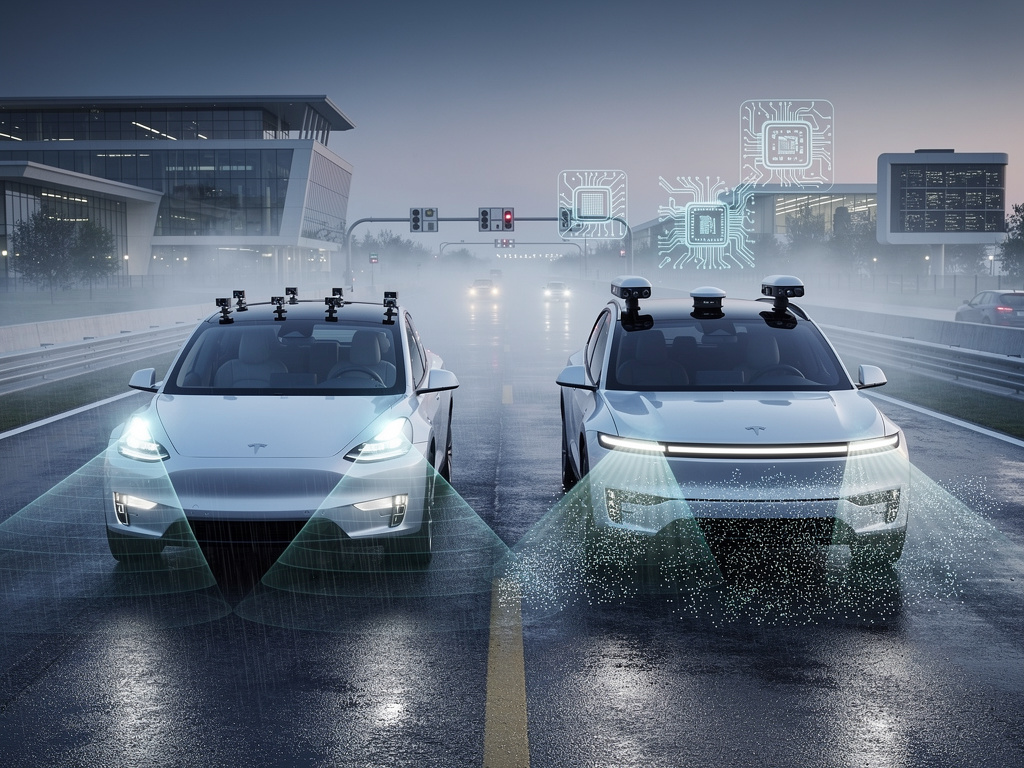
Rivian’s Sensor Gambit: Unmasking the Hidden Flaws in Tesla’s Vision-Only Autonomy
In the rapidly evolving world of electric vehicles and autonomous driving, a new chapter is unfolding that pits innovative upstarts against established giants. Rivian, the adventure-focused EV manufacturer, recently made waves at its Autonomy & AI Day by unveiling a suite of technologies that directly challenge Tesla’s dominance in self-driving systems. At the heart of this confrontation is a fundamental debate over how cars perceive the world: through cameras alone, as Tesla insists, or via a multi-sensor array including lidar and radar, as Rivian advocates. This isn’t just a technical spat; it’s a high-stakes battle that could redefine safety standards and market leadership in the automotive sector.
Drawing from recent announcements, Rivian’s approach integrates an in-house AI chip and advanced sensor fusion, promising hands-free driving on millions of miles of roads at a fraction of Tesla’s costs. According to coverage from The Verge, Rivian’s pivot to AI isn’t merely about catching up to Elon Musk’s company but about addressing perceived shortcomings in vision-only systems. Posts on X (formerly Twitter) from industry observers highlight real-world incidents where camera-based systems falter, such as mistaking billboard images for actual obstacles or failing in low-visibility conditions.
The MSN article titled “Tesla’s Missing Eye: Rivian Just Exposed the Fatal Blind Spot Hidden in Your Car’s AI Brain,” available at MSN, delves into how Rivian demonstrated scenarios where Tesla’s Full Self-Driving (FSD) suite encounters blind spots. For instance, in controlled tests, Rivian’s executives showcased how their lidar-equipped vehicles detect objects in fog or at long distances—capabilities that pure camera systems struggle with due to optical limitations.
The Sensor Fusion Revolution: Why Multi-Modal Systems Are Gaining Traction
Rivian’s strategy hinges on what they call “late-bound sensor fusion,” a method that processes data from cameras, radar, and lidar in real-time using neural networks. This contrasts sharply with Tesla’s early commitment to vision-only autonomy, which Elon Musk has championed as a more scalable and human-like approach. However, as noted in a Yahoo Finance interview with Rivian CEO RJ Scaringe, this vision-only path introduces vulnerabilities, particularly in edge cases like adverse weather or complex urban environments.
Industry insiders point to historical data: Tesla’s FSD has faced scrutiny from regulators following accidents attributed to perception errors. Rivian’s demonstration, as reported, included side-by-side comparisons where their system avoided pitfalls that ensnared Tesla’s, such as failing to detect a pedestrian in a blind spot caused by pillar obstructions. X posts from users like automotive engineers emphasize that A-pillar blind spots—areas where vehicle structure blocks camera views—remain a persistent issue in vision-dependent designs.
Moreover, Rivian’s in-house chip development allows for cost efficiencies, undercutting Tesla’s pricing. CNBC details how Rivian’s Autonomy+ subscription, at $2,500 upfront or $49.99 monthly, covers extensive mapping and updates, positioning it as a more accessible alternative. This pricing model not only challenges Tesla but also signals a broader shift toward subscription-based autonomy features across the industry.
Blind Spots Exposed: Real-World Implications for Driver Safety
The MSN piece highlights a particularly damning example: a simulated scenario where Tesla’s AI misinterprets a stationary vehicle due to lighting conditions, a flaw Rivian claims its lidar mitigates by providing precise depth measurements. This isn’t isolated; recent news from MotorTrend discusses how Rivian’s tech enables fuller autonomy on upcoming models like the R2, potentially surpassing Tesla in cost-effective highway driving.
On X, discussions abound about incidents like a LI Auto vehicle braking abruptly for a billboard illusion, underscoring the risks of over-relying on visual data. Rivian’s Scaringe, in the Yahoo Finance interview, argues that while cameras mimic human eyes, they lack the redundancy humans gain from experience and intuition—hence the need for supplementary sensors.
Critics of Tesla’s approach, including some X posters, note that hardware limitations, such as camera placement and lens distortion, exacerbate these issues. Rivian’s solution? A vertically integrated stack, from custom chips to AI models, as outlined in Technology.org, which claims coverage over 3.5 million miles of North American roads.
Competitive Pressures: Tesla’s Response and Market Dynamics
Tesla, for its part, has doubled down on its vision-only philosophy, with Musk tweeting about the superiority of end-to-end neural networks trained on vast datasets. Yet, Rivian’s announcements have sparked investor interest, with stock surges reported in TechStock². This competition is healthy, Scaringe told Yahoo Finance, as it pushes innovation and prevents monopolies in AI-driven mobility.
The broader implications extend to regulatory landscapes. With the National Highway Traffic Safety Administration probing Tesla’s FSD following crashes, Rivian’s multi-sensor advocacy could influence future standards. X sentiment reflects skepticism toward pure vision systems, with users citing fusion challenges Tesla allegedly faced early on, as per posts from tech analysts.
Rivian’s robotaxi ambitions, teased in the CNBC report, add another layer: by 2026, their R2 could offer point-to-point autonomy, directly rivaling Tesla’s Cybercab plans. This isn’t just about cars; it’s about ecosystems, where AI assistants and over-the-air updates create sticky customer loyalty.
Technological Deep Dive: Comparing Architectures
Diving deeper into the tech, Rivian’s “early-bound vs. late-bound” fusion debate, echoed in X threads, reveals why multi-modal might edge out vision-only in reliability. Tesla’s system reconciles discrepancies between sensors post hoc, but Rivian’s AI integrates them seamlessly, reducing noise—a point Clifford on X argues Tesla overlooked.
From the MSN article, Rivian’s demos exposed Tesla’s “fatal blind spot” in scenarios like detecting hidden cyclists or navigating construction zones. Heatmap News explores how Rivian’s lidar-equipped R2 aims to hit roads next year, potentially leapfrogging Tesla in urban autonomy.
Cost is a key differentiator. MotorTrend notes Rivian’s hardware beats Tesla on price per capability, thanks to proprietary designs. This could democratize advanced driver-assistance systems (ADAS), making them viable for mass-market EVs.
Industry Ripple Effects: Beyond Rivian and Tesla
The rivalry is spurring others: Ford and GM are investing in similar tech, per recent web searches. Rivian’s software updates history, detailed on RivianTrackr, shows a commitment to iterative improvements, contrasting Tesla’s sometimes erratic rollout pace.
X users like Kyle Conner shared uncut rides in Rivian’s prototypes, revealing smooth performance but also hiccups, such as near-misses at intersections—reminders that no system is perfect. The Verge article questions if Rivian’s AI chase is a rabbit hole or a breakthrough.
Ultimately, this exposes a philosophical divide: Tesla’s bet on scalable, camera-based AI versus Rivian’s redundant, sensor-rich path. As Scaringe told Yahoo Finance, competition benefits consumers, potentially accelerating safer autonomous tech.
Future Horizons: Challenges and Opportunities Ahead
Looking ahead, challenges loom. Rivian’s system, while promising, isn’t immune to issues; X videos show prototypes attempting to run red lights, highlighting software immaturity. Tesla, with its data advantage from millions of vehicles, could counter with software refinements.
Policy shifts, as in TechStock²’s EV news, might favor multi-sensor mandates, especially post-2025 regulations. Rivian’s undercutting of Tesla’s costs, per Technology.org, could reshape pricing norms.
For insiders, the real story is data sovereignty: Who controls the AI brains powering our roads? Rivian’s in-house push, as per Business Insider at Business Insider, includes an AI assistant, echoing Tesla’s but with sensor-backed accuracy.
Strategic Implications for Automakers Worldwide
Globally, this debate influences supply chains. Lidar costs are plummeting, enabling Rivian’s model, while Tesla’s vision focus minimizes hardware complexity. X discussions warn of compute demands for distortion correction in Rivian’s cameras, yet their fusion AI might offset this.
The MSN expose underscores a “missing eye” in Tesla’s setup—lacking lidar’s precision in blind spots. Heatmap News posits Rivian could beat Tesla to a true AI car, with R2’s 2026 launch.
Investors eye 2026 forecasts: Rivian’s surge, per TechStock², ties to Autonomy+ and chip tech, potentially eroding Tesla’s lead.
Navigating Uncertainty: Lessons from Early Adopters
Early adopters face tough choices. Rivian’s subscription, detailed in CNBC, offers flexibility, but reliability questions persist from X previews. Tesla’s ecosystem, with seamless integrations, retains appeal despite blind spot critiques.
Industry evolution demands balance: Redundancy for safety without overcomplication. As one X user noted, Rivian’s approach avoids Tesla’s “wall” in sensor reconciliation.
In this high-stakes arena, Rivian’s challenge illuminates paths forward, urging all players to address autonomy’s hidden flaws for a safer tomorrow.


 WebProNews is an iEntry Publication