
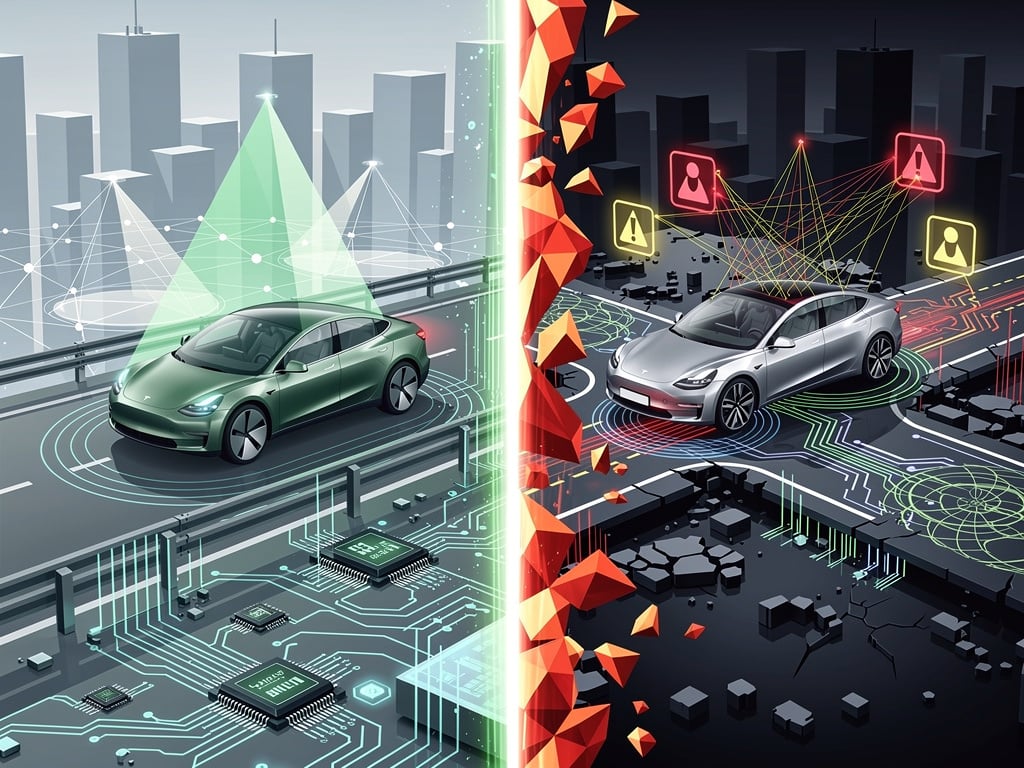
RJ Scaringe thinks Level 4 self-driving will arrive sooner than most expect. The Rivian founder and CEO laid out an aggressive timeline in recent interviews and at the company’s Autonomy & AI Day. Hands-off, eyes-off capability could come within 18 months. Full personal Level 4, where the vehicle operates empty, follows before the end of the decade. His confidence rests on hardware choices that differ sharply from Tesla’s vision-only strategy.
Scaringe doesn’t mince words. “Level four is going to be here much sooner than people think,” he told Top Gear in comments published just days ago. The executive pointed to Rivian’s combination of high-compute processors, LiDAR, radar and a growing fleet. That mix, he argues, lets the company train models faster on real-world edge cases.
But. Tesla’s approach draws fire from within. A Reuters investigation published May 28, 2026 revealed deep doubts among former data labelers and engineers who worked directly on Full Self-Driving. Seven of nine former labelers said they would not trust FSD to drive them. One put it bluntly: he wouldn’t ride in a Tesla robotaxi “if you fucking paid me.” Another veteran engineer who reviewed crash data for years called the company’s safety claims “bullshit” and added, “Definitely, don’t trust Elon on this.”
These insiders saw the system’s struggles daily. Specific teams focused on FSD’s problems recognizing school buses. The software often failed to yield to emergency vehicles, stop properly for pedestrians in crosswalks or handle construction zones without abrupt human intervention. Footage reviewed by labelers frequently captured high-risk incidents. “We have all seen it fail,” one former employee said.
Tesla maintains FSD is up to 10 times safer than human drivers. Yet the Reuters report showed the company’s methodology inflates results. It compares FSD miles to overall U.S. crash statistics rather than like-for-like conditions. Critics say this skews the picture. The labelers’ firsthand accounts add weight to questions about whether the vision-only system can scale reliably to unsupervised driving.
Rivian takes the opposite tack. Its Gen 3 architecture packs 1,600 sparse TOPS of compute and processes 5 billion pixels per second. A “beautifully integrated” LiDAR raises the performance ceiling. Scaringe described the progression clearly in a Bloomberg Television interview. First comes eyes-off highway, then eyes-off everywhere in the 2027 timeframe. Personal Level 4 follows. “The vehicle can operate empty,” he explained. “It can pick your kids up from school. It can drop you at the airport.”
The company already offers hands-free driving through its Autonomy+ subscription. New R1 vehicles come with a 60-day trial. Rivian’s inaugural Autonomy & AI Day in December 2025 showcased vertical integration and in-house AI development. Scaringe opened the event by stressing how the company’s approach positions it for an AI-defined future.
Scale matters. Tesla still leads in fleet size and data collection. Scaringe acknowledges that advantage but positions Rivian for second place. The R2 platform, paired with a major Uber deal announced in March 2026, could accelerate that. Uber committed up to $1.25 billion for as many as 50,000 R2 robotaxis across 25 cities in the U.S., Canada and Europe by 2031. Scaringe called the partnership a chance to move quickly toward Level 4.
And the differences run deeper than sensors. Rivian blends LiDAR for ground-truth training while its camera systems mature. Scaringe has said LiDAR isn’t permanently superior but necessary until vision catches up at scale. Tesla bets entirely on cameras and end-to-end neural networks. That bet has delivered impressive demos. Yet the employee skepticism reported by Reuters suggests the gap between marketing and day-to-day reliability remains wide.
Recent coverage reinforces the contrast. A May 19, 2026 CNN report quoted Scaringe telling OpenAI Chairman Bret Taylor that most drives should be autonomous within five years. He pushed the idea that every new car needs full self-driving capability. Meanwhile, Tesla continues to face owner complaints about phantom braking, erratic lane changes and inconsistent behavior in 2026 FSD versions.
Rivian’s roadmap looks methodical. Level 2 features expand now. Level 3 eyes-off highway arrives on Gen 2 R1, R2 launch editions and vehicles with the higher-compute stack plus LiDAR. Expansion to city streets follows. By decade’s end, Scaringe expects Level 4 to become “the most disruptive and sticky feature we’ve seen in automotive.”
Production ramps help. The Georgia factory opens later this year to build R2 and R3. European sales start in 2027. A larger fleet means faster data feedback loops. Scaringe has repeatedly tied this growth to autonomy progress.
Challenges remain for both. Regulatory approval for true driverless operation varies by region. Corner cases still haunt every developer. Liability questions loom large once vehicles operate without anyone in the driver’s seat. Yet Scaringe sounds unfazed. His public statements show steady conviction that Rivian’s sensor fusion and compute foundation will close the gap quicker than observers predict.
Tesla, for its part, has not directly addressed the specific Reuters interviews with former labelers. The company continues to roll out FSD updates and tout mileage-based safety data. The disconnect between executive promises and some employee views, however, has rarely been documented so starkly.
So what separates the two paths? Hardware redundancy versus pure software elegance. Rapid fleet expansion via consumer trucks and SUVs versus robotaxi-first partnerships. Public transparency on timelines versus iterative over-the-air improvements that sometimes disappoint.
Industry watchers now track which bet pays off first. If Scaringe’s 18-month window to meaningful eyes-off driving holds, Rivian could capture significant mindshare. Should Tesla resolve its internal reliability issues and scale unsupervised driving, its massive data advantage may prove decisive.
Either way, the next 24 months will test these visions. Rivian’s fresh Autonomy & AI Day demonstrations and the Uber robotaxi commitment signal serious intent. Tesla’s own trainers’ lack of trust, detailed in that recent Reuters piece, raises the bar for proof. The race isn’t over. But the contours have sharpened.


 WebProNews is an iEntry Publication