
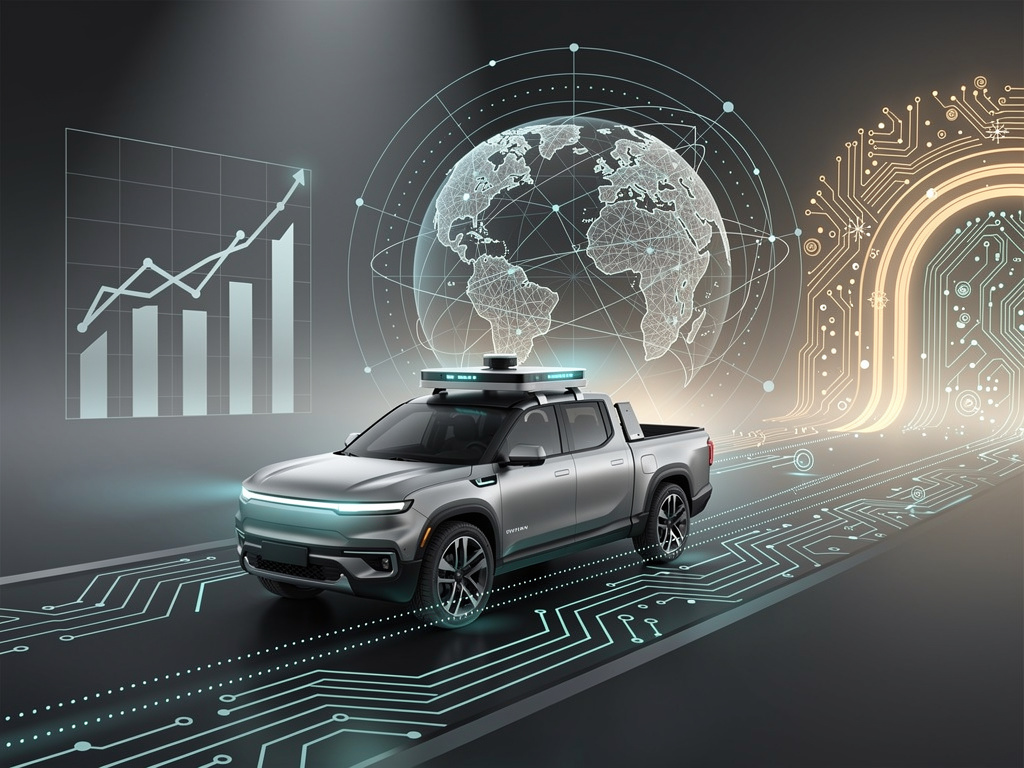
Rivian Automotive just made the most consequential strategic pivot since it went public in 2021. The electric vehicle maker told investors on Wednesday that it is abandoning its target to reach profitability by the end of 2027, choosing instead to pour capital into autonomous driving technology — a move that resets the clock on one of the most closely watched financial milestones in the EV industry.
The decision is bold. Maybe reckless. It depends entirely on whether you believe self-driving capability will become the defining competitive advantage for automakers in the next decade or an expensive distraction that has swallowed billions from companies like Uber, Lyft, and a long list of now-defunct startups.
According to TechCrunch, Rivian CEO RJ Scaringe framed the shift as existential rather than optional during the company’s investor update. “We are not going to be a company that watches autonomy happen to us,” Scaringe said. “We’re going to be a company that makes it happen.” The rhetoric is familiar in Silicon Valley. What’s less familiar is the willingness to explicitly sacrifice a near-term profit commitment to back it up.
Rivian had been on a grinding, painful march toward positive gross margins. The company’s R2 platform, its more affordable midsize SUV slated for production at its Normal, Illinois plant, was supposed to be the vehicle that finally tipped the economics in Rivian’s favor. That vehicle is still coming. But the financial calculus around it has changed dramatically now that Rivian plans to embed advanced autonomous hardware and software into the R2 and future models — an investment that will increase per-unit costs and require significantly more engineering headcount.
Wall Street noticed immediately. Shares dropped more than 9% in after-hours trading following the announcement, as investors recalibrated their models around a company that just voluntarily pushed its break-even horizon further into the future. For a stock that’s already down roughly 80% from its post-IPO peak, the reaction underscored how thin the margin for error has become.
So why do it?
The answer lies in what’s happened over the past 18 months across the auto industry. Tesla’s Full Self-Driving software, while still technically requiring driver supervision, has become a meaningful revenue stream through its subscription model and is increasingly central to the company’s valuation thesis. Waymo, Alphabet’s autonomous driving unit, has expanded its robotaxi service to multiple U.S. cities and is now completing over 150,000 paid rides per week. Chinese automakers like BYD and Xpeng have integrated advanced driver-assistance systems as standard features, using them as key differentiators in a brutally competitive domestic market. The message is clear: autonomy isn’t a future consideration. It’s a present-tense arms race.
Rivian’s approach, as outlined by Scaringe and CTO Mark Vinnels, involves building a proprietary autonomy stack rather than licensing technology from a third party. That’s the expensive path. It’s also the path that Tesla took, and the one that gives a company the most control over its product experience and, critically, its data pipeline. Rivian plans to use the sensor data from its existing fleet of R1T trucks and R1S SUVs — roughly 200,000 vehicles on the road — to train its models, a strategy that echoes Tesla’s fleet-learning approach.
The company disclosed it has been quietly building an autonomy team for over two years, hiring engineers from Waymo, Aurora, Apple’s disbanded Project Titan, and several other programs. According to TechCrunch, Rivian’s autonomy division now numbers more than 800 engineers, a figure that has roughly tripled since early 2025. That kind of hiring spree doesn’t come cheap, particularly when you’re competing for talent against companies like Waymo, Cruise, and Tesla that can offer significant compensation packages.
Rivian declined to specify exactly how much additional capital the autonomy push will require. But the company did say it expects operating expenses to increase by 15–20% relative to its prior guidance for 2026 and 2027. Given that Rivian’s operating expenses ran at roughly $4.5 billion in 2025, that implies somewhere between $675 million and $900 million in incremental annual spending — a staggering sum for a company that has never turned a profit.
The funding question looms large. Rivian ended 2025 with approximately $6.4 billion in cash and equivalents, bolstered by its joint venture with Volkswagen Group, which committed up to $5 billion in investment and technology-sharing. That VW partnership, announced in 2024, was initially focused on electrical architecture and software platforms. It’s now unclear whether VW’s commitment extends to co-funding Rivian’s autonomy ambitions, and neither company addressed the question directly during Wednesday’s presentation.
Analysts were quick to weigh in. Dan Ives of Wedbush Securities, one of the more vocal EV bulls on Wall Street, called the move “a high-wire act with no net” in a note to clients Thursday morning. “Rivian is essentially asking investors to fund a second moonshot before the first one has landed,” Ives wrote. He maintained his neutral rating on the stock.
RBC Capital Markets analyst Tom Narayan was somewhat more sympathetic, noting that Rivian’s decision reflects a genuine strategic threat. “If autonomy becomes table stakes for vehicle sales by 2030, any OEM without a credible self-driving program will be at a severe disadvantage,” Narayan wrote. “Rivian is paying the cost now. The question is whether it can survive long enough for that bet to pay off.”
That survival question isn’t hypothetical. Rivian burned through roughly $5.7 billion in cash in 2025, and while the rate of cash burn has been declining as production efficiencies improve, the autonomy investment threatens to reverse that trend. The company will almost certainly need to raise additional capital within the next 18 to 24 months, whether through equity offerings, debt issuance, or expanded commitments from VW or other partners.
There’s a broader industry context here that matters. The autonomous vehicle sector has experienced a brutal shakeout over the past three years. Argo AI, backed by Ford and Volkswagen, shut down in 2022. Apple killed Project Titan in early 2024 after spending an estimated $10 billion over a decade. Cruise, GM’s autonomous driving subsidiary, suspended operations in late 2023 following a pedestrian injury incident and has only partially resumed service. The companies that have survived and thrived — Waymo, Tesla, and a handful of Chinese players — share common traits: massive data advantages, deep-pocketed backers, and a willingness to endure years of losses.
Rivian has the willingness. Whether it has the financial stamina is another matter entirely.
Scaringe addressed this directly during the Q&A portion of the investor event. “I understand the concern about capital,” he said. “But I’d ask investors to consider what Rivian looks like in 2030 without autonomy. That’s the scenario that should worry you.” It was a striking moment — a CEO essentially arguing that the riskier path is the one that doesn’t involve spending billions on unproven technology.
And yet there’s logic to it. The automotive industry is converging around a model where software, not hardware, drives margins. Tesla’s gross margin on its FSD software is estimated at over 80%, compared to roughly 18% on vehicle sales. If Rivian can develop a comparable autonomy product and deploy it across its fleet, the long-term margin profile of the business changes fundamentally. The R2, priced around $45,000, might sell at thin or negative hardware margins but generate substantial recurring revenue through autonomy subscriptions. That’s the Tesla playbook, and it’s the one Rivian is now explicitly adopting.
The technical challenges are formidable. Rivian’s current vehicles use a camera-and-radar sensor suite, but the company indicated it will add lidar to its R2 platform — a decision that puts it at odds with Tesla’s camera-only approach but aligns it with Waymo, Mercedes-Benz, and most Chinese autonomous driving programs. Lidar adds cost per vehicle, typically $500 to $1,500 depending on the system, but provides higher-resolution 3D mapping that many engineers consider essential for safe autonomous operation.
Rivian also announced it is developing a custom chip for autonomous driving inference, partnering with an unnamed semiconductor company. Custom silicon is another page from the Tesla playbook — Tesla’s Hardware 4.0 computer, designed in-house, gives it significant advantages in processing efficiency and cost. Rivian’s chip is expected to enter production in late 2027 or early 2028, meaning the first vehicles to carry it will likely be later variants of the R2 or the company’s still-unannounced R3 compact vehicle.
The regulatory environment adds another layer of complexity. The National Highway Traffic Safety Administration has been slowly developing a framework for autonomous vehicle regulation, but the rules remain fragmented across states. California, Arizona, and Texas have relatively permissive testing and deployment regimes. Other states are far more restrictive. Rivian will need to build its autonomy system to function within this patchwork, which adds engineering overhead and complicates nationwide deployment timelines.
There’s also the Amazon factor. Amazon, Rivian’s largest institutional shareholder and the buyer of 100,000 electric delivery vans through a 2019 agreement, has its own autonomous driving ambitions through its Zoox subsidiary. The relationship between Rivian and Amazon has been collaborative but also carefully bounded. It’s worth asking whether Amazon might eventually push for Rivian to integrate Zoox technology rather than building its own stack — a move that could reduce Rivian’s costs but also its independence. Neither company has commented on this possibility.
For Rivian’s roughly 17,000 employees, the strategy shift brings both excitement and anxiety. The autonomy team is growing, but other parts of the company may face pressure as resources are redirected. Several current and former Rivian employees, speaking on condition of anonymity, told reporters in recent weeks that internal sentiment is mixed. Engineers in the autonomy group are energized. Those in other divisions worry about budget cuts and layoffs.
The market for autonomous driving talent is also intensely competitive right now. Waymo engineers command total compensation packages exceeding $500,000 annually. Tesla’s Autopilot and FSD teams are similarly well-compensated. Rivian, with its depressed stock price, has less currency to offer in the form of equity — the primary tool startups use to attract top-tier engineering talent. Cash compensation alone may not be enough to win bidding wars against better-capitalized competitors.
But Rivian does have one thing many competitors don’t: a vehicle platform designed from scratch for software-defined functionality. The R2’s electrical architecture, co-developed with Volkswagen, features centralized compute, over-the-air update capability, and zonal wiring — all prerequisites for deploying autonomous driving software at scale. Legacy automakers trying to retrofit autonomy onto platforms designed a decade ago face far steeper integration challenges.
The timing of Rivian’s announcement also coincides with accelerating activity in the autonomous vehicle space globally. In China, Baidu’s Apollo Go robotaxi service has expanded to 11 cities, and Huawei’s ADS 3.0 system is being deployed across multiple automaker brands. In Europe, Mercedes-Benz received regulatory approval for Level 3 autonomous driving in Germany — the first automaker to achieve that milestone — and is expanding the feature to additional markets. The competitive pressure is real and intensifying.
Rivian’s pivot raises a fundamental question about what kind of company it wants to be. When it went public, the pitch was straightforward: build beautiful, capable electric trucks and SUVs, scale production, and reach profitability. That story was simple enough for generalist investors to understand. The new story is more complex. Rivian is now asking the market to value it as both a vehicle manufacturer and an autonomous driving technology company — a dual identity that has historically been difficult for investors to price.
Tesla manages this dual identity, but Tesla also delivers over 1.8 million vehicles per year and generates positive free cash flow. Rivian delivered approximately 90,000 vehicles in 2025. The scale difference is enormous, and it matters because autonomous driving development is, above all else, a data problem. More vehicles on the road means more miles driven, more edge cases captured, and faster model improvement. Rivian’s fleet, while growing, is a fraction of Tesla’s.
Scaringe acknowledged this gap but argued that data quality matters as much as quantity. “Our vehicles operate in conditions — off-road, extreme weather, towing — that most autonomous systems have never encountered,” he said. “That data is incredibly valuable.” It’s a fair point. Rivian’s customer base skews toward outdoor enthusiasts and adventure-oriented drivers, which means the company’s fleet data includes an unusually high proportion of unpaved roads, steep grades, and low-traction surfaces. Whether that data translates into a meaningfully better autonomous system remains to be seen.
The financial markets will ultimately judge Rivian’s decision on one metric: whether the company can reach sustainable profitability before it runs out of money. The autonomy investment makes that timeline longer and more uncertain. But it also potentially makes the eventual business, if Rivian gets there, far more valuable.
It’s a classic startup bet. Double down or play it safe. Rivian chose to double down.
The next 24 months will determine whether that choice was visionary or fatal. Rivian needs to begin R2 production on schedule in the first half of 2026, continue improving gross margins on its R1 line, secure additional capital without catastrophic dilution, and demonstrate meaningful progress on its autonomy stack — all while competing against companies with deeper pockets and larger fleets.
No one said building an automaker was easy. Rivian just made it harder on purpose.


 WebProNews is an iEntry Publication