
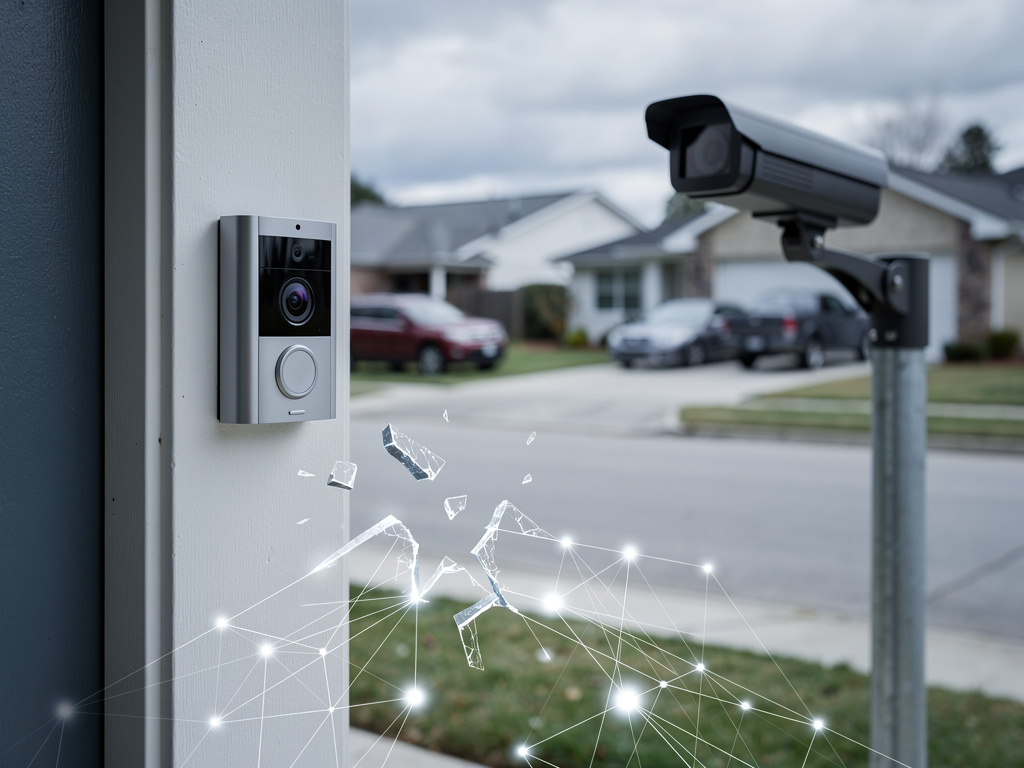
What was pitched as a bold step toward safer neighborhoods became one of the most dramatic corporate reversals in recent memory. Amazon’s Ring, the doorbell camera giant that has long navigated the tension between home security and civil liberties, officially canceled its partnership with Flock Safety, a police surveillance technology company, after weeks of intensifying public backlash that culminated in a controversial Super Bowl advertisement.
The announcement, made jointly by both companies on February 12, 2026, marks a significant retreat for two firms that had envisioned a future where residential doorbell cameras and law enforcement license plate readers operated in seamless coordination. The partnership, first announced in late January, would have allowed police departments using Flock Safety’s platform to request video footage directly from Ring doorbell owners — a capability that privacy advocates immediately flagged as a dangerous expansion of the surveillance state into the private sphere.
A Partnership Born in Controversy, Buried by a Super Bowl Spot
The original integration plan was straightforward in its mechanics but sweeping in its implications. Under the proposed arrangement, law enforcement agencies already subscribed to Flock Safety’s network of automated license plate readers (ALPRs) would gain the ability to send footage requests to Ring camera owners in specific geographic areas relevant to active investigations. Ring emphasized that homeowners would retain the choice to share or decline, but critics argued the very architecture of such a system would normalize mass surveillance requests and create implicit social pressure to comply.
The backlash, which had been building steadily since the partnership’s announcement, reached a fever pitch during Super Bowl LX on February 9, 2026. Flock Safety aired a high-profile advertisement during the game that appeared to celebrate the integration of neighborhood camera networks with law enforcement technology. The ad, which sources described as tone-deaf given the ongoing debate, drew immediate and widespread condemnation on social media and from civil liberties organizations. As NBC News reported, the Super Bowl spot became a lightning rod, transforming what had been a niche privacy debate into a mainstream consumer revolt.
Ring’s Official Statement: ‘We Heard You’
In a blog post published on Ring’s official website, the company stated plainly that the partnership was over. “After careful consideration and listening to feedback from our customers and community, Ring and Flock Safety have mutually decided to cancel our planned partnership,” the company wrote, according to Ring’s blog. The statement emphasized Ring’s commitment to customer trust and privacy, though it stopped short of acknowledging specific failures in how the partnership was conceived or communicated.
Flock Safety published its own statement on the matter. On its company blog, Flock wrote that the decision was mutual and that it remained “committed to helping law enforcement solve and prevent crime,” as noted by Flock Safety’s official update. The company did not directly address the Super Bowl advertisement or the criticism it generated, instead focusing on its broader mission and existing relationships with more than 5,000 law enforcement agencies and community associations across the United States.
The Surveillance Architecture That Alarmed Privacy Experts
To understand why this partnership provoked such intense opposition, it is necessary to examine what each company brings to the table — and what their combination would have meant in practice. Ring, acquired by Amazon in 2018 for approximately $1 billion, has installed tens of millions of doorbell cameras across American homes. The company has previously faced scrutiny for its Neighbors app, which allows users to share footage and has been criticized for fostering racial profiling and vigilante behavior. Ring had already ended its controversial practice of allowing police to directly request footage through the Neighbors app in 2024, making the Flock partnership appear to critics as a backdoor reintroduction of that capability.
Flock Safety, for its part, operates one of the largest networks of automated license plate readers in the country. Its cameras, often mounted on poles in residential neighborhoods and commercial districts, capture and store images of every vehicle that passes — building a searchable database that law enforcement can query. Civil liberties organizations, including the Electronic Frontier Foundation and the American Civil Liberties Union, have long argued that ALPRs constitute mass surveillance because they track the movements of all drivers, not just criminal suspects. The proposed Ring integration would have effectively extended Flock’s reach from public roadways into private driveways and front porches, as The Verge reported.
Security Researchers and Activists Sound the Alarm
The opposition was not limited to traditional advocacy organizations. Prominent security researchers took to social media to dissect the implications of the Ring-Flock alliance. John Scott-Railton, a senior researcher at the Citizen Lab at the University of Toronto’s Munk School, was among the most vocal critics. In a series of posts on X (formerly Twitter), Scott-Railton warned that the partnership represented a qualitative shift in the surveillance capabilities available to law enforcement, effectively crowdsourcing a vast camera network from private citizens, as documented in his posts on X. His analysis was widely shared and cited by journalists covering the controversy.
The concerns raised by researchers like Scott-Railton resonated because they touched on a fundamental question about the role of consumer technology in policing. When a homeowner purchases a Ring doorbell, they are buying a product marketed for personal security — to see who is at the door, to monitor packages, to check on family members. The Flock partnership would have repurposed that personal security device into a node in a law enforcement surveillance network, a transformation that many consumers said they neither anticipated nor consented to when they made their purchase. As Engadget noted, the opt-in nature of the footage requests did little to assuage these concerns, because the mere existence of the request infrastructure changes the relationship between the consumer, the company, and the state.
Amazon’s Broader Balancing Act
For Amazon, the Ring-Flock debacle is the latest chapter in an ongoing struggle to balance the commercial appeal of its home security products with growing public anxiety about surveillance. The company has invested heavily in Ring as a cornerstone of its smart home ecosystem, integrating it with Alexa, Echo devices, and its broader suite of home automation products. But each expansion of Ring’s capabilities — and especially each connection to law enforcement — has drawn fresh scrutiny.
Amazon’s decision to pull the plug on the Flock partnership reflects a calculation that the reputational damage and customer backlash outweighed whatever strategic or commercial benefits the integration might have offered. As CNBC reported, the timing of the cancellation — just days after the Super Bowl ad aired — suggests that the intensity of the public response caught both companies off guard. Industry analysts noted that Amazon, which has faced antitrust scrutiny and regulatory pressure on multiple fronts, could ill afford another high-profile controversy involving consumer privacy.
Flock Safety’s Growing Footprint Faces New Questions
The fallout may prove more consequential for Flock Safety than for Ring. While Ring can retreat to its core consumer product offering, Flock’s entire business model depends on expanding its surveillance network and deepening its integration with law enforcement. The company, which has raised more than $500 million in venture capital funding and achieved a valuation reportedly exceeding $4 billion, has grown rapidly by selling its ALPR technology to police departments, homeowners’ associations, and private businesses. The Ring partnership would have represented a massive expansion of Flock’s data collection capabilities, and its collapse raises questions about whether similar integrations with other consumer technology companies will face comparable resistance.
As Android Authority reported, the cancellation also puts a spotlight on the broader ecosystem of surveillance technology partnerships that operate with relatively little public awareness or oversight. Flock Safety’s existing network of ALPRs already captures billions of vehicle images annually, and the company has faced lawsuits and legislative challenges in several states. The Ring episode may embolden critics who argue that the proliferation of such technology demands stronger regulatory frameworks, including requirements for public notice, data retention limits, and independent audits.
What Comes Next for Consumer Surveillance Technology
The Ring-Flock saga is unlikely to be the last confrontation between consumer technology companies and the public over the boundaries of surveillance. The underlying market forces — consumer demand for home security, law enforcement demand for investigative tools, and technology companies’ desire to monetize data and expand their platforms — remain as powerful as ever. What has changed, at least for now, is the public’s willingness to push back when those forces converge in ways that feel invasive or unaccountable.
For Ring customers, the immediate outcome is clear: their doorbell cameras will not become part of Flock Safety’s law enforcement network. But the broader questions raised by the partnership — about consent, about the repurposing of consumer devices for state surveillance, and about the adequacy of existing privacy protections — remain unresolved. As security researcher Scott-Railton observed on X, the cancellation of one partnership does not address the systemic incentives that made it attractive in the first place. Until those incentives change, the tension between convenience and civil liberties will continue to define the trajectory of smart home technology in America.
The episode serves as a potent reminder that in an era of ubiquitous connected devices, the line between personal security and public surveillance is not drawn by engineers or executives alone — it is drawn, ultimately, by the people who open their front doors every day and decide how much of their world they are willing to share.


 WebProNews is an iEntry Publication