
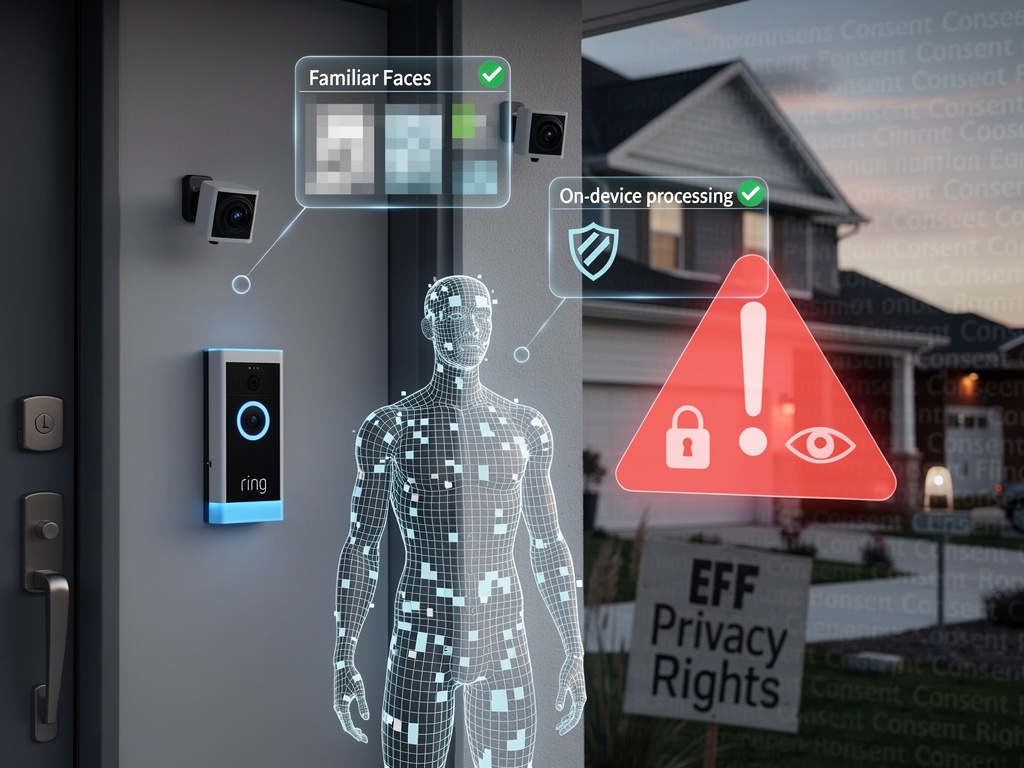
Amazon.com Inc. has unleashed a potent new weapon in its smart-home arsenal: AI-driven facial recognition for Ring video doorbells. Dubbed ‘Familiar Faces,’ the opt-in feature promises to catalog up to 50 known visitors—family, friends, delivery personnel—delivering tailored alerts without users sifting through endless motion clips. Rolled out in December 2025, it marks Ring’s boldest foray into biometric tech amid a regulatory minefield and vocal backlash from privacy watchdogs.
TechCrunch reported the launch on December 9, detailing how users upload photos to build a face library processed entirely on-device, with Amazon insisting biometric data stays local and isn’t fed into training large language models (TechCrunch). Fox News highlighted the convenience just days ago, noting it identifies ‘friends and delivery drivers’ but drew immediate fire from advocates warning of surveillance creep (Fox News).
Biometric Breakthrough Meets Backlash
The timing couldn’t be more fraught. Electronic Frontier Foundation (EFF) lawyers argue in a November analysis that such tools demand explicit consent under state biometric privacy laws like Illinois’ BIPA, which has spawned multimillion-dollar lawsuits against tech giants. ‘Many biometric privacy laws across the country are clear: Companies need your affirmative consent before running face recognition on you,’ EFF stated (EFF). Ring’s feature, while opt-in for owners, scans everyone in frame—including unwitting neighbors or passersby.
CyberGuy’s Kurt ‘CyberGuy’ Knutsson warned on December 22 that ‘critics warn this AI feature crosses a line,’ emphasizing smarter alerts come at the cost of potential misidentification and data exposure risks (CyberGuy). TechRepublic echoed concerns on December 10, framing it as convenience clashing with fresh security headaches in an era of rising deepfake threats.
Regulatory Reckoning Looms Large
Privacy groups aren’t waiting. Technology.org reported on December 10 that advocates and lawmakers are demanding Amazon disable the feature outright, citing Ring’s checkered history of sharing footage with police via the Neighbors app. Posts on X from users and observers amplify the din, with sentiment skewing toward alarm over unchecked AI in consumer devices, though official Ring and Amazon accounts have stayed mum on the uproar in recent threads.
Biometric Update traced the saga to November announcements of a winter rollout, where Ring positioned it as a tool for tagging regulars in camera views (Biometric Update). Mashable flagged early October leaks, branding it ‘Familiar Faces’ and spotlighting consent voids for non-users (Mashable). Android Headlines noted on December 10 the U.S.-only debut amid global moratoriums on facial recognition in public spaces.
Technical Underpinnings and Error Risks
At its core, Familiar Faces leverages edge AI—processing on the doorbell’s chipset to sidestep cloud transmission of raw biometrics. Amazon claims high accuracy for known faces, but real-world tests remain scarce. Dataconomy confirmed the U.S. rollout on December 10, stressing on-device computation as a privacy salve, yet skeptics point to past Ring hacks exposing millions of videos (Dataconomy).
Accuracy falters with masks, hats, or poor lighting, potentially flooding inboxes with false positives. EFF warns of ‘chilling effects’ on neighborhoods, where residents self-censor movements fearing perpetual logging. Fox News quoted privacy expert Albert Fox Cahn: ‘This turns every front porch into a surveillance hub.’
Amazon’s Broader AI Push
This isn’t isolated. TechCrunch detailed on December 18 how Alexa+ integrates conversational AI with Ring, using video analysis of uniforms and packages for contextual smarts (TechCrunch). Ring’s evolution from basic buzzers to AI sentinels underscores Amazon’s $1.7 billion acquisition in 2018, now boasting 20 million devices worldwide.
Yet history haunts. Ring settled FTC charges in 2023 for lax security, paying $5.8 million. X chatter reflects divided views: enthusiasts praise package theft deterrence, while detractors invoke dystopian overtones. Amazon’s silence on recent X posts contrasts with proactive 2019 defenses of video-sharing controls.
Market Ripples and Competitor Plays
Shares of Amazon dipped marginally post-launch, but Ring dominates 60% of U.S. video doorbell sales per Parks Associates. Rivals like Google Nest and Arlo offer person detection sans biometrics, dodging similar flak. Industry insiders eye Europe’s GDPR and proposed U.S. federal privacy bills as brakes on expansion.
Legal eagles predict class actions. Illinois suits against Clearview AI set precedents with $650 million payouts. Ring’s terms grant broad licenses for ‘service improvement,’ fueling fears of future data repurposing despite current pledges.
Stakeholder Strategies Ahead
For Ring owners, activation requires app updates and photo uploads, with deletion options touted. Amazon pitches it as empowerment, but opt-out defaults for guests remain elusive. Watchdogs urge congressional probes, mirroring 2021 scrutiny of Ring-police pacts now curtailed.
As 2025 closes, this face-off tests tech’s social contract. Will convenience trump caution, or force a biometric retreat? Insiders track court filings and app store reviews for signals, with X buzzing over beta tester anecdotes of spotty recognition in winter gloom.


 WebProNews is an iEntry Publication