
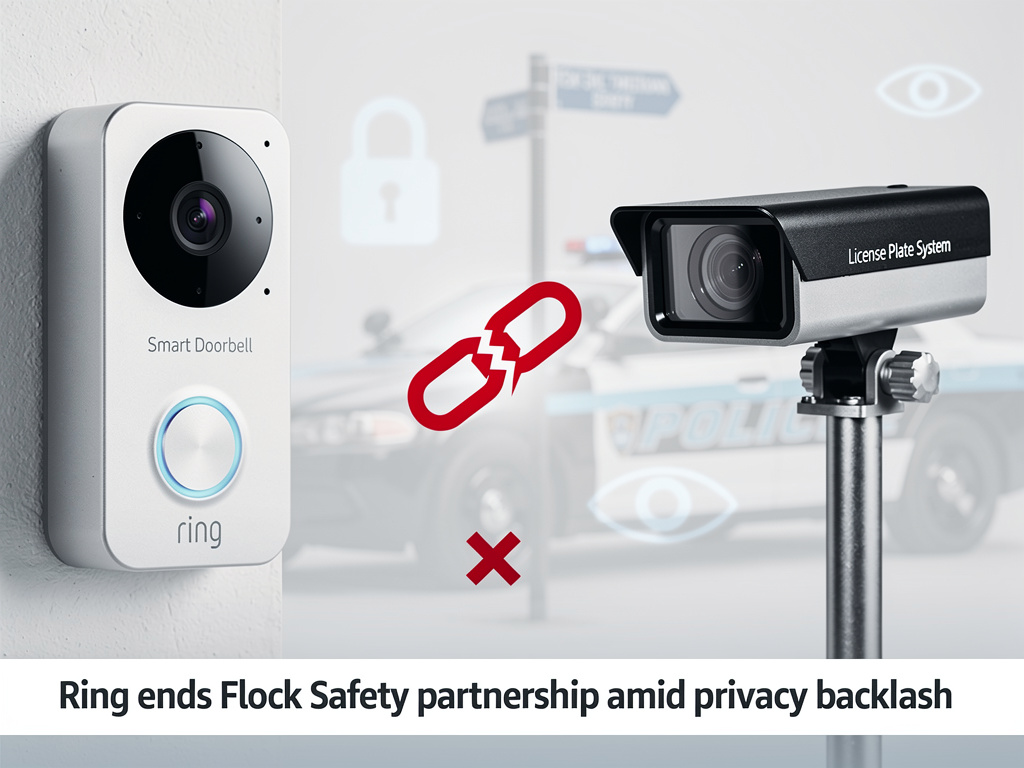
Amazon’s Ring, the doorbell camera company that has become synonymous with home security — and the privacy debates that accompany it — has quietly ended its partnership with license plate reader company Flock Safety. The move marks a significant course correction for a company that has spent years navigating the treacherous waters between consumer convenience and civil liberties concerns, and it raises fresh questions about the future of neighborhood-level surveillance technology in America.
The partnership, which allowed homeowners’ associations and neighborhood groups to purchase Flock Safety’s automated license plate readers (ALPRs) through Ring’s platform, had drawn immediate and intense criticism from privacy advocates when it was first announced. Now, Ring has confirmed that the collaboration is over — a decision that appears to reflect both the weight of public backlash and a broader strategic recalibration at Amazon regarding surveillance technology.
A Short-Lived Alliance Under Fire
As reported by The Verge, Ring confirmed that it has canceled its partnership with Flock Safety, the Atlanta-based company that manufactures solar-powered license plate reading cameras designed to be installed at neighborhood entry points. The cameras automatically capture and log the license plates of every vehicle that passes, creating a searchable database that can be shared with law enforcement agencies upon request or through formal legal processes.
The partnership had been part of Ring’s broader push into neighborhood security solutions that extend beyond the front porch. Through the arrangement, Ring served as a distribution channel for Flock Safety’s hardware, making it easier for HOAs and community groups to purchase and deploy the surveillance cameras. Flock Safety’s devices, which retail for several thousand dollars per unit with ongoing subscription fees, were being marketed as a tool to reduce crime and help police solve cases more quickly.
Privacy Groups Sound the Alarm
The backlash was swift and forceful. Organizations including the Electronic Frontier Foundation (EFF) and other digital rights groups had raised alarms about the partnership almost immediately after it became public. Their concerns centered on several key issues: the mass collection of movement data from individuals who have not been accused of any crime, the potential for law enforcement to access this data without warrants, and the disproportionate impact such surveillance systems can have on communities of color and immigrant populations.
Critics argued that the Ring-Flock partnership represented a dangerous escalation in the normalization of surveillance infrastructure in residential neighborhoods. Unlike a Ring doorbell camera, which captures footage of a single home’s entrance, Flock Safety’s license plate readers are designed to monitor all vehicular traffic flowing through an area, effectively creating a digital dragnet that tracks the movements of residents, visitors, delivery drivers, and anyone else who happens to drive through the neighborhood. The American Civil Liberties Union has long warned that ALPRs, when networked together, can construct detailed portraits of individuals’ daily lives — where they worship, who they visit, what doctors they see — all without any judicial oversight.
Ring’s Troubled History With Law Enforcement Partnerships
The cancellation of the Flock Safety partnership does not exist in a vacuum. Ring has spent the better part of the last five years attempting to distance itself from some of the more controversial aspects of its business model, particularly its cozy relationships with police departments across the United States. At its peak, Ring had established partnerships with more than 2,000 law enforcement agencies, allowing officers to request doorbell camera footage from Ring users through the company’s Neighbors app without needing a warrant.
That program drew fierce criticism and congressional scrutiny. In 2022, Amazon admitted that Ring had provided footage to law enforcement without user consent or a warrant in at least 11 cases, citing emergency circumstances. Senator Edward Markey of Massachusetts was among the most vocal critics, calling Ring’s practices a threat to civil liberties and demanding greater transparency. Under mounting pressure, Ring announced in early 2024 that it would end the feature that allowed police to directly request video from users through the Neighbors app, requiring law enforcement instead to obtain footage through proper legal channels.
Flock Safety’s Expanding Footprint Draws Scrutiny
Flock Safety, for its part, has continued to grow aggressively even without the Ring partnership. The company, which was valued at approximately $7.5 billion in its most recent funding round, has deployed its cameras in thousands of communities and maintains partnerships with more than 5,000 law enforcement agencies and municipal governments across the country. The company has positioned itself as a public safety tool, pointing to case studies in which its technology helped police solve crimes ranging from vehicle thefts to homicides.
However, Flock Safety has faced its own controversies. Reports have surfaced of cities and HOAs installing the cameras without adequately informing residents, and questions persist about data retention policies, who has access to the information collected, and what safeguards exist to prevent misuse. Some municipalities have pushed back against the technology entirely. In 2023, several city councils debated and in some cases rejected proposals to install Flock cameras, citing privacy concerns and the lack of evidence that the technology meaningfully reduces crime rather than simply aiding in after-the-fact investigations.
The Broader Reckoning Over Residential Surveillance
Ring’s decision to sever ties with Flock Safety reflects a growing tension within the consumer technology industry over how far companies should go in enabling surveillance capabilities for private citizens and communities. The proliferation of smart home cameras, doorbell devices, and now automated license plate readers has created a patchwork of private surveillance networks that, when aggregated, rival or exceed the monitoring capabilities of many government agencies.
This trend has accelerated in recent years, driven by consumer demand for security solutions and the declining cost of camera hardware and cloud storage. But it has also prompted a counter-movement among lawmakers and advocacy groups who argue that the regulatory framework has failed to keep pace with the technology. There is currently no comprehensive federal law governing the use of automated license plate readers by private entities, and state-level regulations vary widely. Some states have imposed restrictions on how long ALPR data can be retained or who can access it, while others have no specific rules at all.
Amazon’s Calculated Pivot on Privacy
For Amazon, the parent company that acquired Ring for approximately $1 billion in 2018, the decision to end the Flock partnership appears to be part of a deliberate effort to reposition Ring as a more privacy-conscious brand. The company has made several moves in this direction over the past two years, including the introduction of end-to-end encryption for Ring video footage and the aforementioned elimination of the direct police request feature in the Neighbors app.
These changes have not satisfied all critics — some argue that the fundamental business model of cloud-connected cameras still poses inherent privacy risks — but they suggest that Amazon has concluded the reputational costs of aggressive surveillance partnerships outweigh the potential revenue benefits. The Flock Safety partnership, which generated an unknown amount of revenue for Ring, appears to have been deemed not worth the political and public relations headaches it created.
What Comes Next for Neighborhood Security Technology
The end of the Ring-Flock alliance does not mean the end of automated license plate readers in American neighborhoods. Flock Safety has its own robust sales operation and continues to sign new contracts with communities and police departments. Other companies, including Motorola Solutions, which acquired ALPR maker Vigilant Solutions, also compete in this space. The demand for these tools, driven by real concerns about property crime and public safety, shows no signs of abating.
But the collapse of this particular partnership sends a signal that even the largest players in consumer technology are beginning to recognize limits — or at least the appearance of limits — when it comes to surveillance. Ring, a company that once enthusiastically courted police departments and positioned itself as a force multiplier for law enforcement, is now actively retreating from those associations. Whether this represents a genuine philosophical shift or merely a strategic repositioning remains an open question, but the direction of travel is unmistakable.
For the millions of Americans who have Ring cameras mounted on their doorframes, the practical implications of this decision are minimal. Their devices will continue to function as before. But for the broader debate over how much surveillance a free society should tolerate in its residential neighborhoods — and who should control that surveillance — Ring’s retreat from Flock Safety is a meaningful data point. It suggests that even in an era of ubiquitous cameras and cloud computing, there are still lines that companies are unwilling to cross, at least when the public is watching.


 WebProNews is an iEntry Publication