
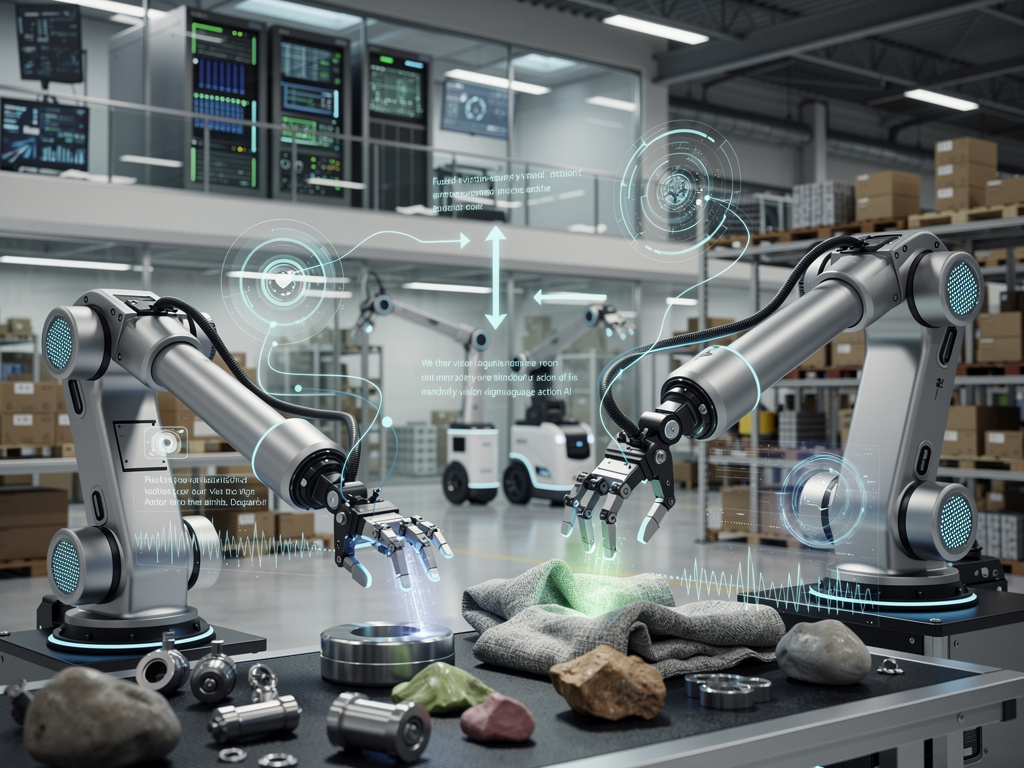
For decades, robots have excelled in structured settings like assembly lines, where tasks are predictable and tightly scripted. Now, Microsoft Research is pushing boundaries with Physical AI, fusing agentic systems with robotics to enable autonomy in dynamic, human-shared spaces. The launch of Rho-alpha, Microsoft’s inaugural robotics foundation model from the Phi series, marks a pivotal shift, translating natural language into precise physical actions.
Ashley Llorens, Corporate Vice President and Managing Director of Microsoft Research Accelerator, emphasized the transformative potential: “The emergence of vision-language-action (VLA) models for physical systems is enabling systems to perceive, reason, and act with increasing autonomy alongside humans in environments that are far less structured.” This vision, detailed in Microsoft Research, positions Physical AI as the next frontier after generative leaps in language and vision.
Rho-alpha stands out as a VLA+ model, incorporating tactile sensing and continual learning from human feedback. Trained on physical demonstrations, simulated tasks via NVIDIA Isaac Sim on Azure, and web-scale visual data, it tackles bimanual manipulation with end-to-end efficiency. Demos on the BusyBox benchmark showcase commands like “Push the green button with the right gripper” or “Pull out the red wire,” executed in real-time on dual UR5e arms equipped with tactile sensors.
Rho-Alpha’s Core Innovations
Challenges like plug insertion test Rho-alpha’s limits; when the right arm falters, human teleoperation via 3D mouse provides corrective input, enabling on-the-fly adaptation. Professor Abhishek Gupta of the University of Washington noted: “While generating training data by teleoperating robotic systems has become a standard practice, there are many settings where teleoperation is impractical or impossible. We are working with Microsoft Research to enrich pre-training datasets collected from physical robots with diverse synthetic demonstrations using a combination of simulation and reinforcement learning.” This collaboration addresses data scarcity head-on.
NVIDIA’s Deepu Talla, Vice President of Robotics and Edge AI, highlighted the simulation edge: “Training foundation models that can reason and act requires overcoming the scarcity of diverse, real-world data. By leveraging NVIDIA Isaac Sim on Azure to generate physically accurate synthetic datasets, Microsoft Research is accelerating the development of versatile models like Rho-alpha that can master complex manipulation tasks.” Evaluations extend to humanoid robots, with technical details forthcoming.
Microsoft’s broader Physical AI push integrates multimodal sensing—vision, language, touch—and plans for force modalities. Tooling for cloud-hosted deployment allows enterprises to fine-tune models with proprietary data, targeting manufacturers and integrators.
Overcoming Data Droughts
Historical robotics constraints—predictable factories versus chaotic real-world variability—are crumbling. Startup News FYI reports Microsoft’s focus on embodied intelligence for warehouses, manufacturing aids, and adaptive autonomy, stressing safety amid physical risks like damage or regulatory hurdles.
Partnerships amplify momentum. Hexagon Robotics teamed with Microsoft at CES to scale Physical AI frameworks across imitation learning, reinforcement, and VLA models for humanoid robots in manufacturing. Aaron Schnieder, Microsoft’s VP of Engineering and Emerging Technologies, stated: “This partnership with Hexagon Robotics marks a pivotal moment in bridging the gap between cutting-edge humanoid robot innovation and real-world industrial impact. By combining AEON’s sensor fusion and spatial intelligence with Microsoft Azure’s scalable AI and cloud infrastructure, we’re empowering customers to deploy adaptive, AI-powered humanoid robots.” Arnaud Robert, Hexagon Robotics President, added: “The strategic partnership with Microsoft is a big step towards realising our vision to build an autonomous future and address labour shortage across vital industries.”
Johns Hopkins APL collaborates on autonomous robot teams and materials discovery, leveraging Microsoft’s generative models for independent planning and execution in complex environments, per Johns Hopkins APL.
Strategic Alliances Accelerate Deployment
Predecessors like Magma, a multimodal foundation model for digital-physical agents, pave the way. It processes UI navigation and robotic tasks using Set-of-Mark annotations for key objects, as outlined in Microsoft Research. Microsoft Research Asia’s StarTrack Scholars advance spatial intelligence via 3D vision for robust actions.
Industry panels, such as Ignite sessions with NVIDIA and Wandelbots, explore wiring factory data into simulations for safe industrial rollouts. Datacenter robotics for self-maintenance, detailed in Microsoft Research, targets transceiver manipulation in cluttered environments.
Early access to Rho-alpha via Microsoft’s Research Program invites experimentation, signaling readiness for enterprise adaptation. As Physical AI evolves, Microsoft’s infrastructure—Azure, Phi lineage, simulation prowess—positions it to dominate real-world applications from factories to homes.
Physical AI’s Industrial Frontier
Broader 2026 trends align: TechCrunch predicts physical AI growth in wearables and games before full robotics scale, while Microsoft’s research forecasts agentic systems as collaborators. Safety, governance, and adaptability remain core, ensuring robots earn trust in human realms.


 WebProNews is an iEntry Publication