
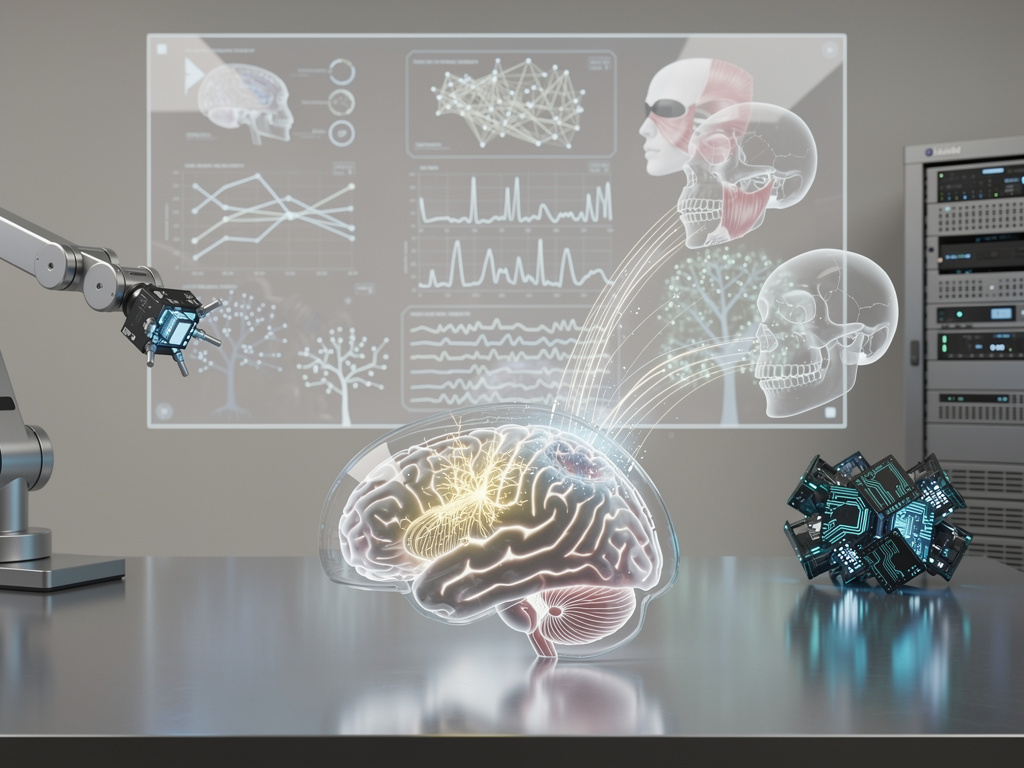
Beyond the Grin: Unraveling the Neural Choreography of Macaque Facial Expressions
In the intricate world of primate communication, facial expressions have long been viewed as instinctive reactions, hardwired responses to emotions or social cues. But recent research is challenging this notion, suggesting that these gestures in macaques—our close evolutionary cousins—might involve more deliberate neural processes than previously thought. A groundbreaking study published in Science reveals that the brain circuits responsible for voluntary movements play a key role in generating facial expressions, blurring the line between reflex and intention. This discovery, led by neuroscientists at Rockefeller University, opens new avenues for understanding how social signals are crafted in the brain, with implications extending to human psychology and even artificial intelligence.
The study focused on rhesus macaques, monitoring their brain activity during natural social interactions. Researchers implanted electrodes to record from neurons in the motor cortex, the brain region typically associated with planned actions like reaching or walking. Surprisingly, they found that these same areas lit up when the monkeys produced facial gestures, such as baring teeth or raising eyebrows—expressions often linked to emotions like fear or affiliation. “We had a good understanding of how facial gestures are received, but now we have a much better understanding of how they’re generated,” noted Winrich Freiwald, a lead researcher, as reported in Futurity.
This isn’t just about monkeys making faces; it’s about rethinking the origins of expression across species. Traditional views held that emotional facial movements stem from subcortical regions, ancient parts of the brain handling reflexes. Yet the new findings indicate that cortical areas, evolved for fine motor control, are deeply involved. In experiments, macaques were observed in pairs, engaging in behaviors that elicited spontaneous expressions. Neural recordings showed patterns of activity in the face motor cortex that preceded and shaped these gestures, suggesting a level of orchestration rather than mere automaticity.
Neural Networks at Play: From Instinct to Intention
Delving deeper, the researchers distinguished between two subregions of the motor cortex: the lateral area, which handles voluntary facial movements, and the medial area, more tied to emotional responses. Both were active during social gesturing, but with distinct temporal signatures. For instance, when a macaque responded to a dominant peer with a submissive lip-smack, the lateral cortex fired in patterns akin to those for deliberate actions, while the medial added an emotional flavor. This interplay was highlighted in coverage by Medical Xpress, which described how brain regions “work together in surprising new ways” to choreograph these signals.
Comparisons to human studies add another layer. In people, the Facial Action Coding System (FACS) breaks down expressions into action units, much like the Macaque FACS (MaqFACS) used in primate research. A 2021 paper in eNeuro developed automatic recognition tools for MaqFACS, showing that macaque expressions can be quantified and analyzed for affective states. The recent Rockefeller work builds on this, demonstrating that what we code as “emotional” might actually recruit voluntary motor pathways, a finding echoed in posts on X where scientists discuss the continuum between reflex and control in primate behavior.
Moreover, the study’s implications ripple into evolutionary biology. Macaques, like humans, live in complex social groups where facial cues maintain hierarchies and alliances. A 2022 study in R Discovery found that crested macaques intensify facial movements in risky interactions, suggesting adaptive flexibility. The new research posits that this flexibility arises from cortical involvement, allowing primates to tailor expressions to context, much like a human might force a smile in a tense meeting.
Evolutionary Echoes: Parallels in Primate and Human Brains
Tracing back, earlier work on macaque face perception provides context. A 2018 study in Nature Communications revealed that monkeys preferentially attend to trustworthy human faces, focusing on features like eye regions—mirroring human biases. This attentional preference likely ties into the motor side: if perceiving expressions involves cortical processing, generating them might too. The Rockefeller team extended this by showing that anterior face patches in macaques respond more to local features like eyes or mouth, as detailed in another Nature Communications paper from 2022, but the motor cortex integrates these for output.
Human parallels are striking. Recent news from The Transmitter reports that grimaces in humans activate cortical pathways similar to voluntary movements, challenging the instinct-only model. In macaques, this could explain why expressions vary by social risk; a 2022 Philosophical Transactions paper noted stereotyped intensity in high-stakes encounters, possibly due to deliberate neural modulation.
Beyond biology, these insights inform technology. Efforts to imbue robots with empathetic expressions, as explored in a CBC News piece on teaching robots empathy, draw from primate models. A CNET article on lip-syncing robot faces highlights the need for naturalistic gestures, which the macaque study suggests require integrated neural-like processing for authenticity.
Technological Frontiers: From Labs to AI Applications
Industry insiders in neuroscience and AI are buzzing about applications. On X, posts from outlets like Ars Technica emphasize that macaque facial gestures are “more than just a reflex,” linking to broader discussions on primate communication. This aligns with a 2024 Science paper on marmoset vocal labeling, showing how non-human primates use sophisticated signals, potentially analogous to facial “dialects” in macaques.
In practical terms, the findings could refine brain-computer interfaces. For patients with facial paralysis, understanding cortical control of expressions might lead to targeted therapies. Rockefeller’s own announcement in their news release underscores how neural circuits respond to social cues, paving the way for prosthetics that mimic natural movements.
Critically, the study addresses methodological rigor. By recording from freely interacting macaques, researchers avoided artificial setups, capturing genuine behaviors. This contrasts with older studies relying on restrained animals, as noted in a 2021 Science Magazine post on bat and macaque group tracking. The approach revealed that expressions form a continuum, with voluntary and emotional elements blending seamlessly.
Social Dynamics: Risk, Trust, and Communication
Diving into social implications, macaque expressions often signal trust or dominance. The 2018 Nature Communications study on implicit preferences for trustworthy faces found correlations with facial width-to-height ratios, a metric predicting perceived reliability. In the new research, such features are actively generated via motor cortex, suggesting primates “perform” trustworthiness to navigate hierarchies.
Risky interactions amplify this. The R Discovery paper on crested macaques shows intensified, stereotyped movements in tense scenarios, likely to de-escalate conflicts. Integrating this with the Rockefeller findings, it’s clear that cortical involvement allows for nuanced adjustments—perhaps why low-ranked males in a 2020 Research Outreach post on Japanese macaques use alternative behaviors to court females, including subtle facial cues.
Human societies echo these patterns. Earth.com articles report that human facial expressions are planned rather than purely instinctive, produced through interconnected brain networks. This shared mechanism underscores our primate heritage, where expressions evolved as tools for cooperation.
Future Horizons: Bridging Biology and Innovation
Looking ahead, the research inspires interdisciplinary work. A 2024 X post from Science Magazine on macaque frontal cortex influencing risk attitudes ties into how expressions might modulate social risks. Similarly, a recent Imaging Neuroscience paper on cortical processing of motion in macaques suggests broader sensory-motor integration, potentially including facial feedback loops.
In AI, emulating this could create more relatable machines. The CBC effort at Simon Fraser University aims to teach robots empathy, drawing from primate studies to program responsive expressions. Meanwhile, National Geographic España’s coverage of macaque smiles highlights cross-cultural fascination, reminding us that these gestures foster bonds across species.
Ultimately, this study reshapes our view of facial communication as a sophisticated neural ballet, not a simple reflex. By crediting the motor cortex’s role, it invites further exploration into how brains craft the silent language of connection, with ripples felt from evolutionary biology to cutting-edge tech. As Freiwald’s team continues, expect more revelations on the deliberate artistry behind every grin and grimace.


 WebProNews is an iEntry Publication