
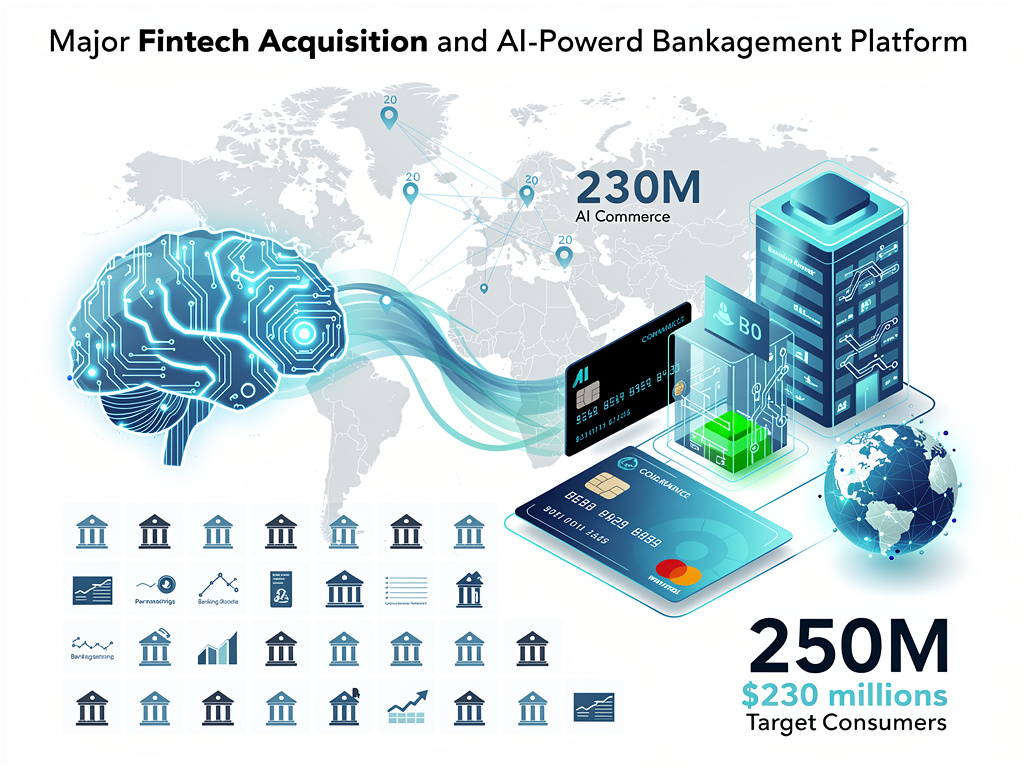
In a deal that underscores the accelerating convergence of artificial intelligence, banking infrastructure, and consumer loyalty programs, NASDAQ-listed Rezolve AI has agreed to acquire Reward, a UK-based fintech platform, for $230 million in an all-cash transaction. The acquisition, announced on July 10, 2025, represents one of the most significant moves yet by an AI-native company to embed itself directly into the plumbing of global financial services and commerce.
The transaction is expected to close in the third quarter of 2025, subject to customary regulatory approvals. Upon completion, Rezolve AI will gain immediate access to Reward’s established network of over 60 bank and fintech partnerships spanning more than 20 countries, along with a platform that currently reaches approximately 100 million consumers, according to a press release distributed via PR Newswire.
A Strategic Bet on the Intersection of AI and Banking Infrastructure
Rezolve AI, which trades on NASDAQ under the ticker RZLV, has positioned itself as a commerce-focused AI company with proprietary technology designed to enhance consumer engagement and transaction experiences. The company’s product suite includes its Brain Commerce and Brain Checkout platforms, which leverage large language models and AI to streamline digital commerce. But with the Reward acquisition, the company is making a decisive pivot toward embedding its AI capabilities directly within banking ecosystems — a move that could fundamentally reshape how financial institutions deliver personalized offers and loyalty rewards to their customers.
Reward, founded in the United Kingdom, has built a business-to-business-to-consumer (B2B2C) platform that enables banks and fintechs to offer card-linked loyalty programs, cashback incentives, and merchant-funded rewards. The company’s technology integrates directly with banking apps and payment systems, allowing financial institutions to deliver targeted offers to consumers at the point of transaction. Its client roster reportedly includes major banking names across Europe, the Middle East, and other global markets.
Daniel Wagner’s Vision: From AI Commerce to AI-Powered Financial Services
Daniel M. Wagner, Chairman and CEO of Rezolve AI, framed the acquisition as a transformative moment for the company. “This acquisition is a defining moment for Rezolve Ai,” Wagner said in the announcement, as reported by PR Newswire. “By combining Reward’s deeply embedded banking relationships and proven commerce infrastructure with our cutting-edge AI, we are creating a first-of-its-kind AI-powered engagement and commerce platform for the global banking sector.”
Wagner’s ambitions appear to extend well beyond simply bolting on a loyalty platform. The combined entity, according to the company, aims to create what it describes as a “first-of-its-kind” AI-powered engagement and commerce platform purpose-built for global banking. The thesis is straightforward but ambitious: banks sit atop enormous troves of transaction data and have direct relationships with hundreds of millions of consumers, yet most have struggled to monetize those relationships beyond traditional lending and fee-based services. By injecting Rezolve’s AI capabilities into Reward’s existing bank integrations, the combined company believes it can unlock new revenue streams for banks while simultaneously delivering hyper-personalized commerce experiences to consumers.
The Financial Mechanics: All-Cash and Revenue Accretive
The $230 million all-cash consideration is notable for several reasons. First, it signals confidence in Rezolve AI’s balance sheet and financing capabilities at a time when many AI companies are still burning through cash with limited revenue. The company stated that the transaction is expected to be immediately revenue and EBITDA accretive, suggesting that Reward is already generating meaningful income — a rarity in the AI acquisition space, where targets are often pre-revenue or deeply unprofitable.
Reward’s revenue model is primarily based on merchant-funded rewards, meaning that brands and retailers pay to have their offers surfaced to consumers through banking apps. This creates a three-sided marketplace dynamic: banks get enhanced engagement tools at no cost, consumers receive relevant cashback and rewards, and merchants gain access to highly targeted, transaction-level marketing channels. The model has proven sticky in markets where it has been deployed, as banks are reluctant to remove features that drive customer engagement and app usage.
Scaling to 250 Million Consumers: The Growth Roadmap
Perhaps the most eye-catching figure in the announcement is the combined company’s stated ambition to reach 250 million consumers across more than 45 countries. Currently, Reward’s platform touches approximately 100 million consumers through its existing bank partnerships. Rezolve AI’s own commerce technology has been deployed across various markets, though the company has been less specific about its direct consumer reach. The 250-million target suggests an aggressive international expansion strategy, likely leveraging Reward’s existing bank relationships as distribution channels for Rezolve’s AI-powered tools.
The geographic footprint is particularly significant. Reward’s partnerships span developed markets in Europe as well as fast-growing financial services markets in the Middle East and Asia. In many of these regions, digital banking adoption is accelerating rapidly, and financial institutions are actively seeking differentiated technology to attract and retain customers. An AI-powered loyalty and commerce platform that can be white-labeled and integrated into existing banking apps could prove highly attractive to institutions competing for digital-native consumers.
Industry Context: The Race to Embed AI in Financial Services
The Rezolve-Reward deal arrives at a moment of intense activity at the intersection of AI and financial services. Major banks including JPMorgan Chase, Goldman Sachs, and Morgan Stanley have all announced significant investments in proprietary AI capabilities in recent months. Meanwhile, fintech companies and AI startups are racing to offer AI-as-a-service solutions to smaller banks and financial institutions that lack the resources to build their own systems.
The loyalty and rewards segment, in particular, has seen renewed interest from investors and acquirers. Card-linked offer platforms have historically operated in a fragmented market, with companies like Cardlytics (which partners with major U.S. banks), Dosh, and various regional players competing for bank partnerships. Rezolve AI’s acquisition of Reward represents a bet that AI can be the differentiating factor in this space — that the ability to deliver truly personalized, contextually relevant offers in real time will separate winners from also-rans in the next generation of banking commerce.
What Reward Brings to the Table Beyond Technology
While much of the announcement focuses on technology synergies, the strategic value of Reward’s existing relationships should not be underestimated. Building direct integrations with banks is a notoriously slow and difficult process, often requiring years of compliance work, security audits, and technical integration. Reward has already navigated these hurdles with more than 60 institutions, creating a distribution moat that would be extraordinarily expensive and time-consuming for Rezolve AI to replicate organically.
Gavin Dein, CEO of Reward, emphasized this point in his comments on the deal. According to the PR Newswire announcement, Dein expressed enthusiasm about combining Reward’s established banking infrastructure with Rezolve’s AI capabilities, suggesting that the merger would allow the combined entity to deliver capabilities that neither company could achieve independently. The retention of Reward’s leadership and operational teams is expected to ensure continuity with existing bank partners during the transition period.
Risks, Open Questions, and the Path Forward
For all its strategic logic, the deal carries meaningful execution risks. Integrating two companies with different technology stacks, corporate cultures, and geographic footprints is never straightforward. Rezolve AI will need to demonstrate that its AI technology can be seamlessly layered onto Reward’s existing platform without disrupting service to current bank partners. Any integration hiccups that affect bank-facing operations could jeopardize relationships that took years to build.
There are also questions about Rezolve AI’s ability to finance the $230 million all-cash transaction. As of its most recent public filings, the company’s market capitalization and cash reserves will need to support a deal of this magnitude, potentially requiring debt financing or other capital market transactions. The company has not disclosed the specific financing structure, which will be closely watched by investors and analysts.
Additionally, the competitive response from established players in the card-linked offers and banking technology space could be swift. Companies like Cardlytics, which has deep relationships with major U.S. banks, and Mastercard and Visa, which have their own loyalty and offers platforms, are unlikely to cede ground without a fight. Rezolve AI’s AI-first approach will need to deliver measurable, demonstrable improvements in consumer engagement and merchant ROI to win and retain bank partnerships in an increasingly competitive environment.
Nevertheless, the Rezolve AI-Reward combination represents a bold and potentially transformative bet on the future of AI-powered banking commerce. If the company can execute on its vision of a unified, AI-driven platform that serves banks, merchants, and consumers simultaneously across dozens of countries, it could establish a new category in financial technology — one where artificial intelligence doesn’t just analyze transactions after the fact, but actively shapes the commerce experience in real time.


 WebProNews is an iEntry Publication