
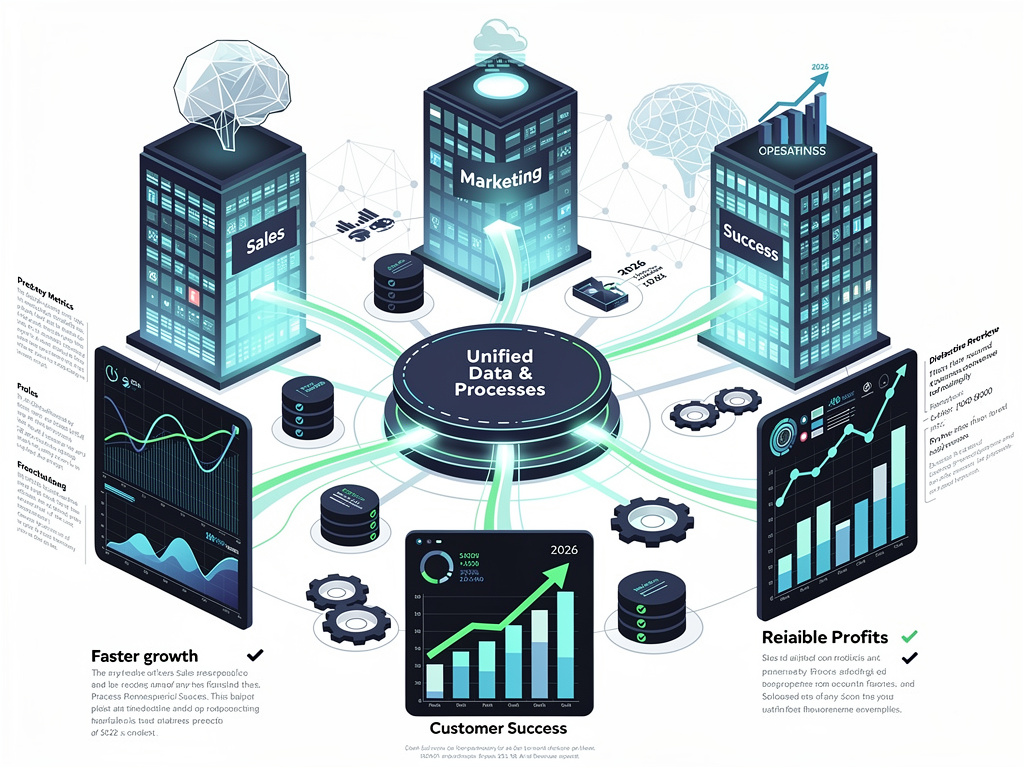
In the high-stakes arena of B2B growth, Revenue Operations—or RevOps—has evolved from a niche coordination effort into the central nervous system powering top performers. Companies embracing RevOps grow 19% faster and boast 15% higher profitability, according to Forrester. As 2026 dawns, with Gartner forecasting that 75% of the world’s highest-growth firms will deploy RevOps models—up from under 30% today—this function is no longer optional but imperative for sustainable expansion.
RevOps unites sales, marketing, customer success, and even finance around unified processes, data, and technology. Unlike siloed SalesOps or MarketingOps, it spans the full revenue lifecycle, from lead generation to retention. ProperExpression’s comprehensive guide outlines core activities: coordinating cross-team collaboration, eliminating data silos, sealing funnel leaks, and automating workflows to boost conversions and customer journeys.
Yet adoption lags intent. While 86% of B2B executives deem RevOps essential, only one-third report true alignment, per a Salesforce-Forrester report. This gap underscores the need for rigorous strategies amid economic pressures demanding efficient growth metrics like Net Revenue Retention and CAC payback.
Breaking Down Silos for Unified Revenue
RevOps thrives by dismantling departmental barriers. Sales, marketing, and service often operate in isolation, with distinct KPIs fostering competition over collaboration. RevOps imposes shared definitions, real-time data access, and clear handoff protocols. As ProperExpression notes, “RevOps produces shared definitions and improves lines of communication… ensuring data is accessible and everybody has a clear understanding of their roles.”
Benefits cascade: heightened visibility into pipeline health, optimized performance yielding three times faster growth versus non-adopters (Forrester), and predictable revenue through automation. Efficiency surges as manual tasks vanish, freeing teams for high-impact work. In SaaS, where recurring revenue reigns, this alignment cuts churn— one firm redesigned post-sale journeys via RevOps, slashing churn 22% in two quarters, reports INSIDEA.
Challenges persist: organizational misalignment rooted in cultural clashes, tech stack sprawl creating data silos, and the complexity of inter-team dynamics. Executive buy-in demands ironclad business cases highlighting fixes for current weaknesses and untapped opportunities.
Strategic Frameworks Powering Implementation
Success hinges on structured frameworks anchoring people, processes, data, and technology. Popular models include the Waterfall approach, funneling leads through linear stages with optimized handoffs. ProperExpression advocates mapping the ideal buyer journey: analyze current paths and tech, chart the target process, list required actions, and timeline execution.
RevOps teams—blending specialists from sales, marketing, IT, or dedicated experts—handle reporting, automation, evaluations, tech scouting, and systems management. Key traits: defined responsibilities, KPI-driven accountability, and unwavering consistency. As ORM Technologies predicts for 2026, RevOps leaders ascend to VP levels, reporting to CEOs and orchestrating cross-functional planning, syncing product launches with sales ramps and support scaling.
Technology underpins it all. The CRM market hit $64 billion last year, but sprawl breeds chaos. Best stacks prioritize simplicity, usability, and integration—HubSpot excels here with no-code automation and centralized data, per ProperExpression. Gartner urges aligning GTM stakeholders for a buyer-centric roadmap emphasizing data strategy and tech enablement.
AI and Tech Stack Mastery in 2026
Artificial intelligence transforms RevOps from reactive to predictive. By 2026, AI embeds deeply for forecasting, lead scoring, and intelligent augmentation beyond dashboards, states ORM Technologies. Task-specific AI agents hit 40% enterprise adoption, reshaping workflows from prospecting to coaching, notes Outreach.
A single source of truth (SSoT) is non-negotiable—consolidating revenue data eliminates conflicting metrics. SalesMotion’s best practices include breaking silos via unified architectures, while SalesMotion reports RevOps as the backbone for B2B motions. Tools like HubSpot’s Operations Hub shine in 2026 with data cleaning and self-serve automation, reducing IT dependency (INSIDEA).
Fractional RevOps pods deliver rapid wins—one rebuilt a lifecycle in six weeks, tripling rep productivity and nailing forecasts. Lane Four advises prepping for 2026 by auditing data integrity: “Run a delta report comparing raw data exports to dashboards,” revealing hidden gaps.
Overcoming Hurdles with Executive Alignment
Tech barriers loom large—legacy systems, underused tools, and absent strategies exacerbate silos. RevOps navigates this via ongoing optimization, though upfront investment daunts many. Organizational complexity demands nuanced communication; changing one team’s incentives ripples across others.
Executive buy-in seals the deal. Forbes Councils emphasize elevating RevOps to strategic planning: “Move RevOps leadership into executive roles… give them authority to call out misalignment,” per Thasha Batts in Forbes. Ethical AI practices and culture shifts amplify impact.
Implementation starts small: high-impact areas like handoffs, treating strategies as living systems (Highspot). RevOps Co-op stresses data hygiene as foundational, with monthly readouts spotting trends.
2026 Trends: Predictive, AI-Driven Precision
Looking ahead, RevOps prioritizes efficiency over raw growth. Skaled forecasts emphasis on usability: “Stop obsessing over visibility and start enabling usability,” training teams for real-time data response. Advanced metrics evolve—predictive KPIs via revenue intelligence platforms track nuanced indicators beyond CAC and CLV (Atak Interactive).
End-to-end ownership of customer journeys eliminates relay-race handoffs. Elefante RevOps highlights streamlining to end silos, fueling growth. Communities and podcasts proliferate for peer learning, with LinkedIn thought leaders sharing workflows (Flowla).
For industry insiders, 2026 demands RevOps as the “strategic conscience,” per ORM Technologies—guiding with data-driven ethics. Firms ignoring this risk operational surprises; those acting now audit systems, clarify ownership, and embed AI for resilient GTM machines.


 WebProNews is an iEntry Publication