
For American manufacturing, the postwar world was a golden age. Industry boomed from the 1940s up through the 1970s, fueling tremendous economic growth for the country, soaring profits for companies and bright prospects for workers. Plenty of Americans graduated high school, joined a union and landed factory jobs that paid enough to buy a house, raise a family and retire with dignity.
Many Americans believe that the heyday of manufacturing was the natural order of things, and they have pinned their hopes for a vibrant new middle class on a manufacturing revival. Politicians of all stripes invoke this moment as something lost and easily restored via tariffs or buying American. It cannot. The mid-20th century model of American manufacturing wasn’t normal. It was a historical fluke. And we can’t bring it back.
The industrial golden age was born in unique conditions that dissipated almost as quickly as they appeared. Global competitors had been bombed into submission, energy was dirt cheap, and American unions could demand concessions without fear of losing jobs to foreign rivals. These were accidents of history, not features of capitalism that can be recaptured with the right policies.
A Unique Balance Emerges
The golden age—and middle-class prosperity—began with intense jockeying between industry and labor after World War II. “Strikes were big and frequent in all the great industries of that era: steel, auto, trucking, rubber and coal mining,” says UC Santa Barbara labor and capital historian Nelson Lichtenstein.
That relentless pressure from an organized working class “raised real wages and created a set of fringe benefits, including health insurance and retirement pay,” he says. The power of unions also shaped public opinion and federal policy. At the 1956 dedication of the AFL-CIO national headquarters, built directly across from the White House, President Eisenhower declared, “Labor is the United States. The men and women who, with their minds, their hearts and hands, create the wealth that is shared in this country—they are America.”
Government support for unions kept managerial behavior in check. Executive salaries remained just a few times median income and stock buybacks were illegal or frowned upon, ensuring prosperity went into workers’ pockets. During the Korean War, inflationary pressures were partly restrained through temporary wage and price controls.
Cracks Form in the Foundation
By the mid-1960s, though, financial winds were beginning to shift. The Vietnam War was draining federal coffers, forcing Lyndon Johnson to balance military spending with domestic programs like the Great Society. Inflation accelerated as government deficits exploded, causing the dollar to weaken. When Richard Nixon abandoned the gold standard in 1971, it signaled the collapse of the Bretton Woods system, which had underpinned stable exchange rates and global trade since 1944.
This move unleashed currency volatility, undermining the U.S. dollar’s purchasing power abroad, and contributing to the economic uncertainty that would challenge American industry and the middle class in the decade that followed. Then came the oil shocks. In 1973, OPEC’s oil embargo quadrupled energy prices, gobbling up manufacturers’ profits. At the same time, foreign competition returned with a vengeance, as Japan, Korea and West Germany rebuilt their industrial sectors.
American companies, meanwhile, were saddled with mounting legacy costs like pensions that discouraged investment in upgrades and research and development. Economists were watching. In a 1970 New York Times essay, Milton Friedman declared that the social responsibility of business is to increase its profits. In practice, that meant shareholder value would come before union obligations or community ties.
Globalization Accelerates the Shift
When Bill Clinton signed Nafta in 1993 and championed the World Trade Organization in 1995, it wasn’t a betrayal so much as the logical culmination of a new consensus: Free trade and globalization, not industrial protection, would drive prosperity. While policymakers debated the wisdom of abandoning manufacturing, American identity was transforming. In the 1960s, the children of steelworkers went to college in record numbers, and few aspired to return to the mills; even if they did, their parents discouraged them.
As Daniel Bell observed in his 1973 classic “The Coming of Post-Industrial Society,” America was shifting from an economy of “things” to an economy of “ideas.” Manufacturing, once the cornerstone of civic pride, fell out of fashion as prestige shifted to finance, law, technology and media. In 1980, financial services accounted for less than 5% of GDP; by 2007, it had nearly doubled. The glamour of Wall Street had replaced the dignity of the skilled laborer.
The steel industry is a potent symbol of America’s industrial decline. Historian Judith Stein, author of “Running Steel, Running America,” notes that the U.S. had the best steel plants in the world in 1945—and the oldest steel plants in the world by 1970.
Bethlehem Steel’s Fall
Consider the story of one of the biggest players in the industry. At its height, Bethlehem Steel was everywhere. From its mills in Indiana, Pennsylvania, Maryland and New York rolled out the H-beams that held up the Empire State Building. Its blast furnaces refined steel used in U.S. battleships and large-caliber guns. Its girders spanned San Francisco Bay and the Hudson River. In the mid-1950s, the company employed around 150,000 people, most of whom lived in steel towns, where the company paid good wages and played a major role in local economies.
The crises of the 1960s and 1970s took a toll on the steelmaker, as the national economy slumped, and foreign competitors armed with the latest technology muscled into industry. Bethlehem Steel’s employment fell steadily through the 1970s and collapsed in the next decade. In 2001, the company filed for bankruptcy, undone by competition, inefficiency and a mountain of pension obligations. The company ended up paying out more in retiree benefits than it invested in new equipment. The site of its former hometown plant in Bethlehem, Pa., is now a casino.
Bethlehem Steel reminds us that America’s manufacturing heyday unraveled decades ago. Nostalgia blinds us to the fact that what looked healthy and sustainable was really a historical anomaly.
CHIPS Act Sparks Semiconductor Surge
That is not to say that manufacturing is irrelevant to America’s future prosperity. On the contrary, it remains essential to national security and economic resilience. Today’s promising examples—semiconductors in Arizona, advanced textiles in Massachusetts, electric vehicles in Michigan—depend on innovation, skilled labor, low interest rates and complex global supply chains. They are capital-intensive, not labor-intensive. They create good jobs, but not the vast armies of unionized workers that once defined steel towns.
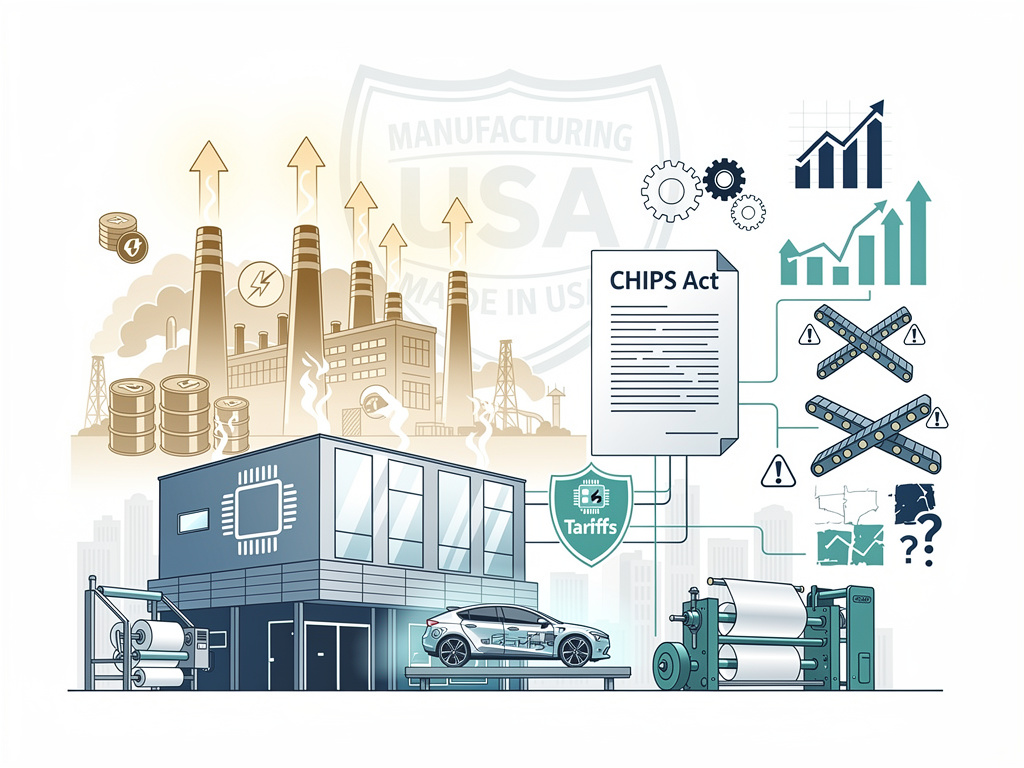
The CHIPS and Science Act of 2022 has catalyzed a boom in domestic semiconductor production. By early 2026, the $39 billion program has spurred over $1.2 trillion in private investment announcements for new fabs and related facilities, according to posts found on X and Deloitte Insights. In Arizona, TSMC’s massive Phoenix complex is ramping up, with Phase 1 expected online in 2025, aiming to produce advanced 4nm chips amid federal incentives totaling $6.6 billion.
Yet challenges persist. Factory construction spending peaked in 2024 but began declining in 2025 as CHIPS projects near completion, per U.S. Census data cited in X discussions. Labor shortages loom large, with 500,000 unfilled manufacturing jobs nationwide as of late 2025, exacerbated by an aging workforce.
Tariffs Test Reshoring Resolve
Tariffs under both Trump and Biden administrations have aimed to accelerate onshoring, but results are mixed. U.S. tariffs boosted headlines but have not yet rebuilt capacity at scale, with manufacturing employment dropping 42,000 jobs since April 2025 amid rising costs, according to Supply Chain Management Review. Posts on X highlight how tariffs slashed China’s duties from 125% to 10% while generating $500 billion in annual U.S. revenue, funding deficit reduction.
In Michigan, electric vehicle production surges with investments from Ford, GM and startups, bolstered by the Inflation Reduction Act. Yet IRA repeal threats have slowed clean energy construction. Advanced textiles in Massachusetts leverage innovation hubs like those at MIT, focusing on high-tech fibers for aerospace and defense rather than mass apparel.
Deloitte’s 2026 Manufacturing Outlook warns that reshoring and tariffs alone won’t suffice for a sector with shrinking GDP share. Targeted tech investments in AI and automation are essential for competitiveness, as factory construction hit $220.4 billion annualized in August 2025 per Census data.
Labor and Investment Hurdles Ahead
Finding workers remains a core constraint. The Cleveland Fed notes millions of jobs lost since the 1980s, with reshoring firms eyeing Midwest and Sun Belt regions for talent pools, per Cleveland Fed Data Brief. X sentiment echoes this, with users pointing to high interest rates post-Biden election discouraging growth.
Despite headwinds, optimism persists. Private investment in semiconductors, electronics and pharma has surged to $1.2 trillion since 2025, building on CHIPS groundwork, as noted in X posts. The Stimson Center warns that Trump’s tariff regime will profoundly shape U.S. chip manufacturing’s future, balancing economic nationalism with supply chain realities, via Stimson Center.
We can’t re-create America’s fleeting golden age, and we can’t continue to mythologize it into permanence. But we can imagine a new industrial strategy—if we stop using the past as our blueprint. Modern manufacturing demands capital depth, skilled talent and innovation, forging a resilient base distinct from postwar mass production.


 WebProNews is an iEntry Publication