
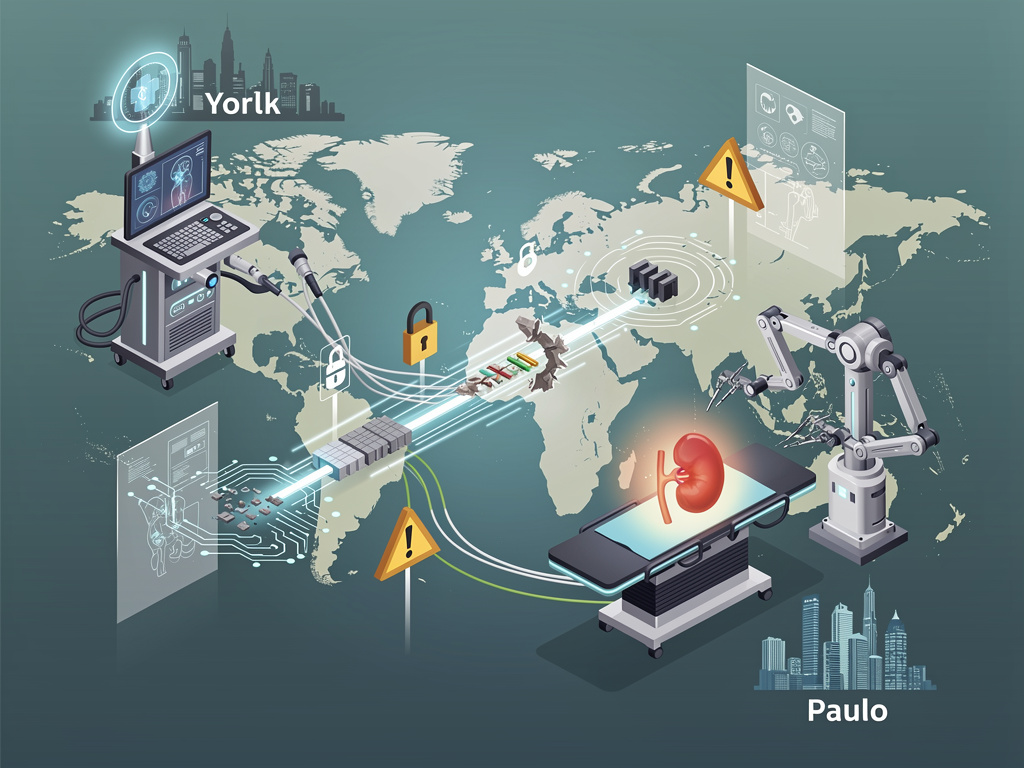
A surgeon in New York operated on a patient in São Paulo, Brazil. Fifteen hundred miles apart. No one died. That’s the headline, and it deserves serious scrutiny rather than breathless applause.
In early March 2025, a team at NYU Langone Health completed what they’re calling a landmark: a remote robotic surgical procedure performed across international borders on a living patient, using a modified version of the da Vinci surgical system connected over a dedicated high-bandwidth network. The patient underwent a partial nephrectomy — removal of part of a kidney — and recovered without complications. Slashdot reported on the story, drawing from coverage that detailed both the technical achievement and the significant engineering required to pull it off.
Let’s be direct: this is genuinely impressive engineering. But it is not new.
Remote surgery — telesurgery — has been demonstrated before. The first notable case was Operation Lindbergh in 2001, when a surgeon in New York removed a gallbladder from a patient in Strasbourg, France, using the ZEUS robotic system. That was 24 years ago. The technology worked then, too. And yet telesurgery hasn’t become standard practice in the intervening decades. Understanding why matters more than celebrating the latest demonstration.
The core problem has always been latency. When a surgeon moves a control instrument in New York and the robotic arm responds in São Paulo, the delay between input and action needs to be imperceptibly small — ideally under 150 milliseconds. Anything above 200 milliseconds and surgeons report significant difficulty performing precise movements. The 2001 Lindbergh operation ran on a dedicated fiber-optic line with latency around 155 milliseconds. According to reporting by Fierce Healthcare, the 2025 NYU procedure achieved latency in the range of 80-100 milliseconds using a combination of dedicated network infrastructure and edge computing nodes positioned along the transmission route.
That’s a meaningful improvement. But here’s the catch: it required a custom network setup that doesn’t exist as standard infrastructure. You can’t replicate this over commodity internet. Not yet. And that’s precisely the bottleneck that has kept telesurgery confined to demonstrations and proofs of concept for a quarter century.
Proponents argue that 5G and eventually 6G networks will solve the latency problem at scale. They might be right — eventually. Current 5G deployments in the United States average latency of 25-35 milliseconds under ideal conditions, according to Opensignal’s 2024 benchmarking data. But those are averages. Surgical applications can’t tolerate jitter — the variation in latency from moment to moment. A network that averages 30 milliseconds but occasionally spikes to 300 is useless for surgery. Consistency matters as much as speed.
So where does this leave us practically?
The most honest assessment is that remote robotic surgery remains a technology in search of reliable infrastructure. The surgical robots themselves are capable. The surgeons are skilled. The missing piece is a network layer that guarantees sub-150-millisecond latency with near-zero jitter, available everywhere, all the time. We don’t have that. Not in rural Appalachia. Not in sub-Saharan Africa. Not in the places where telesurgery would matter most.
And the regulatory picture is complicated. The FDA has not established a clear approval pathway for telesurgical procedures performed across state lines, let alone international borders. Medical licensing is state-based in the U.S. A surgeon licensed in New York operating on a patient in Texas faces legal questions that haven’t been resolved. Cross-border procedures add layers of liability, malpractice jurisdiction, and credentialing complexity that no one has fully addressed. STAT News has covered these regulatory gaps extensively, noting that the legal framework lags years behind the technical capability.
There’s also the question of whether remote surgery is solving the right problem. The global shortage of surgeons — particularly specialists — is real. The World Health Organization estimates that 5 billion people lack access to safe surgical care. Remote surgery could theoretically allow a specialist in Boston to operate on a patient in rural Kenya. That’s a compelling vision. But it assumes the receiving facility has a functioning surgical robot (which costs $1-2 million), trained support staff to position the patient and manage anesthesia, reliable power, and the network infrastructure described above. The surgeon is only one piece of a complex system.
I grew up in the Midwest, in communities where the nearest specialist was hours away. I understand the appeal of telemedicine and its extensions. But having watched technology hype cycles for decades — I started tinkering with computers before most of my classmates knew what a modem was — I’ve learned to distinguish between what works in a demonstration and what works at Tuesday-morning scale.
The NYU team deserves credit. Genuinely. They’ve pushed the technical envelope and demonstrated that the latency barrier can be managed over intercontinental distances with the right infrastructure. Dr. Michael Lee, who led the surgical team, told reporters the procedure went “exactly as planned,” and the patient was discharged within the expected recovery window. That’s a good outcome.
But one successful procedure on a dedicated network doesn’t constitute a viable clinical program. Intuitive Surgical, the maker of the da Vinci system, has been cautious in its public statements about telesurgery, and for good reason. Their business model depends on reliability and regulatory compliance, not headline-grabbing demonstrations. According to their 2024 annual report, the company installed over 9,000 da Vinci systems worldwide, but none are marketed or approved for remote operation across clinical sites.
The path forward likely involves incremental steps rather than a dramatic leap. Telementoring — where an expert surgeon guides a less experienced surgeon in real time via video and augmented reality overlays — is already happening and doesn’t require the same latency guarantees as direct telemanipulation. It’s less glamorous. It also works with existing infrastructure. Several academic medical centers, including the Mayo Clinic and Johns Hopkins, have active telementoring programs that have demonstrated measurable improvements in surgical outcomes at partner hospitals, as reported by Healthcare IT News.
My position is straightforward. Remote robotic surgery will eventually become clinically viable at scale. The physics and engineering support it. But “eventually” is doing a lot of work in that sentence. The infrastructure gap is real, the regulatory framework is absent, and the cost barriers are substantial. Industry insiders should watch the network buildout — particularly dedicated medical-grade network slicing on 5G — more closely than they watch surgical demonstrations. The robot isn’t the bottleneck. The pipe is.
And until someone solves the pipe problem, telesurgery remains what it has been since 2001: a spectacular proof of concept waiting for the world to catch up.


 WebProNews is an iEntry Publication