
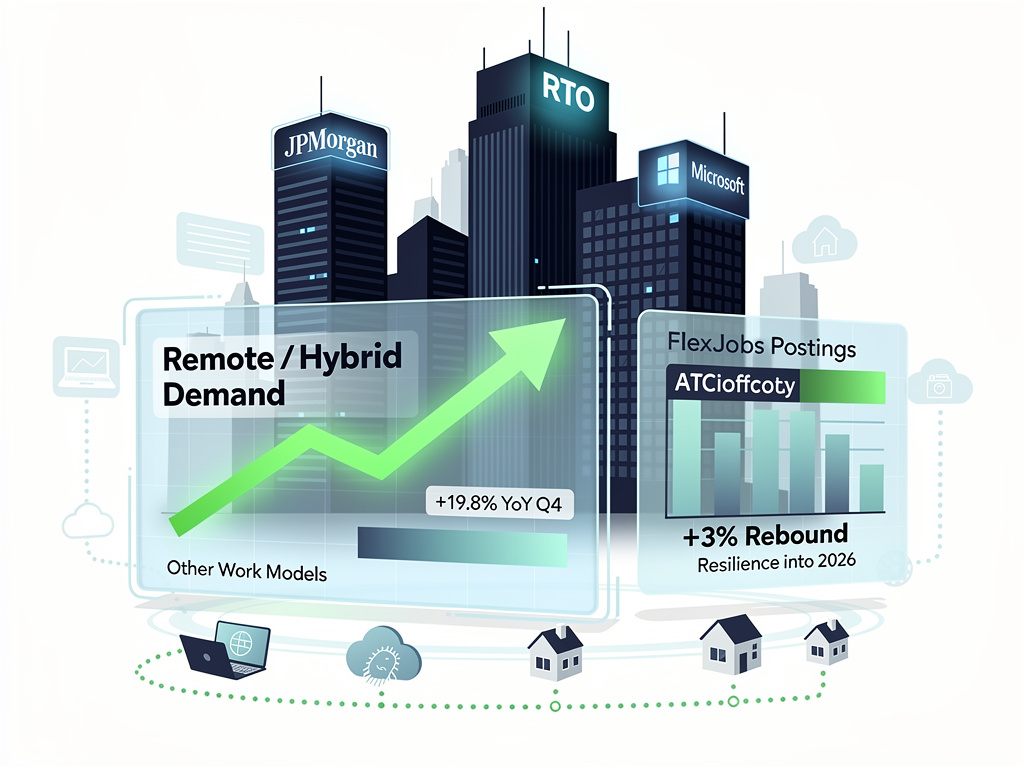
High-profile return-to-office mandates from JPMorgan Chase and Microsoft grabbed headlines throughout 2025, yet demand for remote and hybrid roles in technology and professional services outpaced in-office positions. Toptal’s High-Skilled Job Report for Q4 2025 reveals global demand for experienced remote and hybrid professionals rose 19.8% year-over-year from Q4 2024, compared to 19.4% across all work models including in-office roles. Full-year growth hit 10.9% for remote and hybrid talent versus 10.4% overall.
Quarter-over-quarter, remote and hybrid demand dipped 4%, milder than the 4.7% decline for the broader market. “The talent market is undergoing a structural shift as organizations redefine how work gets done, finding a balance between AI and human judgment, and between remote flexibility and in-person collaboration,” said Erik Stettler, Toptal’s Chief Economist and report author, in the Toptal report.
Office occupancy in major U.S. markets has climbed from pandemic lows but lingers below 2019 levels, fostering an equilibrium where companies strategically deploy remote teams for talent access and speed. This resilience persists amid mandates, as firms experiment with AI integration and distributed work.
Corporate Mandates Clash with Market Realities
Instagram demanded five days in-office starting February 2026 to build a “winning culture,” per CEO Adam Mosseri, while Truist and Paramount Skydance enforced full-time office presence from January. Microsoft requires hybrid employees in offices three or more days weekly from February, announced Chief People Officer Amy Coleman. A ResumeBuilder survey of business leaders in October 2025 found nearly half of companies planning at least four in-office days in 2026, with 28% phasing out remote work entirely, as reported by Newsweek.
Amazon, AT&T, Goldman Sachs, Intel, and Starbucks tightened policies, with a majority of Fortune 100 employees under full-time mandates by Q2 2025, up from 5% two years prior, according to Placer.ai data cited in Business Insider. Average required days rose to 3.9 weekly. Yet actual work-from-home rates held steady at 25-30%, fueled by manager exceptions for high performers.
Stacie Haller, chief career advisor at ResumeBuilder, told Newsweek many firms use RTO to trim headcount indirectly: “Leaders are often aware that a portion of the workforce will choose to leave in favor of roles offering greater flexibility.”
FlexJobs Tracks Remote Posting Rebound
Remote job postings grew 3% in Q4 2025, reversing earlier cooling, per FlexJobs’ Remote Work Index. Sixty-seven percent targeted mid- to senior-level candidates, with just 6% entry-level. High-salary roles over $100,000 dominated demand. FlexJobs data shows 85% of workers prioritize remote options in job applications over pay or benefits at 72%, and 76% would seek new jobs if RTO eliminates remote work.
Hybrid roles prevail among remote-capable U.S. employees at 52%, with 26% fully remote and 22% on-site, Gallup found. Smaller firms under 500 employees offer flexibility far more than Fortune 100 giants, per Flex Index Q3 2025 report, sustaining remote work for half of private-sector employees.
Keith Spencer, career expert at FlexJobs, noted the uptick signals targeted hiring for outcome-driven roles amid rigid mandates.
AI Fuels Demand in Key Sectors
Toptal data spotlights AI-driven surges: data science +32% YoY, developers +30%, marketing experts +33%, product managers +30%. Project managers rose 6%, sales 12%, while designers, info security, and management consultants dipped 2%. Senior talent with 5+ years outperforms juniors across models, as AI reshuffles teams.
Global tech layoffs totaled 122,500 in 2025, down 20% from 2024 but above pre-2020 norms. U.S. postings grew 2.1% QoQ in Q4, bucking declines elsewhere. Toptal’s Market Strength Score rates remote/hybrid demand “Strong,” outpacing blended markets despite volatility from experimentation.
Companies leverage remote for diverse pools and rapid scaling, beyond cost savings. Five years post-COVID peaks, flexible models mature as permanent fixtures.
Worker Pushback and Compliance Shifts
Only 7% of workers would quit outright over non-negotiable RTO in 2026, down from 51% in 2025, signaling “The Great Compliance,” per a report in CPA Practice Advisor. Combined, 91% threatened exit or job hunts last year; resolve wanes in a tougher market.
74% expect equal or less bargaining power for flexibility in 2026. On-site workers lead for pay and promotions at 40%, hybrid 14%, remote 7%. Jennifer Schielke of Summit Group Solutions called RTO motives “culture, collaboration, control, cost and copout,” per Newsweek.
Remote thrives quietly via exceptions, coffee badging, and small-firm policies. Founder Reports notes 22.9% of U.S. employees worked partially remote in November 2025, down slightly from 23.3% in 2024, with hybrids outnumbering full remote.
Equilibrium Emerges Amid Experimentation
Frank Weishaupt, CEO of Owl Labs, predicts “hybrid creep” with 34% at four office days, up from 23% in 2023, shifting flexibility to “when” over “where.” Yet Toptal’s Stettler emphasizes optionality: “Organizations that build optionality through disciplined experimentation… will be positioned to lead.”
Remote work endures for strategic hires, AI specialists, and non-Fortune 100 firms, defying mandates. As 2026 unfolds, demand data underscores flexibility’s edge in attracting senior talent during transition.


 WebProNews is an iEntry Publication