
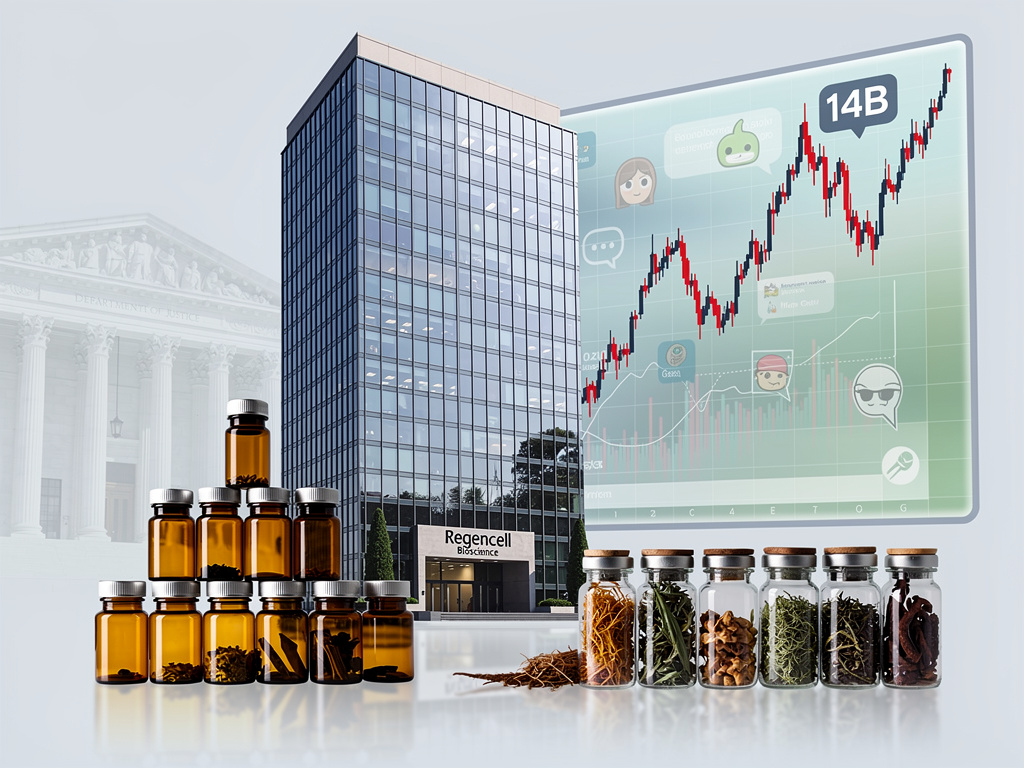
Regencell Bioscience Holdings Ltd., a tiny Hong Kong outfit with Cayman Islands incorporation and a Nasdaq ticker, commands a staggering $14.4 billion market capitalization as of January 26, 2026, despite zero revenue, persistent losses, and a U.S. Justice Department probe into its trading activity. Shares of RGC closed at $29.20 that day, down from a 52-week peak of $83.60 but up more than 23,000% over the prior year, according to Yahoo Finance. This valuation eclipses many established biotech firms, placing Regencell among the top 20 in the Nasdaq Biotechnology Index by market value, though it sits outside the benchmark.
The company’s singular focus—developing traditional Chinese medicine herbal formulas for autism spectrum disorder and attention-deficit hyperactivity disorder—stems from the personal experience of founder and CEO Yat-Gai Au, who served as “patient #1” and reported “remarkable results,” per chief operating officer James Chung in comments to The Wall Street Journal. Au owns roughly 89% of the roughly 495 million outstanding shares, leaving a razor-thin public float that amplifies volatility and deters short sellers with sky-high borrow fees.
In its fiscal 2025 annual report on Form 20-F, filed October 31, 2025, Regencell disclosed a $3.58 million net loss for the year ended June 30, improved slightly from $4.36 million the prior year, with cash and investments dwindling to $4.9 million from $8 million. Research and development outlays totaled under $1 million, primarily salaries for its 10 employees. The auditor echoed the company’s warning of “substantial doubt regarding our ability to continue as a going concern.”
DOJ Scrutiny Shadows Speculative Surge
Regencell’s October filing revealed a subpoena from the Justice Department seeking records on operations, finances, accounting, and share trading amid extreme price swings. The company is cooperating but anticipates hefty legal costs, as noted in the report. Law firms like Bronstein, Gewirtz & Grossman and Bragar Eagel & Squire launched investor probes into potential claims, per announcements in early January 2026 reported by Simply Wall St.
Chung attributed volatility to persistent short selling since the 2021 IPO, declining further comment. The stock’s 126-fold rise since then includes a mid-June 2025 peak above $38 billion market cap post a 38-for-1 split, when shares hit $78 adjusted. Recent swings saw a 40% intraday gain on no news in early January, followed by sharp reversals, as tracked by CNBC.
Trading volume hovers around 400,000-450,000 shares daily, fueling short-squeeze risks in this low-float name. Borrow costs remain prohibitive, making long positions precarious for all but the boldest speculators.
Herbal Formulas Face Steep Hurdles
Regencell positions its therapies as alternatives to conventional drugs with side effects, citing CDC data that no cure exists for ADHD or ASD. Its Sik-Kee Au TCM Brain Theory underpins formulas targeting brain blood flow restrictions. Interim results from a second efficacy trial showed a 37% mean symptom improvement in 37 patients via the SKATBT-A3 assessment, with no adverse effects, announced in 2025 press releases on the company site.
Yet skeptics abound. Average drug development costs $4 billion, per industry norms Regencell itself flags, dwarfing its R&D spend. No products are approved or salable, and trials remain early-stage, lacking peer-reviewed validation or regulatory nods from FDA or equivalents, as detailed in filings.
Au, a UC Berkeley Haas graduate with investment banking roots at Deutsche Bank, has poured over $15 million personally into the venture, boosting his stake to 81% via purchases like $5 million in 2022, per StockTitan. He pledged a $1 salary until $1 billion market cap.
Speculation Echoes Broader Frenzy
Regencell’s odyssey mirrors meme-stock excesses amid AI hype, crypto revivals, and dubious overseas listings flooding Nasdaq. From 11 cents adjusted a year ago, shares embody a market fringe detached from fundamentals, as Bloomberg chronicled its 82,000% June 2025 surge.
X chatter in January 2026 amplified the frenzy, with traders eyeing squeezes and Turkish posts dissecting the anomaly, per semantic searches. TipRanks noted unexplained surges, while Seeking Alpha warned of survival-mode cost cuts amid DOJ risks.
With cash burn accelerating under probe expenses, Regencell’s endurance tests investor appetite for absurdity. Au’s control ensures alignment but liquidity traps abound, underscoring capital markets’ thirst for peril.
Valuation Defies Biotech Norms
At 518% above fair value per Morningstar, RGC trades as a sentiment play. Peers with pipelines and revenue lag far behind. Thin institutional interest and CEO dominance signal high-wire risks.
Recent X posts from WSJ Markets and traders highlight the outlier status, with no fresh catalysts beyond speculation. As January volatility persists—drops of 18% one day, rebounds the next—Regencell exemplifies how thin floats ignite meme infernos.
For industry watchers, it spotlights Nasdaq’s gatekeeping of foreign shells and regulatory blind spots fueling manias.


 WebProNews is an iEntry Publication