
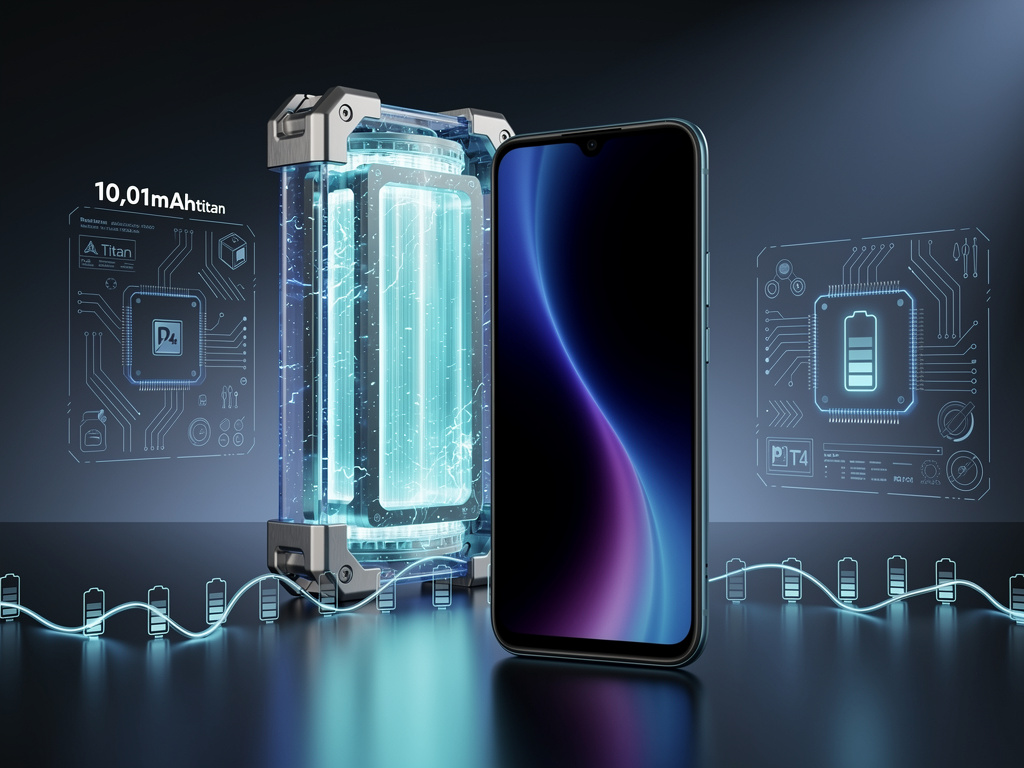
Realme’s Power Revolution: A Smartphone That Defies the Daily Charge
In the fiercely competitive world of smartphones, where incremental upgrades often dominate headlines, Realme is making a bold statement with its latest innovation. The company has unveiled the P4 Power, a device boasting an unprecedented 10,001mAh battery, promising to redefine user expectations for endurance. This move comes at a time when consumers are increasingly frustrated with the need for constant recharging, and Realme aims to address that pain point head-on. Drawing from recent announcements, the phone is set to launch in India on January 29, 2026, positioning it as a game-changer in the mid-range segment.
The P4 Power’s battery capacity dwarfs the industry standard of around 5,000mAh found in most flagships, such as Samsung’s Galaxy S25 Ultra. According to details shared in a report by The Verge, Realme claims this massive power reserve could deliver multiple days of usage on a single charge, potentially lasting up to a week under light conditions. This isn’t just hype; it’s backed by advancements in battery technology that allow for higher energy density without significantly increasing the device’s size or weight.
Industry analysts note that Realme’s approach taps into a growing demand for longer-lasting devices, especially in emerging markets like India where power outages are common and users rely heavily on their phones for daily tasks. The phone’s specifications, including a 6.78-inch AMOLED display with a 144Hz refresh rate, suggest it’s not sacrificing performance for battery life. Instead, it’s integrating cutting-edge components to balance power efficiency and capability.
Battery Technology Breakthroughs
At the heart of the P4 Power is what Realme calls its “Titan” battery, a silicon-carbon anode design that achieves an energy density far superior to traditional lithium-ion cells. Sources from GSMArena highlight that this technology enables the phone to maintain a slim profile—rumored to be around 9.5mm thick—while packing in that enormous capacity. Weighing in at approximately 208 grams, it’s remarkably light for its specs, avoiding the bulkiness that plagued earlier high-capacity phones.
This innovation didn’t emerge overnight. Realme has been teasing concept devices with even larger batteries, such as a 15,000mAh prototype showcased in 2025, as noted in various tech forums and social media discussions. Posts on X (formerly Twitter) from that period reflect excitement among tech enthusiasts, with many praising the potential for “four days of standard usage” without needing a plug. Such sentiment underscores a shift in consumer priorities toward reliability over flashy features.
Moreover, the P4 Power supports 80W fast charging, allowing users to top up that massive battery in under an hour, according to preliminary specs outlined in a piece by Business Standard. This combination of capacity and speed could eliminate the anxiety of running out of power during travel or extended outings, a common complaint in user reviews of competing devices.
Processor and Performance Integration
Powering the device is the MediaTek Dimensity 7400 chipset, a mid-range processor known for its efficiency and AI capabilities. As detailed in coverage from Beebom Gadgets, this SoC is expected to handle everyday tasks like streaming, gaming, and multitasking without draining the battery excessively. Realme has incorporated AI features to optimize power consumption, such as intelligent resource allocation that extends runtime by predicting user behavior.
Comparisons to predecessors reveal how far Realme has come. The company’s earlier models, like those in the GT series, experimented with high-density batteries but fell short of the 10,000mAh mark due to manufacturing constraints. Now, with mass production underway, as reported in StartupNews.fyi, Realme is scaling up to meet demand, potentially influencing other manufacturers to follow suit.
On the camera front, the P4 Power features a 50MP primary sensor, promising solid photography without the premium price tag. Expected to retail around ₹22,999 in India, based on estimates from Beebom Gadgets, it targets budget-conscious consumers who value longevity over top-tier specs. This pricing strategy could disrupt the market, pressuring rivals like Xiaomi and Samsung to innovate in battery tech.
Market Implications and Challenges
The launch timing is strategic, aligning with India’s post-festive season when smartphone sales typically surge. Insights from PCMag suggest that while the P4 Power offers “multiple-day-long battery life,” availability might be limited initially, creating buzz through scarcity. Realme’s focus on India as the primary market reflects the region’s massive user base and appetite for affordable, feature-rich devices.
However, challenges loom. Larger batteries raise concerns about safety and longevity, with potential risks of overheating or degradation over time. Realme addresses this through advanced cooling systems and durable materials, but industry watchers will scrutinize real-world performance post-launch. Additionally, while the phone supports 5G, its mid-range processor might not appeal to power users seeking flagship-level speed.
Social media buzz on X indicates strong positive sentiment, with users hailing it as a “battery beast” that could end the era of daily charging. Posts from influencers and tech accounts in 2025 and early 2026 emphasize the innovation’s potential to transform habits, from extended gaming sessions to reliable use in remote areas.
Competitive Dynamics and Future Trends
Realme’s push echoes broader industry shifts toward sustainable power solutions. Competitors like Oppo and Vivo, part of the same BBK Electronics family, have dabbled in high-capacity batteries, but none have crossed the 10,000mAh threshold in production models. A report in Techlusive notes that this could spark a “battle of the big batteries,” encouraging advancements in silicon-anode tech across the board.
Looking ahead, experts predict that by 2027, average smartphone battery capacities could rise significantly, driven by consumer demand and technological progress. Realme’s Titan battery might set a new benchmark, with energy densities approaching 887Wh/L, as seen in their concepts. This evolution could extend to wearables and IoT devices, broadening the impact.
Environmental considerations also play a role. Larger batteries mean fewer charging cycles, potentially reducing electronic waste from power banks and cables. Realme’s commitment to ethical manufacturing, as affirmed in StartupNews.fyi’s coverage, aligns with growing scrutiny on supply chains in the tech sector.
User Experience and Real-World Testing
Early teasers suggest the P4 Power could last up to 31 days in standby mode, a claim that, if verified, would be revolutionary. Drawing from X posts, users express eagerness for a device that “lasts as long as you want it to,” highlighting scenarios like long-haul flights or outdoor adventures where recharging isn’t feasible.
In terms of software, Realme’s custom UI, likely based on Android 15 or later, includes power-saving modes enhanced by AI. This integration, as discussed in Gadgets 360, allows for adaptive brightness, app hibernation, and background process management to maximize efficiency.
For industry insiders, the real intrigue lies in how this affects component suppliers. MediaTek’s Dimensity series gains a boost from such partnerships, potentially increasing its market share against Qualcomm. Battery manufacturers, meanwhile, may see a surge in demand for silicon-carbon cells, reshaping global supply dynamics.
Strategic Positioning and Global Ambitions
Realme’s announcement, timed just before the launch, builds anticipation through targeted marketing. The company’s history of aggressive pricing and rapid iteration has carved out a niche, and the P4 Power extends that to endurance-focused consumers. As per details in GSMArena, the 144Hz display ensures smooth visuals, making it suitable for gaming despite the mid-range chip.
Globally, expansion beyond India could face hurdles like varying regulations on battery safety. Yet, with positive reception on platforms like X, where tech communities laud the “huge 10,001mAh Titan battery,” Realme might accelerate international rollouts.
Ultimately, this device represents more than a spec bump; it’s a statement on prioritizing user needs in an era of constant connectivity. By tackling the perennial issue of battery life, Realme is not just launching a phone—it’s challenging the status quo and inviting the industry to evolve. As the January 29 launch approaches, all eyes will be on whether the P4 Power lives up to its promises, potentially heralding a new standard in mobile power management.


 WebProNews is an iEntry Publication