
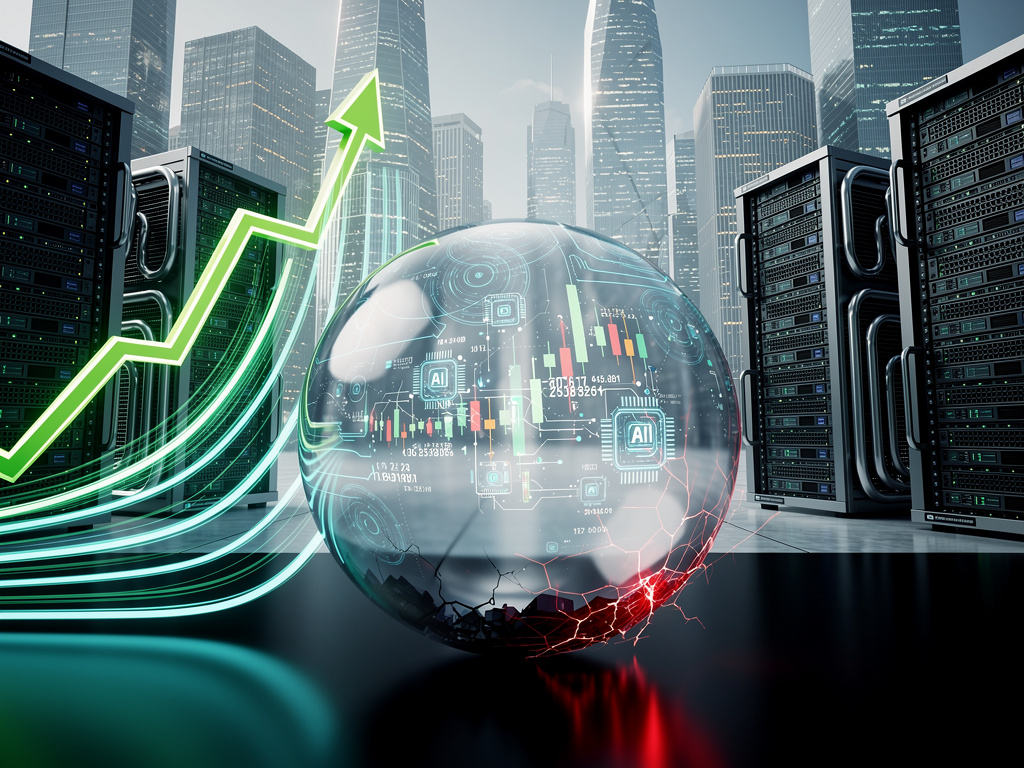
The AI Mirage: When Hype Meets Hard Economics
In the high-stakes world of technology investments, artificial intelligence has emerged as the undisputed star, drawing trillions in capital and fueling stock market surges. Yet, beneath the glittering promises of transformative innovation, a growing chorus of investors and analysts is sounding alarms about an impending reckoning. As 2026 unfolds, the sector’s massive expenditures on infrastructure and development are outpacing tangible returns, raising specters of a bubble poised to deflate.
Recent reports highlight the scale of this frenzy: tech giants and startups alike have poured hundreds of billions into AI data centers, chips, and software, often justified by projections of exponential growth. But skepticism is mounting. For instance, hedge fund titan Ray Dalio has publicly warned that the AI boom is entering its early bubble phase, a sentiment echoed in a Reuters article detailing his social media post. Dalio’s caution points to overinflated valuations driven more by speculation than by proven profitability.
This isn’t mere pessimism; data underscores the disconnect. While AI-related revenues are climbing, they lag far behind the investment torrent. A piece from The Guardian notes that although sales are rising rapidly, they’re insufficient to offset the “wild levels” of spending, potentially shaking global economies if a correction hits.
Signs of Overreach in AI Investments
Industry leaders are acknowledging the risks, even as they champion the technology. Google CEO Sundar Pichai, in an exclusive interview, described the trillion-dollar AI investment surge as having “elements of irrationality,” according to a BBC report. Pichai hailed AI as an “extraordinary moment” but stressed that no firm would escape unscathed if the bubble bursts, highlighting the precarious balance between innovation and financial prudence.
Comparisons to past market manias are inevitable. Analysts draw parallels to the dot-com era of the late 1990s, where euphoria led to a devastating crash. A CNBC analysis explores these echoes, noting how current AI hype mirrors the overvaluations that preceded the 2000 bust and even the 2008 financial crisis. The difference? Today’s stakes are higher, with AI intertwined in critical sectors like healthcare and finance.
Social media platforms buzz with investor sentiment, amplifying these concerns. Posts on X from market watchers predict a 2026 correction, with some likening the situation to a “debt bomb” ready to detonate. These online discussions reflect a mix of optimism and dread, where users debate whether the AI surge represents a genuine super cycle or an unsustainable hype wave, often citing massive data center buildouts funded by profitable but debt-laden tech behemoths.
Historical Parallels and Market Warnings
Delving deeper, experts like Yale’s Jeffrey Sonnenfeld outline potential bursting scenarios in a Yale Insights piece, pointing to intertwined deals among tech giants as signs of overinvestment. They argue that regulatory scrutiny or a slowdown in adoption could trigger a cascade of failures, unraveling the fragile web of AI partnerships.
Financial memos add weight to these fears. Howard Marks of Oaktree Capital, in his latest analysis, probes the uncertainty surrounding AI’s potential while urging prudence. Marks identifies hallmarks of past bubbles—widespread enthusiasm, rapid capital inflows, and a disconnect from fundamentals—applying them to the current AI fervor, where valuations soar despite unclear paths to monetization.
On the ground, the investment figures are staggering. Reuters reports that investors are split on the trillion-dollar question of whether AI demand will sustain the spending spree, as detailed in an article from late 2025. With billions funneled into infrastructure, any tail-off in demand could leave companies with stranded assets, echoing the telecom overbuilds of the early 2000s.
Investor Strategies Amid Uncertainty
As 2026 progresses, some investors are pivoting toward value hunting beyond overhyped tech stocks. A Reuters piece suggests that concerns over an AI bubble are pushing traders to undervalued market segments, diversifying away from the “Magnificent Seven” giants that have dominated recent gains. This shift indicates a maturing rally, where discernment replaces blind enthusiasm.
Analysts foresee a “fractured” AI trade this year, with opportunities emerging in non-tech areas. Yahoo Finance explores how 2025’s AI courtship must now confront 2026’s bill-paying reality in a report, predicting that other sectors might finally eclipse the tech heavyweights as the hype cycle evolves.
Public discourse on platforms like X reveals a spectrum of views, from predictions of a massive pop to calls for measured optimism. Users discuss how AI’s shift toward domain-specific systems and physical applications could sustain growth, yet many flag risks like overinvestment in data centers outstripping demand, potentially leading to a mid-2026 deflation.
Economic Ripples and Global Impacts
Broader economic implications loom large. The Guardian’s Heather Stewart warns that the cost of subpar AI outputs—dubbed “AI slop”—might force a global rethink, as revenues fail to match investments. This could exacerbate inflationary pressures, with a Reuters survey identifying AI-driven inflation as 2026’s most overlooked risk, fueled by stimulus and booming tech spending.
MIT Technology Review grapples with defining the bubble itself in a thoughtful exploration, noting consensus on its existence but disagreement on its form and fallout. This ambiguity underscores the challenge: AI’s vast promise coexists with speculative excess, creating a volatile mix for global markets.
Investor surveys, such as one cited in UK press via X posts, rank AI bubble burst as the top 2026 worry, surpassing other macro threats. This reflects a contrarian view that AI can be transformative yet mispriced at scale, prompting calls for regulatory guardrails to temper the frenzy.
Navigating the Potential Fallout
For industry insiders, the key lies in distinguishing genuine innovation from froth. BizToc’s analysis of an AI “supercycle” amid bubble fears, in a preview, projects sustained spending but warns of misallocation if revenues don’t accelerate. This duality—opportunity laced with peril—defines the current moment.
Historical lessons from the dot-com crash remind us that bubbles don’t erase technologies; they recalibrate them. Yale Insights’ Sonnenfeld and co-author detail three bubble-popping mechanisms: regulatory intervention, market saturation, or economic downturns, each potentially reshaping AI’s trajectory.
X discussions highlight emerging trends, like a focus on silicon-based workforces and decentralized AI in regions like China and Korea, suggesting that even a reckoning could pivot the sector toward more sustainable models rather than outright collapse.
Future Pathways for AI Sustainability
As we peer into 2026, the narrative shifts from unbridled optimism to strategic caution. Bridgewater’s Dalio, via Reuters, emphasizes the early-stage bubble dynamics, urging investors to monitor Wall Street’s tech-driven gains for signs of fatigue.
Oaktree’s Marks reinforces this with his emphasis on prudence, drawing on decades of market cycles to argue that AI’s potential, while immense, demands tempered expectations. The Yale piece complements this by outlining how overinvestment tangles could unravel, potentially through antitrust actions or funding droughts.
Ultimately, the AI reckoning may not spell doom but a necessary correction. CNBC’s bubble debate captures this nuance, comparing today’s surge to past crises while noting AI’s unique societal integration, from enterprise training mandates to evolving assistants that manage real-world tasks.
Balancing Innovation and Realism
Industry forecasts, such as those from Forrester mentioned in X posts, predict market corrections but also growth in AI fluency across enterprises. This suggests a maturation where hype gives way to practical applications, potentially mitigating the bubble’s impact.
Global policies will play a pivotal role. X users speculate on U.S. ETF regulations boosting adoption and China’s push for alternatives, indicating that geopolitical factors could either exacerbate or cushion a downturn.
In this environment, savvy investors are eyeing diversified portfolios, as Reuters advises, to weather potential volatility. The Guardian’s economic risk assessment warns of a shake-up if investments continue unchecked, yet it also hints at resilience through rapid revenue growth in niche areas.
Emerging Opportunities Post-Reckoning
Looking ahead, a post-bubble AI sector might emphasize efficiency over scale. MIT’s review posits that popping the bubble could clarify what truly works, weeding out “AI slop” and fostering innovations with clear profitability.
Yahoo Finance’s take on footing the bill in 2026 underscores a transition where AI integrates into broader economies, outshining pure tech plays. This could herald undervalued opportunities in manufacturing, gaming, and beyond, as X posts suggest.
For insiders, the lesson is clear: while AI’s transformative power endures, the current investment mania demands vigilance. As Dalio and Pichai intimate, irrational elements must be confronted to ensure the technology’s long-term viability, turning potential reckoning into a catalyst for grounded progress.


 WebProNews is an iEntry Publication