
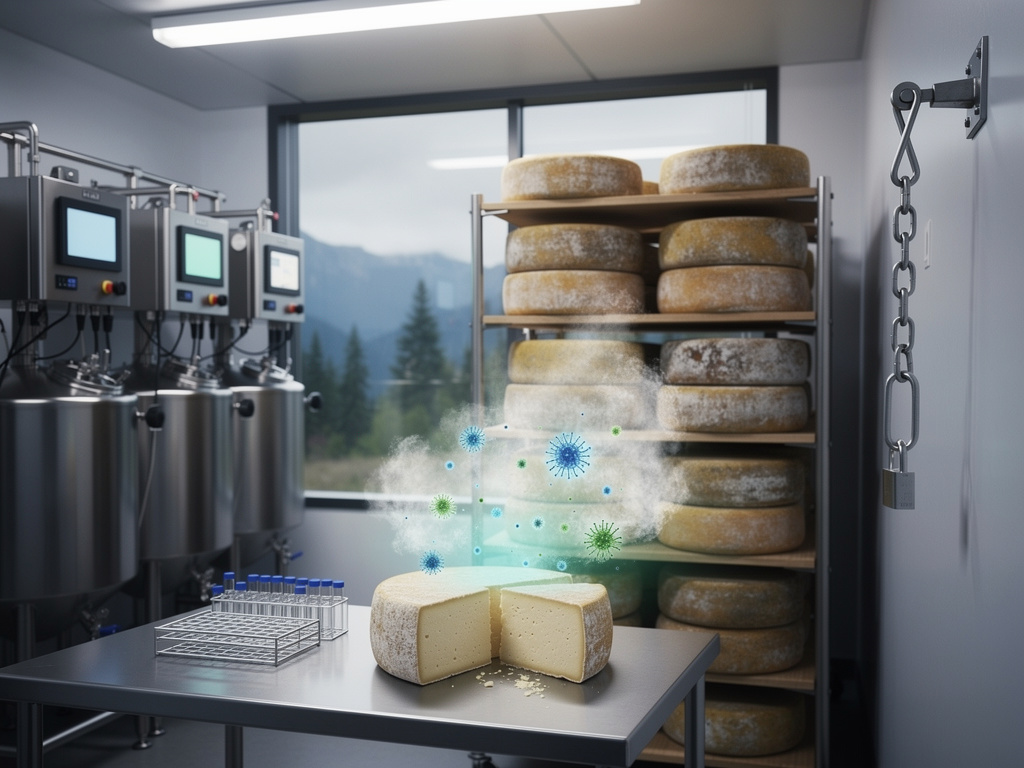
A small artisan cheesemaker in Washington state is locked in a standoff with the Food and Drug Administration over a listeria outbreak that federal investigators say is linked to its raw milk cheese. The company disagrees. It has refused to issue a recall. And the dispute is raising hard questions about food safety enforcement, the limits of federal authority, and the growing cultural divide over raw dairy products in America.
The FDA announced in late March 2026 that it had linked an outbreak of Listeria monocytogenes infections to cheese produced by Samish Bay Cheese, a small farmstead creamery in Bow, Washington. According to the agency, whole genome sequencing connected clinical isolates from sick patients to samples found in the company’s facility. At least four people across multiple states have been hospitalized. One death has been reported.
Listeria is not a trivial pathogen. It kills roughly one in five people it hospitalizes, according to the Centers for Disease Control and Prevention. Pregnant women, the elderly, newborns, and immunocompromised individuals face the greatest risk. The bacterium thrives at refrigerator temperatures, making contaminated cheese a particularly dangerous vector.
Yet Samish Bay Cheese has publicly disputed the FDA’s findings. In a statement posted to its website and shared on social media, the company said it “100% disagrees” with the agency’s conclusions and will not voluntarily recall its products. The company argues that its own testing has not confirmed the presence of listeria in finished cheeses available to consumers, and that the FDA’s environmental samples don’t prove the cheese reaching store shelves is contaminated.
The FDA, for its part, issued a public advisory urging consumers to avoid Samish Bay products. But without a voluntary recall, the agency’s immediate options are limited.
The Enforcement Gap
Here’s the thing most consumers don’t realize: the FDA cannot unilaterally order a food recall in most circumstances. The agency’s primary tool is the voluntary recall — a system built on the assumption that companies will cooperate when presented with evidence of contamination. When they don’t, the FDA must pursue a slower, more cumbersome legal process.
Under the FDA Food Safety Modernization Act of 2011, the agency does have the authority to issue a mandatory recall, but only after first giving the company an opportunity to voluntarily recall and only after the FDA’s commissioner determines there is a “reasonable probability” that the food is adulterated and that the use of or exposure to the product will cause serious adverse health consequences. Even then, the company can appeal, and the administrative process takes time — time during which potentially contaminated products may remain on shelves.
In practice, the FDA almost never invokes mandatory recall authority. The agency has used it only a handful of times since FSMA was enacted. The vast majority of food recalls in the United States are technically voluntary, initiated by the company itself, often after behind-the-scenes pressure from federal regulators.
Samish Bay’s refusal represents something rare. And uncomfortable.
The company’s position isn’t entirely without precedent. Small producers have occasionally pushed back on FDA findings, questioning sampling methodology or arguing that environmental positives don’t equate to contaminated finished products. In the raw dairy world, distrust of federal regulators runs deep — a sentiment that has only intensified in recent years amid broader skepticism of government health agencies.
But public health experts say the science here is straightforward. Whole genome sequencing — the technique used to link clinical and environmental isolates — is considered the gold standard in outbreak investigation. When the genetic fingerprint of listeria found in a production facility matches the strain making people sick, epidemiologists treat that as powerful evidence of a causal connection.
“WGS doesn’t lie,” one former CDC epidemiologist told reporters. “When you have a match at that resolution, you’re not talking about coincidence.”
Samish Bay has not publicly challenged the sequencing data itself. Instead, the company has focused on the distinction between environmental samples taken from its facility and the finished products sold to consumers — a distinction that food safety scientists say is less meaningful than it might appear. If listeria is present in the production environment, the risk of it contaminating cheese during aging, cutting, or packaging is significant, particularly in a raw milk product that hasn’t undergone pasteurization.
Raw milk cheeses aged fewer than 60 days are illegal to sell in the United States precisely because of pathogen risks. Cheeses aged longer than 60 days are permitted under federal regulations, on the theory that the aging process — combined with salt, acidity, and reduced moisture — creates conditions inhospitable to dangerous bacteria. But listeria is notoriously resilient. It can survive and even grow under conditions that would suppress other pathogens. The 60-day rule, some food scientists argue, provides insufficient protection against L. monocytogenes specifically.
Raw Milk’s Political Moment
The Samish Bay standoff arrives at a politically charged moment for raw dairy in the United States. Over the past two years, raw milk has moved from the fringes of the food freedom movement to something closer to the mainstream — boosted by social media influencers, wellness culture, and high-profile political figures who frame pasteurization mandates as government overreach.
During the H5N1 bird flu outbreak that affected U.S. dairy herds in 2024 and 2025, raw milk sales actually surged in several states, even as public health officials warned that unpasteurized milk from infected cows could contain live avian influenza virus. The phenomenon baffled epidemiologists but made a certain cultural logic: for a segment of the population, official warnings had become a reason to buy, not a reason to avoid.
Robert F. Kennedy Jr., confirmed as Secretary of Health and Human Services in early 2025, has long been associated with skepticism toward conventional public health orthodoxy. While Kennedy’s HHS has not directly commented on the Samish Bay situation, his broader posture toward deregulation and food freedom has emboldened raw dairy advocates who see FDA oversight as heavy-handed and scientifically questionable.
State-level politics have shifted, too. Several states have loosened restrictions on raw milk sales in recent legislative sessions. In 2025 alone, bills expanding direct-to-consumer raw milk sales were introduced in more than a dozen state legislatures, with several passing. Proponents argue that consumers should have the right to choose what they eat, and that small-scale, pasture-based dairy operations produce safer milk than the industrial system pasteurization was designed to clean up.
There’s a kernel of truth in that last argument. Pasteurization was developed in the 19th century partly in response to filthy urban dairies where cows were fed distillery slop and milked in unsanitary conditions. Modern small-scale dairy operations, with their emphasis on herd health and hygiene, do produce cleaner raw milk than those historical predecessors. But cleaner doesn’t mean sterile. And listeria, unlike many pathogens, doesn’t require gross contamination to cause an outbreak. A single colony-forming unit in the wrong place at the wrong time can be enough.
The tension between food freedom and public health is real, and it’s not going away. But the Samish Bay case isn’t really about philosophy. It’s about a specific outbreak, specific hospitalizations, and a specific death.
For the families affected, the debate over consumer choice is abstract. The listeria was not.
Industry observers are watching closely to see whether the FDA will escalate enforcement. The agency could seek a court order to seize products, or it could pursue an injunction against the company. Both options require Department of Justice involvement and take weeks or months to execute. In the interim, the FDA’s advisory stands as the primary public-facing action — a warning without teeth, critics say, in a system that depends on voluntary compliance.
Some food safety advocates have called on retailers to pull Samish Bay products from shelves regardless of the company’s position on a recall. Several natural food co-ops and specialty retailers in the Pacific Northwest have reportedly done so. But the company also sells directly to consumers at farmers markets and through its farm store, channels that are harder for regulators to reach.
What Happens Next
The Samish Bay case will likely become a reference point in the ongoing national argument about raw dairy regulation — cited by both sides for different reasons. Food safety professionals will point to it as evidence that the current recall system has dangerous gaps. Raw milk advocates will argue that the FDA’s case is circumstantial and that the agency is targeting a small producer it can’t fully control.
Neither framing captures the full picture. The recall system does have gaps. And the FDA’s evidence, based on whole genome sequencing, is more than circumstantial — it’s the same standard of evidence the agency uses to link outbreaks to major food manufacturers, who almost always comply with recall requests.
What’s different here isn’t the science. It’s the culture. Small artisan producers operate in a world where personal relationships with customers, a commitment to traditional methods, and a skepticism of industrial food systems form the foundation of their business identity. Being told by a federal agency that your product may have killed someone is not just a regulatory event. It’s an existential one. The instinct to push back is human, even when the evidence is strong.
But instinct isn’t epidemiology. And the listeria doesn’t care about anyone’s business model.
The FDA has said its investigation is ongoing. More cases may emerge. If they do, the pressure on the agency to act — and on Samish Bay to reconsider — will intensify. For now, the cheese remains on some shelves, the advisory remains in effect, and the standoff continues.
Four people hospitalized. One dead. A company that says it disagrees.
The system, such as it is, grinds on.


 WebProNews is an iEntry Publication