
In the world of single-board computing, even the smallest changes to a proven design can ripple across industries — from hobbyist workshops to industrial automation floors. The Raspberry Pi Foundation has quietly introduced a revised version of its flagship Raspberry Pi 4, and while it may look identical to the untrained eye, the internal changes tell a story about semiconductor supply chains, engineering pragmatism, and the delicate balancing act of keeping a beloved product alive in an era of chip uncertainty.
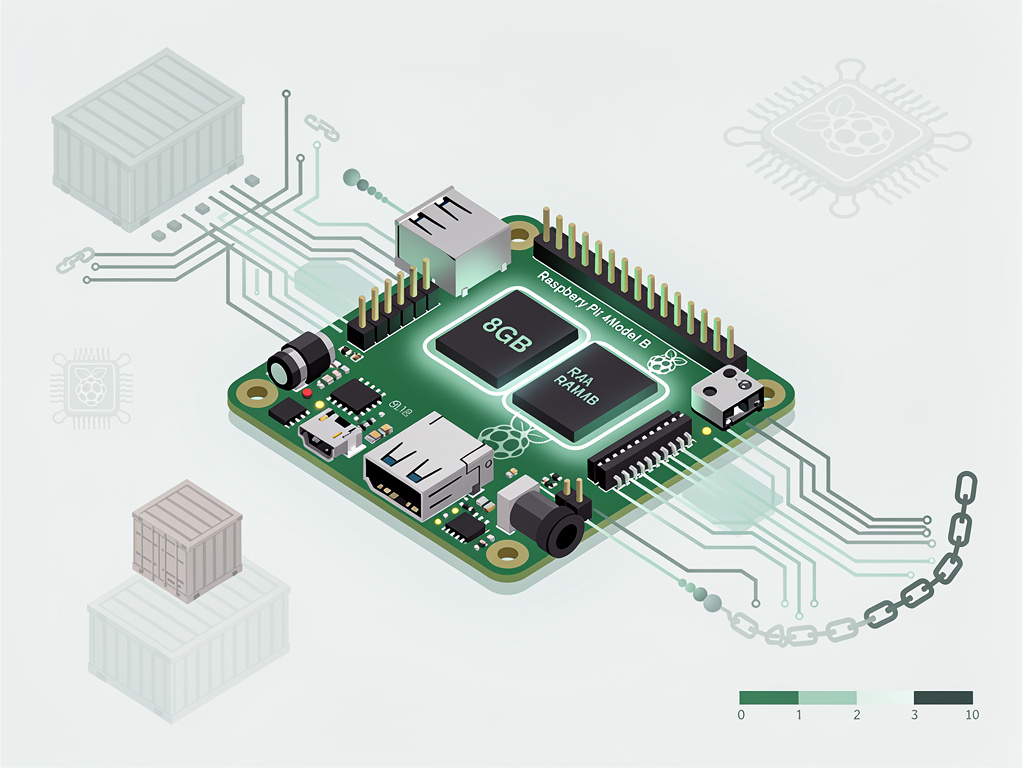
The updated Raspberry Pi 4 Model B, which has begun shipping without any formal fanfare, splits its RAM across two separate memory chips rather than housing it in a single package. This architectural shift — moving from a single LPDDR4 chip to a dual-chip configuration — has been confirmed across multiple hardware revisions spotted by eagle-eyed community members and reported by Slashdot. The change applies to the 8GB variant of the Pi 4, which has been the most popular configuration among power users and commercial deployers since its introduction.
A Supply Chain Story Written in Silicon
To understand why the Raspberry Pi Foundation would alter the memory architecture of a product that has been in production since 2019, one must look at the broader semiconductor supply dynamics that have defined the past several years. The global chip shortage that began during the COVID-19 pandemic exposed critical vulnerabilities in single-source component strategies. Raspberry Pi was among the hardest-hit products, with wait times stretching to months and prices on the secondary market ballooning to multiples of the official $35-$75 price range. Eben Upton, CEO of Raspberry Pi Ltd., has spoken extensively about how the shortage forced the company to rethink its supply chain relationships and component sourcing strategies.
The move to a dual-chip RAM configuration is a direct manifestation of this strategic pivot. By qualifying a second memory layout — two 4GB LPDDR4 chips instead of a single 8GB package — the Foundation gains sourcing flexibility. Single 8GB LPDDR4 chips are produced by fewer manufacturers and in smaller volumes compared to their 4GB counterparts, which are commodity components used across smartphones, tablets, and a wide range of embedded devices. Splitting the RAM across two chips opens the door to a broader supplier base and reduces the risk of a single-point-of-failure in the bill of materials.
What the Dual-Chip Design Means for Performance
For end users, the natural question is whether this change affects performance. The short answer, based on early testing by community members and hardware reviewers, is that the difference is negligible for the vast majority of workloads. LPDDR4 memory, whether served from one chip or two, operates at the same clock speeds and interfaces with the Broadcom BCM2711 system-on-chip through the same memory bus. In theory, a dual-chip configuration could offer marginally different memory access patterns due to interleaving, but in practice, the Pi 4’s memory controller treats the configuration transparently. The operating system — Raspberry Pi OS and other Linux distributions — requires no changes to accommodate the new layout.
That said, some edge cases could surface. Industrial users running real-time applications or those who have characterized the Pi 4’s memory behavior down to the nanosecond for latency-sensitive deployments may want to validate their systems against the new revision. The Raspberry Pi Foundation has historically been diligent about maintaining backward compatibility across board revisions, and this case appears to be no exception. The board revision code, which can be queried programmatically via the /proc/cpuinfo file or the vcgencmd utility, has been updated to reflect the new hardware, allowing software to detect which variant is in use if needed.
The Broader Implications for Industrial and Commercial Users
The Raspberry Pi has long transcended its origins as an educational tool. Millions of units are deployed in commercial and industrial settings — digital signage, point-of-sale terminals, factory automation controllers, thin clients, and edge computing nodes. For these customers, hardware consistency is paramount. A change in memory architecture, even one that is functionally transparent, triggers validation and certification processes that can be costly and time-consuming. Companies that have built products around the Pi 4 with specific component-level qualifications will need to assess whether the dual-chip variant requires re-certification under their quality management systems, particularly in regulated industries.
The Raspberry Pi Foundation has navigated this tension before. Over the years, the Pi 4 has undergone several silent revisions — from changes to the USB-C power circuitry that fixed a compatibility issue with certain cables, to thermal management improvements on the PCB layout. Each revision has been documented in the board revision history, but none have been marketed as new products. This approach keeps the product line simple for consumers while placing the burden of revision tracking on professional users who need that level of detail. As reported by Slashdot, the community has been quick to document and discuss the implications of this latest change.
How This Fits Into the Pi 5 Era
The timing of this revision is also notable given that the Raspberry Pi 5, launched in late 2023, is now the Foundation’s flagship product. The Pi 5 uses LPDDR4X memory in a package-on-package configuration atop the new Broadcom BCM2712 SoC, a fundamentally different architecture. Yet the Pi 4 remains in active production and continues to sell in enormous volumes. For many commercial applications, the Pi 4 is the preferred platform because it has years of field-proven reliability, a mature software ecosystem, and a lower price point. The Foundation has committed to keeping the Pi 4 in production for the foreseeable future, consistent with its long-standing policy of extended product lifecycles — the original Raspberry Pi Model B was produced for nearly a decade.
Maintaining the Pi 4 as a viable product while the Pi 5 ramps up production requires exactly the kind of supply chain engineering that the dual-chip revision represents. It is a move born of necessity and executed with the quiet competence that has characterized the Raspberry Pi Foundation’s hardware operations. Rather than announcing a new SKU or confusing the market with a “Pi 4 Rev 2” branding, the Foundation has simply updated the hardware, documented the change in its revision codes, and continued shipping.
The Art of the Silent Revision in Hardware Manufacturing
Silent revisions are a common practice in the electronics industry, but they are rarely discussed openly because manufacturers prefer to maintain the illusion of product consistency. Apple, for instance, has made numerous mid-cycle changes to Mac and iPhone internals — swapping NAND suppliers, adjusting display panel sources, and modifying antenna designs — without any external indication to the consumer. The difference with Raspberry Pi is that its user base includes a significant population of hardware engineers and embedded systems developers who notice these changes, discuss them publicly, and hold the Foundation accountable for transparency.
This dynamic creates a unique feedback loop. The Foundation benefits from having a community that effectively performs distributed quality assurance, catching issues and documenting changes that might otherwise go unnoticed. In return, the community expects — and generally receives — a level of openness about hardware changes that is unusual in the consumer electronics world. The dual-chip RAM revision is a case study in how this relationship works: the Foundation made the change, updated the technical documentation, and the community identified, tested, and disseminated the information within days.
What Comes Next for Single-Board Computing
Looking ahead, the dual-chip approach may become more common across the single-board computer market. As memory densities increase and the economics of chip packaging evolve, manufacturers will continue to optimize their designs for supply chain resilience rather than pure technical elegance. The lesson of the past five years — that a single-source component can bring an entire product line to its knees — has been internalized across the industry. Raspberry Pi’s decision to split its RAM is a small but telling indicator of how hardware design priorities have shifted in the post-shortage era.
For the millions of Raspberry Pi 4 users worldwide, the practical impact of this change is minimal. Their projects will continue to run, their applications will perform as expected, and their boards will remain supported for years to come. But for those who pay attention to the engineering decisions beneath the surface, the dual-chip revision is a reminder that even the most established products are never truly static. They evolve, adapt, and respond to forces that extend far beyond the circuit board — into the factories, supply chains, and strategic calculations that determine whether a product can continue to exist at all.


 WebProNews is an iEntry Publication