
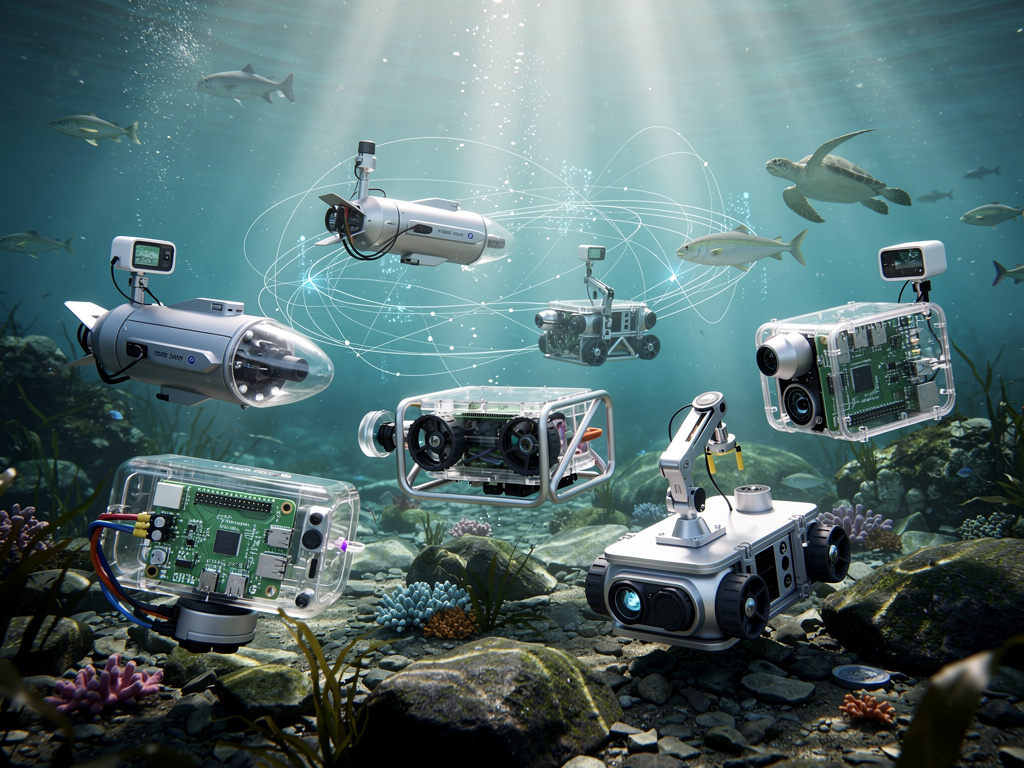
The ocean covers more than 70 percent of Earth’s surface, yet much of it remains unexplored, holding secrets about marine life, climate patterns, and geological features. Recent advancements in affordable computing have opened new paths for researchers and hobbyists to build devices that venture into these depths. One standout example involves small, single-board computers powering autonomous underwater vehicles, enabling data collection in challenging environments. This approach has gained traction through projects that integrate low-cost hardware with sophisticated software, making ocean study more accessible.
At the heart of many such initiatives is the Raspberry Pi, a compact computer originally designed for education but now widely used in robotics and environmental monitoring. Its versatility allows integration with sensors, cameras, and propulsion systems, turning it into the brain of marine robots. These devices can navigate underwater, capture images, measure water quality, and even track marine animals, all while operating on a budget that was once prohibitive for small teams or individual enthusiasts.
A recent report highlights how teams are employing Raspberry Pi in underwater exploration. As detailed in the Raspberry Pi news article, engineers and scientists have developed robots that use this hardware to explore coral reefs, monitor pollution, and study ocean currents. One project features a submersible drone equipped with a Raspberry Pi 4, which processes real-time data from depth sensors and sonar. This setup allows the robot to map seafloor topography without constant human intervention, reducing risks associated with deep dives.
Building these marine robots starts with selecting appropriate components. The Raspberry Pi serves as the central processor, handling tasks like image recognition and navigation algorithms. Paired with waterproof enclosures, it withstands pressure and moisture. For propulsion, small motors or thrusters connect via GPIO pins, controlled through Python scripts or other programming languages. Sensors for temperature, salinity, and pH levels feed data back to the Pi, which logs information or transmits it to a surface station via tethered cables or wireless links when possible.
In practical applications, these robots address real-world problems. Coastal erosion, for instance, affects communities worldwide, and monitoring it requires consistent data from hard-to-reach areas. A Raspberry Pi-powered robot can patrol shorelines, using GPS modules to maintain position and cameras to document changes over time. Researchers have deployed such systems in regions like the Great Barrier Reef, where they collect evidence of bleaching events caused by warming waters. By automating these observations, teams gather more comprehensive datasets than manual surveys alone could provide.
Another area of focus is biodiversity tracking. Marine robots equipped with hydrophones—underwater microphones—listen for sounds from whales, dolphins, or fish schools. The Raspberry Pi processes these audio signals on-board, using machine learning models to identify species. This method helps in conservation efforts, such as mapping migration routes or detecting illegal fishing activities. In one documented case, a team used a Pi-based robot to follow sea turtles, attaching lightweight trackers that relay position data back to the device. Such innovations contribute to protecting endangered species by providing insights into their habitats without disturbing them.
Technical challenges arise in designing these systems. Power management is key, as batteries must last for extended missions in remote locations. Raspberry Pi’s low energy consumption helps, but engineers often add solar panels or efficient charging circuits for surface operations. Communication underwater poses another hurdle; radio waves don’t travel well through water, so acoustic modems or optical links become necessary. The Pi’s flexibility supports these additions, with community-developed libraries simplifying integration.
Software plays a vital role in making these robots effective. Open-source tools like ROS (Robot Operating System) run on Raspberry Pi, enabling modular programming for tasks such as obstacle avoidance or path planning. Users can write code to analyze environmental data in real time, triggering actions like surfacing if hazardous conditions are detected. For example, if salinity levels spike, indicating a pollution event, the robot could alert operators via satellite uplink. This automation extends the reach of human researchers, allowing them to focus on analysis rather than constant oversight.
Education and community involvement amplify the impact of these technologies. Schools and maker groups build simplified versions of marine robots as learning projects, teaching students about electronics, coding, and ocean science. Workshops often start with assembling a basic rover on land, then adapting it for water. This hands-on experience fosters interest in STEM fields and encourages innovative solutions to environmental issues. Online forums share blueprints and code, accelerating development for everyone from amateurs to professionals.
Looking at specific implementations, the Raspberry Pi news article describes a collaboration where a robot explored underwater caves in Mexico’s Yucatan Peninsula. Equipped with LED lights and high-resolution cameras, it captured footage of ancient formations and microbial life. The Pi handled video compression and storage, ensuring that large files could be retrieved later. Data from this mission informed studies on freshwater aquifers connected to the ocean, revealing how climate change affects these hidden ecosystems.
Scalability is another advantage. While large research vessels cost millions, a Raspberry Pi robot might be built for a few hundred dollars. This democratizes access, allowing non-profits in developing countries to monitor local waters. In Southeast Asia, for instance, such devices track plastic waste accumulation in rivers before it reaches the sea. By identifying hotspots, communities can organize cleanups more effectively.
Safety and ethical considerations guide these projects. Robots minimize human exposure to dangers like strong currents or toxic spills. However, designers must ensure they don’t harm marine life—propellers are often shrouded to prevent entanglement, and materials are chosen to avoid pollution. Regulations vary by region, so teams comply with guidelines from bodies like the International Maritime Organization to prevent interference with shipping or protected areas.
Future developments promise even greater capabilities. Advances in AI could enable robots to make autonomous decisions, such as altering courses based on weather data or collaborating in swarms for large-scale mapping. Integrating 5G connectivity for surface operations would improve real-time control. As battery technology improves, missions could extend from hours to days, covering vast ocean expanses.
Collaboration between academia, industry, and government enhances these efforts. Universities partner with tech companies to refine hardware, while funding from environmental grants supports fieldwork. One ongoing project involves deploying a fleet of Pi-powered buoys in the Pacific to monitor El Niño patterns, providing early warnings for fisheries and weather forecasting.
The integration of Raspberry Pi in marine robotics also sparks creativity in unexpected ways. Artists and filmmakers use these tools to create immersive documentaries, capturing perspectives from beneath the waves. In one artistic endeavor, a robot filmed bioluminescent plankton, syncing the footage with music to raise awareness about ocean health.
Despite obstacles, the progress is evident. Early prototypes faced issues like corrosion or software glitches, but iterative improvements have led to reliable systems. Community feedback loops, through platforms like GitHub, refine designs rapidly. For instance, a fix for water ingress in enclosures was shared widely, benefiting multiple projects.
In marine archaeology, these robots uncover shipwrecks without disturbing sites. A Pi-controlled vehicle can scan artifacts with 3D imaging, preserving history for virtual tours. This non-invasive method respects cultural heritage while expanding knowledge.
Climate research benefits immensely. Robots measure carbon dioxide absorption in seawater, contributing to models of global warming. By stationing them in polar regions, scientists track ice melt rates, informing policy decisions.
The affordability of Raspberry Pi lowers barriers, inviting diverse participants. Women-led teams in Africa use them to study mangrove ecosystems, combining local knowledge with technology for sustainable management.
As these technologies mature, they could transform how we interact with the ocean. From disaster response—deploying robots after oil spills to assess damage—to recreational uses like underwater photography, the possibilities expand.
Overall, employing Raspberry Pi in marine robots represents a practical step toward understanding and preserving our planet’s largest habitat. Through continued innovation and shared expertise, these tools will uncover more of the ocean’s mysteries, benefiting science and society alike.


 WebProNews is an iEntry Publication