
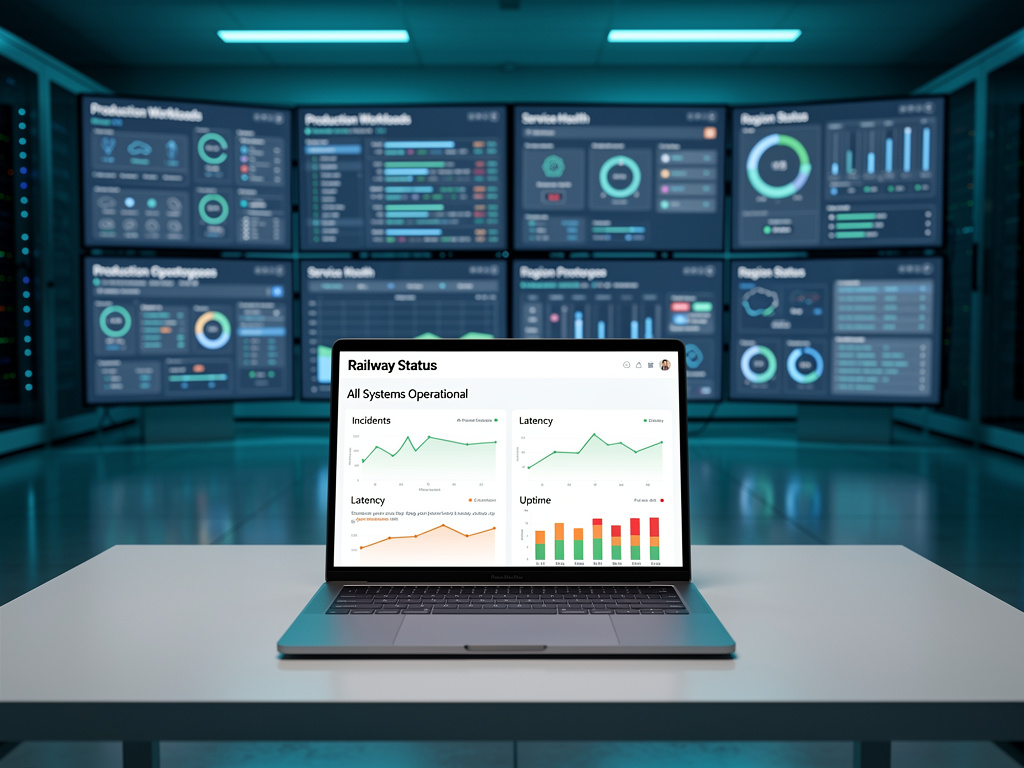
For a generation of developers who have grown weary of the complexity baked into legacy cloud providers, Railway has emerged as a compelling alternative — a platform-as-a-service that promises to simplify deployment with an elegant interface and a developer-first philosophy. But as the San Francisco-based startup scales to serve tens of thousands of users, its public status page has become a window into the very real engineering challenges that accompany rapid growth in cloud infrastructure.
A review of Railway’s official status page reveals a pattern familiar to anyone who has watched a cloud platform mature: periodic incidents affecting builds, deployments, networking, and API availability, punctuated by stretches of stable operation. The transparency is notable — Railway publishes detailed incident reports, timestamps, and resolution notes that offer unusual visibility into the inner workings of a modern PaaS provider. But for industry insiders, the data tells a more nuanced story about what it takes to build reliable infrastructure at scale.
A Platform Built on Speed — Now Tested by Scale
Railway launched with a vision of making cloud deployment as simple as pushing code to a Git repository. The platform handles provisioning, networking, databases, and scaling behind the scenes, abstracting away the operational burden that has long been the domain of DevOps teams. The approach has resonated: Railway has attracted a loyal following among indie developers, startups, and small engineering teams who value speed over configurability.
But the same simplicity that makes Railway attractive also concentrates risk. When the platform experiences an incident, users have limited ability to route around problems — they are, by design, dependent on Railway’s infrastructure layer. This trade-off is well understood in the PaaS model, but it becomes acutely visible when incidents stack up. According to the Railway status page, the platform has experienced multiple incidents in recent months affecting core services including build pipelines, deployment mechanisms, and networking layers. While most have been resolved within hours, some have stretched longer, prompting pointed questions from users about the platform’s readiness for production workloads.
Reading Between the Lines of the Status Page
Railway’s status page categorizes its infrastructure into several key components: Builds, Deployments, Networking, API, Dashboard, and Database services. Each component carries its own operational history, and the granularity of reporting is a credit to the company’s commitment to transparency. Incidents are logged with timestamps, severity levels, and detailed postmortem-style updates that walk users through root causes and remediation steps.
What stands out to infrastructure veterans is not the presence of incidents — every cloud provider has them — but the nature of the failures. Build pipeline disruptions, for instance, suggest challenges in the container orchestration layer that underpins Railway’s deployment model. Networking incidents point to the complexity of managing overlay networks and ingress routing at scale. These are not trivial engineering problems; they are the same challenges that have consumed billions of dollars in R&D at Amazon Web Services, Google Cloud, and Microsoft Azure over the past two decades.
The Transparency Gambit: A Double-Edged Sword
Railway’s decision to maintain a detailed, publicly accessible status page is both a strategic asset and a potential liability. On one hand, it builds trust with developers who have grown skeptical of cloud providers that obscure their reliability records behind vague service health dashboards. On the other hand, it creates a permanent, searchable record that competitors and critics can point to when questioning the platform’s maturity.
This tension is not unique to Railway. Atlassian’s Statuspage product, which powers many such dashboards across the industry, has long grappled with the paradox of transparency: the more honestly a company reports its incidents, the worse it can appear relative to competitors who report less. Railway appears to have made a deliberate choice to err on the side of openness, a posture that aligns with its developer-centric brand but that will be tested as it pursues larger enterprise customers who demand contractual uptime guarantees.
How Railway Stacks Up Against the PaaS Competition
Railway operates in an increasingly crowded segment of the cloud market. Competitors include Render, Fly.io, Vercel, and the venerable Heroku, which was recently spun out from Salesforce’s shadow and given new investment. Each platform makes slightly different trade-offs between simplicity, control, pricing, and reliability. Render, for instance, has positioned itself as a more infrastructure-aware alternative, while Fly.io has leaned into edge computing and low-latency deployments.
What distinguishes Railway in this cohort is its emphasis on the developer experience during the initial setup and deployment phase. The platform’s UI is widely praised, and its integration with GitHub and other version control systems is seamless. But as users move from prototyping to production, the calculus changes. Uptime, incident response times, and the predictability of the platform’s behavior under load become paramount. This is where Railway’s status page becomes more than a transparency exercise — it becomes a competitive benchmark.
The Engineering Challenges Behind the Curtain
Running a PaaS at scale involves solving a cascading series of engineering problems, each of which introduces new failure modes. At the base layer, Railway must manage compute resources — likely a combination of bare metal and virtualized instances — across multiple availability zones. On top of that sits the container orchestration layer, almost certainly built on or inspired by Kubernetes, which handles scheduling, scaling, and lifecycle management for user workloads.
Above the orchestration layer, Railway must maintain its build pipeline — the system that takes user code, packages it into containers, and deploys it to the appropriate infrastructure. This pipeline is a critical path component: if builds fail, nothing else works. The status page has documented several build-related incidents, suggesting that this layer has been a recurring source of friction. This is not uncommon; build systems are notoriously difficult to make both fast and reliable, as anyone who has operated a CI/CD pipeline at scale can attest.
Networking adds another dimension of complexity. Railway must manage DNS resolution, TLS termination, load balancing, and traffic routing for potentially thousands of user applications, each with its own domain configuration and traffic patterns. Incidents in this layer can be particularly disruptive because they affect application availability directly, even when the underlying compute and application code are functioning correctly.
What Enterprise Buyers Are Watching For
For Railway to make the leap from developer darling to enterprise-grade platform, it will need to demonstrate sustained reliability improvements. Enterprise procurement teams typically evaluate cloud providers against a set of criteria that include historical uptime (usually measured over 12 months), mean time to resolution for incidents, the availability of Service Level Agreements with financial penalties for downtime, and the maturity of the provider’s incident management processes.
Railway’s public status page provides some of this data implicitly, but the company has not yet published formal SLAs with the kind of teeth that enterprise buyers expect. This is not unusual for a company at Railway’s stage — most startups defer SLA commitments until they have the operational track record and financial reserves to back them up. But it does place a ceiling on the types of workloads that risk-conscious organizations will entrust to the platform.
The Road Ahead for Railway’s Reliability Story
Railway’s trajectory mirrors that of many successful infrastructure companies: rapid adoption driven by developer enthusiasm, followed by a period of operational hardening as the platform confronts the realities of scale. AWS, Google Cloud, and Azure all went through similar growing pains — the difference is that they did so in an era when public status pages and social media scrutiny were less pervasive.
For Railway, the path forward likely involves significant investment in observability, redundancy, and incident response capabilities. The company will need to build out its Site Reliability Engineering function, invest in chaos engineering practices to proactively identify failure modes, and potentially diversify its infrastructure footprint to reduce single points of failure. These are expensive, time-consuming endeavors, but they are table stakes for any platform that aspires to host production workloads at scale.
In the meantime, Railway’s status page will continue to serve as both a badge of transparency and a scoreboard. For the developers and startups who have bet on the platform, each green checkmark is a quiet affirmation; each incident, a reminder that building reliable infrastructure remains one of the hardest problems in software engineering. The question is not whether Railway will experience more incidents — it will — but whether the company can reduce their frequency and severity fast enough to keep pace with its own growth.


 WebProNews is an iEntry Publication