
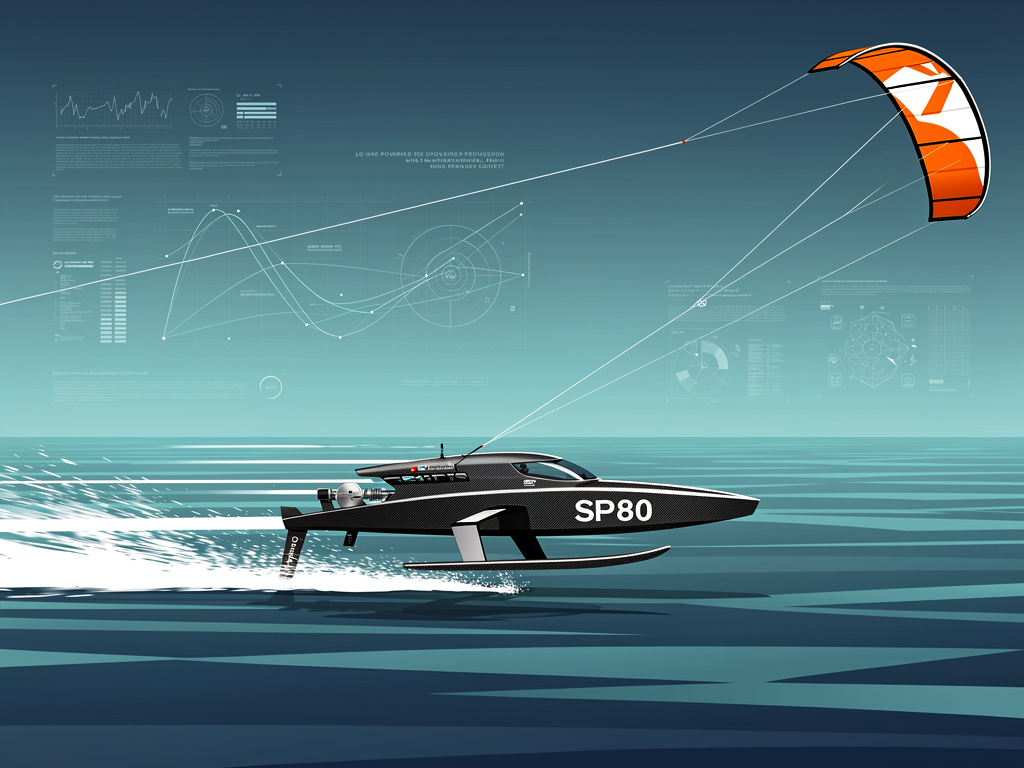
In the relentless pursuit of maritime velocity, a French sailing team is preparing to harness one of nature’s most powerful forces in an unconventional way. The SP80 project, a radical hydrofoil sailboat powered by a massive kite rather than traditional sails, aims to break the world sailing speed record by reaching speeds exceeding 80 knots—approximately 92 miles per hour—across water. This ambitious endeavor represents not merely an incremental improvement in nautical engineering, but a fundamental reimagining of how wind power can propel vessels to unprecedented velocities.
According to CNET, the SP80 team has been methodically developing their craft with the specific goal of claiming the outright sailing speed record. The current record stands at 65.45 knots, set by Paul Larsen in the Vestas Sailrocket 2 back in 2012. The SP80’s target of 80 knots would represent a staggering 22% improvement over that mark, a quantum leap in a sport where fractions of a knot can take years to achieve. The vessel’s name itself—SP80—boldly announces this ambition, with “SP” standing for “Sailing Performance” and “80” representing their target speed in knots.
The engineering philosophy behind SP80 diverges dramatically from conventional high-speed sailing craft. While traditional speed sailing vessels rely on rigid wing sails or conventional fabric sails, SP80 employs a 200-square-meter kite tethered to the boat. This kite flies at altitudes where wind speeds are significantly higher and more consistent than at sea level, potentially generating forces equivalent to what would be produced by a sail area of 400 square meters at surface level. The kite’s ability to access these stronger, steadier winds at altitude provides a fundamental aerodynamic advantage that conventional sails simply cannot match.
The Physics of Extreme Velocity
The hydrofoil design of SP80 represents the culmination of decades of advancement in foiling technology. The craft essentially flies above the water’s surface on carbon fiber foils, dramatically reducing drag by minimizing contact with the water. This configuration has become the gold standard in high-performance sailing, from America’s Cup yachts to Olympic sailing classes. However, SP80 takes this concept to an extreme, with foils designed to operate at speeds where even the smallest imperfection or instability could prove catastrophic.
The team’s approach to stability and control involves sophisticated computer modeling and real-world testing in progressively more challenging conditions. The pilot must manage not only the vessel’s attitude and trajectory but also the kite’s position and power output, all while traveling at speeds where reaction times are measured in fractions of a second. The margin for error at these velocities is vanishingly small—a sudden gust, an unexpected wave, or a momentary loss of concentration could send the craft tumbling in a violent crash that would likely destroy the vessel and endanger the pilot.
Material science plays a crucial role in SP80’s construction. The entire structure must be simultaneously lightweight enough to achieve maximum speed yet strong enough to withstand the enormous forces generated when traveling at nearly 100 miles per hour. Carbon fiber composites form the backbone of the craft, but the team has also incorporated advanced materials in critical stress points. The kite itself represents a masterpiece of textile engineering, constructed from ultra-high-molecular-weight polyethylene and other advanced fabrics that can handle the tremendous loads while remaining light enough to fly efficiently.
The Historical Context of Speed Sailing
The quest for sailing speed records has captivated adventurers and engineers for over a century. Early attempts in the 1970s and 1980s saw purpose-built craft achieving speeds that seemed impossible for wind-powered vessels. The progression from 30 knots to 40, then 50, and eventually past 60 knots required fundamental innovations at each threshold. Each new record typically stood for years, as teams worked to develop the next breakthrough in aerodynamics, hydrodynamics, or materials that could push the boundaries further.
Paul Larsen’s 2012 record in Vestas Sailrocket 2 represented what many considered the apex of conventional sailing speed technology. That vessel used a rigid wing sail and a highly refined hydrofoil configuration, optimized through years of testing and development. The fact that this record has stood for over a decade speaks to the difficulty of achieving meaningful improvements in this rarefied realm of performance. SP80’s kite-based approach represents a different evolutionary branch in speed sailing, one that could potentially bypass the limitations that have stymied conventional designs.
The location chosen for record attempts is as critical as the vessel itself. Speed sailing records are typically attempted in specific venues that offer the ideal combination of strong, steady winds, flat water, and sufficient space for acceleration and deceleration. The SP80 team has identified potential locations that meet these exacting criteria, though the precise venue for their record attempt remains closely guarded. Weather windows for such attempts are narrow, requiring not just strong winds but also the right direction, minimal gusts, and calm seas—a combination that may occur only a handful of times each year.
Commercial Implications Beyond Records
While SP80’s primary mission is breaking the speed record, the technologies being developed have potential applications far beyond the realm of sporting achievement. The maritime shipping industry, responsible for approximately 3% of global greenhouse gas emissions, is desperately seeking alternatives to fossil fuels. Kite propulsion systems, though not at the extreme performance level of SP80, are already being tested on cargo ships as auxiliary power sources that can reduce fuel consumption by 10-20%.
Companies like Airseas and SkySails have developed commercial kite systems for freight vessels, demonstrating that the concept has practical merit beyond speed records. The lessons learned from SP80’s extreme engineering—particularly regarding kite control systems, materials, and the interaction between kites and marine vessels—could accelerate the development of these commercial applications. The data gathered from pushing a kite-powered vessel to its absolute limits provides invaluable insights that can be applied to more mundane but economically significant applications.
The SP80 project also serves as a proving ground for advanced control systems and autonomous operation technologies. Managing a vessel at such extreme speeds requires sensor systems and computer control that can react faster than any human pilot. These systems, which integrate data from GPS, accelerometers, wind sensors, and other instruments to make split-second adjustments, represent cutting-edge development in marine automation. As the shipping industry moves toward autonomous vessels, the extreme testing environment provided by SP80 offers lessons that could prove valuable in developing robust, reliable control systems.
The Human Element in Extreme Engineering
Behind the carbon fiber, advanced textiles, and sophisticated electronics lies an equally important human story. The pilot who will attempt to guide SP80 to a record faces physical and mental challenges that few athletes ever encounter. The forces experienced during acceleration and high-speed runs are substantial, requiring exceptional physical conditioning. More critically, the mental demands of maintaining focus and making precise control inputs while traveling at speeds where the environment becomes a blur requires a unique combination of skills.
The team developing SP80 represents an international collaboration of specialists, each bringing expertise in their respective fields. Naval architects, aerodynamicists, materials scientists, and professional sailors have contributed to the project’s development. This multidisciplinary approach is essential when pushing the boundaries of what’s physically possible—no single discipline holds all the answers, and breakthrough performance comes from the synthesis of multiple areas of expertise.
The timeline for SP80’s record attempt has been deliberately methodical, with the team prioritizing safety and thorough testing over rushing to attempt the record prematurely. This measured approach reflects hard-won lessons from the history of speed sailing, where catastrophic failures have resulted from inadequate preparation or pushing beyond the limits of understanding. Each testing session provides data that feeds into refined simulations, which in turn guide modifications to the craft and operating procedures. This iterative process of incremental improvement, though time-consuming, offers the best chance of success while minimizing risk.
Technical Challenges at the Frontier
The transition from theoretical design to functional reality has presented numerous challenges that couldn’t be fully anticipated through simulation alone. The dynamic interaction between the kite, the tether, and the hydrofoil creates a complex system with multiple potential failure modes. Ensuring that these components work in harmony across the full range of operating conditions—from initial acceleration to maximum speed—requires extensive real-world testing and refinement. Even seemingly minor issues, such as vibration in the tether or unexpected aerodynamic effects at high speeds, can have cascading consequences that limit performance or compromise safety.
Water conditions present another variable that significantly impacts performance and safety. While the ideal scenario involves perfectly flat water, reality rarely cooperates. Even small waves or ripples can cause significant problems when a hydrofoil is traveling at extreme speeds. The foils must be designed to handle some degree of surface irregularity while maintaining stable flight, but there are limits to what’s possible. Finding the narrow weather window when wind conditions are optimal and water conditions are sufficiently calm represents a significant logistical challenge, potentially requiring the team to maintain readiness for weeks or months while waiting for the perfect opportunity.
The verification and certification of any speed record attempt involves strict protocols established by the World Sailing Speed Record Council. Multiple independent GPS systems must record the speed, and the attempt must occur within a defined course length. These requirements ensure that records are legitimate and comparable across different attempts and venues. For SP80, achieving their target speed isn’t enough—they must do so under conditions that meet all the technical requirements for official recognition, adding another layer of complexity to an already formidable challenge.
Looking Beyond the Record Books
The broader significance of the SP80 project extends into the realm of inspiration and public engagement with engineering and science. High-profile attempts to break records capture public imagination in ways that incremental technological progress rarely does. The drama of pushing human achievement to new limits, combined with the visual spectacle of a craft traveling at nearly 100 miles per hour powered only by wind, creates a compelling narrative that can inspire the next generation of engineers and scientists.
As climate change drives increased focus on renewable energy and sustainable transportation, projects like SP80 demonstrate the potential of wind power in dramatic fashion. While a speed record boat has little direct practical application, it serves as a powerful symbol of what’s possible when human ingenuity is applied to harnessing natural forces. The technological spillovers from such extreme engineering projects often find their way into more practical applications in unexpected ways, justifying the investment of time and resources even when immediate commercial applications aren’t obvious.
The SP80 team’s journey from concept to record attempt embodies the spirit of innovation that has driven maritime advancement for millennia. Whether they ultimately achieve their goal of 80 knots or fall short, the attempt itself pushes the boundaries of what’s known and possible. In an era when so much technological development is focused on incremental improvements to existing systems, projects that dare to reimagine fundamental approaches deserve attention and support. The kite-powered speedboat represents not just a novel way to go fast on water, but a different way of thinking about the relationship between wind, water, and human ambition—a reminder that even in well-established fields, revolutionary approaches can still emerge to challenge conventional wisdom and redefine what’s achievable.


 WebProNews is an iEntry Publication