
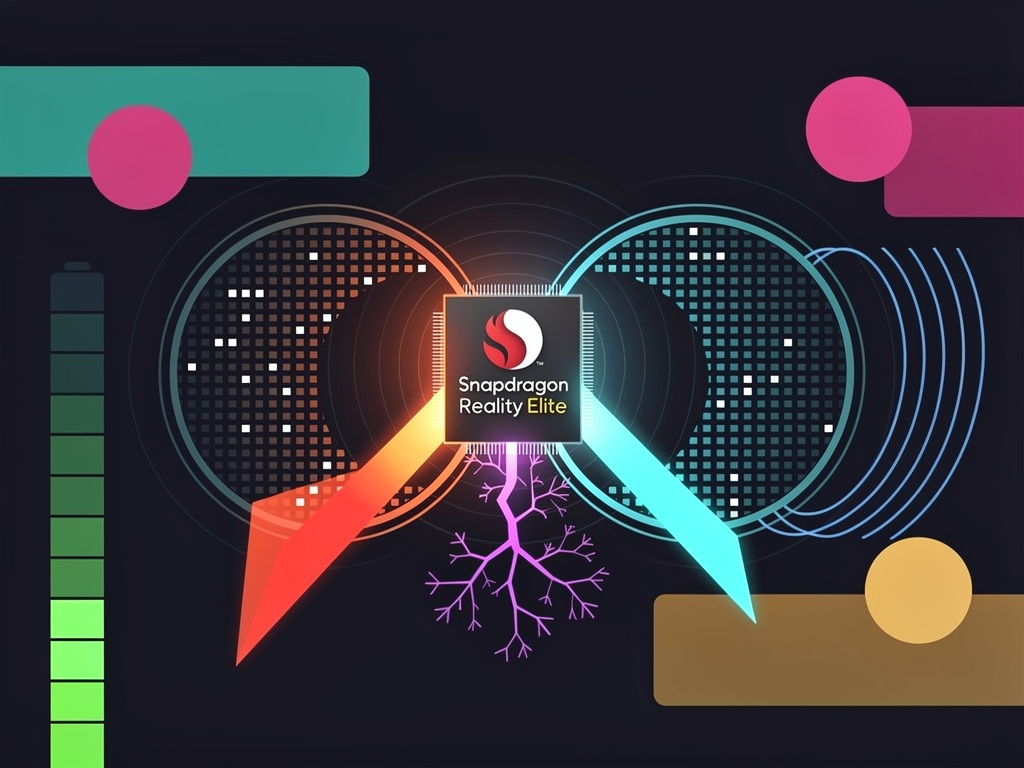
Qualcomm just dropped its most advanced XR processor yet. The Snapdragon Reality Elite promises sharper visuals, stronger on-device AI and better efficiency for the coming generation of smart glasses and headsets. Announced today at Augmented World Expo, the chip will first appear in Xreal’s Project Aura compute puck this fall. And the timing could not be better.
Smart glasses have lingered in prototype territory for years. Battery drain, dim displays and overheating plagued early attempts. But demand keeps building. More than 60 million XR devices already sit in the market, according to Qualcomm. Now the industry wants glasses that feel like regular eyewear yet deliver real-time spatial computing and generative AI without constant cloud calls. The Reality Elite aims squarely at that goal.
Performance jumps stand out. GPU performance rises 60 percent. CPU gains hit 30 percent. The neural processing unit sees up to 160 percent higher performance. Those numbers translate to support for 4.4K resolution per eye at 90 frames per second. Latency drops. The platform handles photorealistic avatars and real-time 3D content creation with less strain. Battery life stretches up to 20 percent longer. Devices run up to 12 degrees Celsius cooler under heavy load. Impressive claims. Real-world tests will decide if they hold.
The chip supports both video see-through and optical see-through designs. That flexibility matters. It works with Android XR, the platform Google and partners like Samsung and Xreal are pushing hard. Xreal’s Aura glasses, previewed at Google I/O, already hinted at the upgrade. Qualcomm says the first devices will arrive soon. Play for Dream counts among early adopters too.
This announcement builds directly on earlier work. Back in 2025 Qualcomm introduced the Snapdragon AR1+ Gen 1. It powered demonstrations of fully local generative AI running on glasses without a phone or cloud connection. A live demo at AWE that year featured an AI assistant chatting through RayNeo X3 Pro glasses. The processor was 26 percent smaller than prior versions. It improved image quality, cut power draw and enabled small language models directly on the device. Qualcomm’s own report described the moment as opening new possibilities for augmented reality.
Yet the AR1 series targeted lighter, all-day wearable glasses. The Reality Elite pushes further for mixed reality experiences that blend heavier graphics with AI. It sits apart from the Snapdragon XR2+ Gen 2 used in bulkier headsets like Samsung’s Galaxy XR. The distinction shows how Qualcomm splits its silicon families. One line for slim audio-first or basic AR glasses. Another for display-heavy spatial computing.
Partners are lining up. Snap spun out Specs Inc. to focus on consumer AR glasses. The company signed a multi-year deal with Qualcomm in April 2026 to use Snapdragon XR platforms in future Specs. Those glasses will be standalone, see-through and lighter than current prototypes. They promise digital content overlaid on the physical world with on-device processing for speed and privacy. Road to VR detailed the agreement and confirmed the 2026 consumer launch target.
Samsung confirmed its own Android XR smart glasses for 2026. Reports point to Qualcomm’s AR1 platform inside them, though some speculation mentions the newer AR1+ variant unveiled at AWE 2025. Google meanwhile works with Warby Parker, Gentle Monster and Xreal on Android XR glasses. The platform race has grown intense. Apple reportedly eyes a 2027 entry with its own AI-focused glasses. IDC forecasts strong growth in the glasses segment through 2030 while traditional VR headsets slow.
Qualcomm also released Snapdragon Start, a toolkit with hardware reference designs, software and AI models to speed development of smart glasses. The idea is to let manufacturers move faster from concept to shelf. In India the company hosted an XR Day event highlighting AI-powered glasses and spatial use cases with partners like Lenskart. The push spans regions and form factors.
But challenges remain. Current smart glasses often trade comfort for capability. Heavy compute means bigger batteries or tethered pucks. Overheating risks make users wary of wearing them all day. The Reality Elite’s efficiency gains address those pain points directly. Cooler operation and longer battery matter when the device sits on your face. Still, optics quality, field of view and accurate hand or eye tracking will determine consumer adoption. Hardware alone won’t win the market.
AI features take center stage. On-device inference enables context-aware assistants that understand your surroundings without sending data elsewhere. Local small language models reduce latency and protect privacy. Qualcomm demonstrated such capabilities last year with Meta’s Llama model variants running on glasses. The Reality Elite raises the ceiling. Up to 48 TOPS of AI performance opens doors to more complex models and real-time scene understanding.
The broader wearable story ties in. Qualcomm’s Snapdragon Wear Elite, announced earlier in 2026, targets audio glasses, watches and pins with similar AI focus. Together the chips signal a bet that personal AI will spread across body-worn devices. Glasses become the ideal canvas. They offer cameras, microphones, speakers and a direct line to your field of view. Information appears where you need it. Notifications. Translations. Navigation. All without pulling out a phone.
Analysts watch the supply chain closely. Qualcomm supplies silicon to Meta, Google, Samsung, Snap, Xreal and others. Its success depends on how well these partners execute. Early devices will test the waters. If battery life and comfort improve enough, mainstream interest could follow. Price will matter too. Many consumers still view $300-plus smart glasses as luxury items rather than daily drivers.
Today’s announcement feels like a hinge point. The original Verge report on the Reality Elite captured the excitement and the caveats. The Verge noted that the upgrades hint at what wearable makers like Meta and Google are demanding. It also flagged the persistent tradeoffs in display glasses. The new chip tries to ease those constraints. Whether the improvements feel transformative depends on the final products.
Industry insiders have seen similar promises before. Yet the combination of better silicon, maturing Android XR software, multiple major brands entering the category and genuine on-device AI changes the equation. Qualcomm isn’t just shipping another chipset. It’s enabling a shift toward glasses that augment reality in meaningful ways while staying comfortable enough for extended wear. The fall launch of Xreal’s Aura will offer the first real test. More devices will follow in 2027. The glasses era may finally be arriving.


 WebProNews is an iEntry Publication