
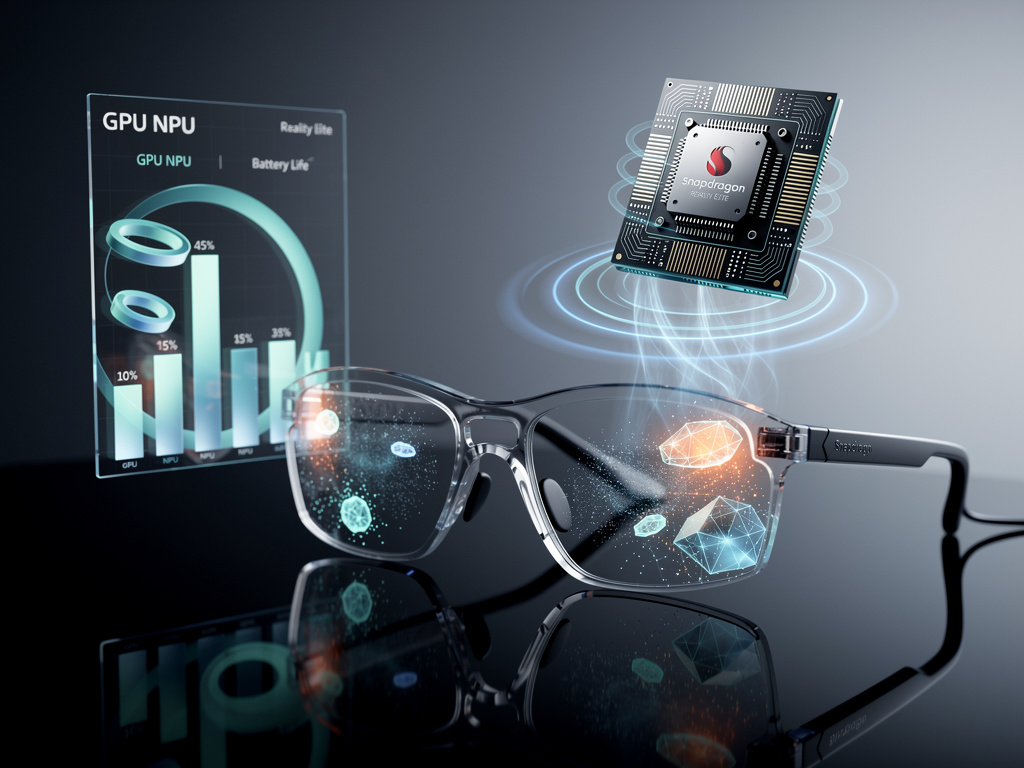
Qualcomm just dropped a new flagship processor for the next wave of augmented reality hardware. Called Snapdragon Reality Elite, the chip promises smaller, cooler devices that last longer on a charge. Yet it packs enough extra muscle for sharper visuals and far more ambitious artificial intelligence features.
The announcement landed at the Augmented World Expo. It marks a deliberate shift away from the XR branding Qualcomm has used for years. Engadget reported that the new name reflects greater emphasis on see-through displays and generative AI capabilities. Matthew DeHamer, director of product marketing at Qualcomm, called it a “new phase” for the company’s mixed reality efforts.
Numbers tell the story best. The Reality Elite delivers 60 percent higher GPU performance. CPU gains reach 30 percent. Neural processing jumps 160 percent, hitting 48 TOPS. Battery life stretches up to 20 percent further on the same workload. The chip runs as much as 12 degrees Celsius cooler than its predecessor, the Snapdragon XR2+ Gen 2.
Resolution climbs modestly to 4.4K per eye at 90 frames per second. Image quality improves. Latency drops. These tweaks matter. Text becomes more readable. Overlays look more convincing. Passthrough video feels less like a compromise.
Additional upgrades compound the advantage. Photon-to-photon latency falls another 10 percent. Power draw for camera processing decreases 33 percent. The chip supports faster UFS 4.0 storage, RAM at 4.2 GHz, dual USB 3.1 ports, Bluetooth 6.0 and Wi-Fi 7. An expanded engine handles more computer vision tasks such as 3D environment reconstruction. UploadVR detailed these enhancements hours after the reveal.
Such headroom opens doors for on-device AI that earlier silicon could not touch. Photorealistic avatars. Agentic assistants. Real-time 3D object generation. A 3-billion-parameter large language model could run at 45 tokens per second. A 512-by-512 vision model might process in about 1.7 seconds. These figures come straight from Qualcomm’s briefings.
The first device to use the Reality Elite arrives this fall. Xreal’s Aura glasses will tether to a separate compute puck powered by the new chip. The design choice lets the eyewear stay thin and light. Google has partnered with Xreal on the Android XR platform that will run on the hardware. Preorders for the Aura have already begun, though final pricing remains undisclosed.
Play for Dream, a virtual reality headset maker, also plans a flagship product around the silicon. Samsung’s Galaxy XR headset, by contrast, relies on the older XR2+ Gen 2. No immediate successor has surfaced for that device.
Qualcomm did not stop at one chip. It introduced the START platform built on the AR1+ processor for smart glasses. The package includes off-the-shelf hardware, software and companion apps. Brands can license the reference design and add their own AI features. Inspecs, a UK-based eyewear company, has signed on. It holds licenses for brands including O’Neill, Barbour and Superdry. DeHamer told Engadget the approach gives companies “a way for brands to start their journey to take existing products and solutions and add AI capabilities to them.”
Analysts see the dual-track strategy as pragmatic. High-end mixed reality headsets still need substantial compute. Lightweight everyday glasses cannot carry the same thermal or power burden. Tethered pucks solve that equation for now. The Reality Elite works in both standalone headsets and external modules. Gizmodo noted the distinction between optical see-through glasses and video passthrough systems like those in the Samsung Galaxy XR or Apple Vision Pro. Qualcomm’s new silicon targets both categories.
Competition looms. Apple continues to iterate on Vision Pro. Meta pushes its own Quest line and Ray-Ban smart glasses. Chinese vendors flood the market with affordable AR viewers. Qualcomm’s bet rests on performance per watt, AI acceleration and an open platform that lets partners move faster than a single company could alone.
Success will hinge on real-world experiences. Will the cooler operation translate into all-day wear? Can developers create compelling AI agents that justify the hardware cost? Early feedback from Xreal’s previous models suggests demand exists for lightweight, tethered designs. The Reality Elite version should sharpen that appeal.
Longer term, Qualcomm envisions these chips spreading beyond dedicated headsets. The same silicon architecture could appear in wearables, pendants or other form factors as the industry experiments with where AI should live on the body. For now the focus stays on AR and mixed reality. The Reality Elite gives device makers more room to maneuver. Smaller. Smarter. Cooler. The question is whether the market rewards that combination before the next leap arrives.


 WebProNews is an iEntry Publication