
Qualcomm once defined the smartphone era. Its Snapdragon processors powered billions of Android devices and delivered consistent profits tied to handset cycles. Those days look distant now. The company has placed a heavy bet on becoming a force in artificial intelligence compute that stretches from pocket-sized devices to hyperscale racks.
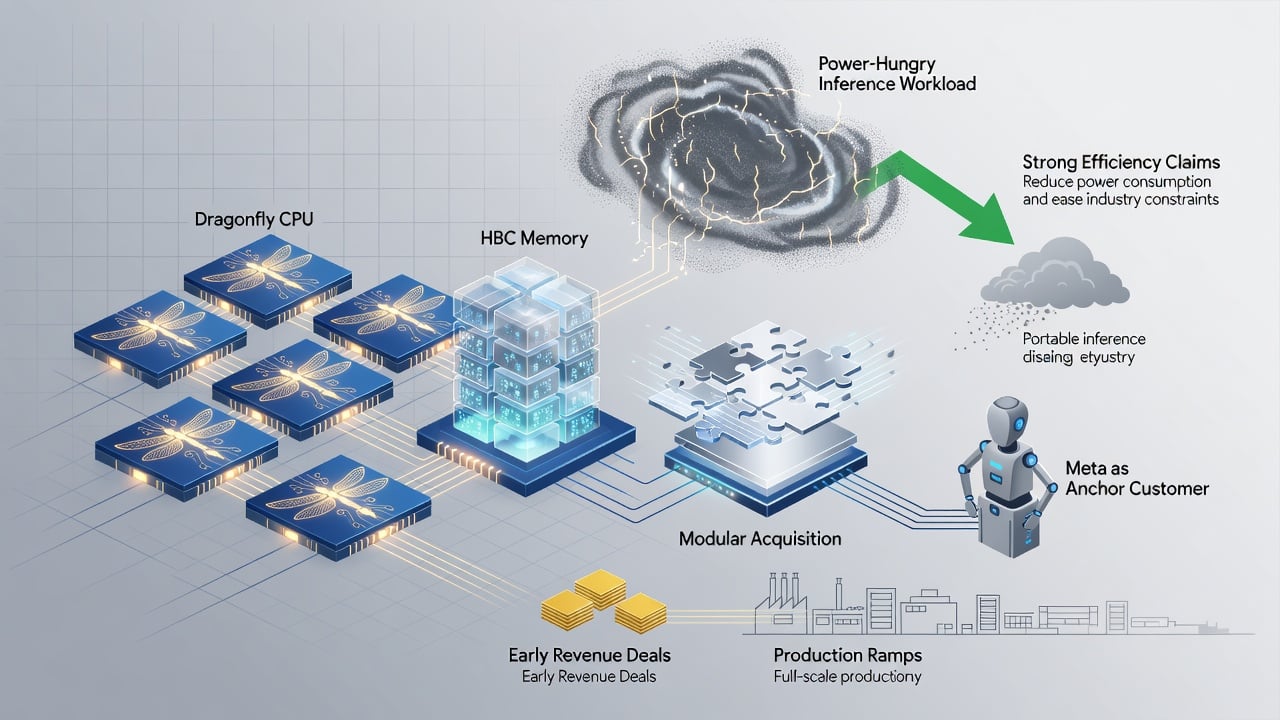
Just days ago, on June 24, 2026, executives gathered in Manhattan for an investor day that laid out the shift in explicit terms. President and CEO Cristiano Amon introduced the Dragonfly brand for data center products. He described a full-stack platform spanning edge, cloud and data center workloads built around agentic AI systems that act with greater autonomy. CNBC reported that Qualcomm unveiled the Dragonfly C1000 CPU designed for AI agent orchestration and low-latency tasks. The chip features more than 250 cores in a chiplet design and promises more than 2x better performance per watt than existing server processors.
Power efficiency sits at the center of the pitch. Data center operators face soaring electricity bills as large language models devour tokens. Qualcomm claims its approach delivers up to 8 times better tokens per watt compared with traditional GPU setups in certain inference scenarios. The secret lies in High Bandwidth Compute technology. By fusing memory and compute dies inside the package, HBC eliminates energy spent shuttling data across the system. It sidesteps the high-bandwidth memory tax and targets the decode bottleneck that slows token generation.
But hardware alone rarely wins these battles. Software lock-in has kept many customers tied to incumbent suppliers. Qualcomm moved to address that weakness with a $3.92 billion all-stock acquisition of Modular. The deal, announced the same week as the investor presentations, brings in the Mojo programming language and the MAX inference engine. Developers can now write code once and deploy it across CPUs, GPUs, NPUs and custom silicon without major rewrites. Chris Lattner, the engineer behind LLVM and Apple’s Swift, joins as part of the package.
A June 30 analysis on Yahoo Finance framed the acquisition as a direct assault on the switching costs that have protected GPU makers. “This establishes a silicon-agnostic compute layer,” the piece noted. The move lowers barriers for enterprises wary of vendor dependence. It also aligns with Qualcomm’s projection of $40 billion in non-handset revenue by fiscal 2029, drawn from data centers, automotive systems, industrial robotics and Internet of Things devices.
Meta has signed on as an anchor customer. The social media giant will use the Dragonfly C1000 CPU when production begins in 2028, according to statements released during the investor event. The partnership spans multiple generations and signals confidence in Qualcomm’s power-efficient design for AI agent workloads. Additional agreements with unnamed hyperscalers point to custom silicon revenue starting late this year.
Analysts have taken notice. A July 1 report from Constellation Research detailed the broader portfolio. Qualcomm outlined not only the C1000 but also a general-purpose CPU variant and an AI head node processor for XPUs. The AI300 inference accelerator pairs with second-generation HBC technology. It supports third-generation air- and liquid-cooled racks aimed squarely at inference at scale. Near-memory computing forms the architectural foundation. The setup delivers what the company calls 10 times higher effective memory bandwidth at significantly lower power.
These claims invite direct comparison with the current market leader. Nvidia dominates AI training and has extended its reach into inference. Yet training and inference differ in important ways. Training benefits from massive parallelism and floating-point precision. Inference, especially for agentic systems that generate tokens in real time, rewards low latency, high throughput per watt and predictable costs. Qualcomm’s architecture targets exactly those metrics. Its edge-to-cloud consistency could prove attractive to companies already using Snapdragon silicon in devices and now seeking uniform AI capabilities across their infrastructure.
And the edge matters. Qualcomm has spent years optimizing AI inside phones, laptops and cars. The Snapdragon X Elite brought strong neural processing to Windows PCs. Newer wearables incorporate dedicated neural processors for on-device tasks. That experience translates. Inference that runs locally reduces cloud dependency, cuts latency and protects privacy. TIME named Qualcomm to its 2026 list of most influential companies in April, citing the shift of AI from cloud to devices. “As the world is changing, our technology becomes more relevant to more people and more industries,” CFO and COO Akash Palkhiwala told the publication. “The DNA of the company has already evolved.”
Yet execution risks remain high. The semiconductor industry punishes missed timelines. Memory supply constraints in China recently triggered a more than 20 percent stock drawdown for Qualcomm despite low short interest. Production of the C1000 does not start until 2028. Early custom silicon revenue from hyperscalers offers nearer-term validation but at smaller scale. Integration of the Modular technology must happen smoothly. Any delay in closing the deal or delivering the promised developer experience could erode momentum.
Qualcomm has assembled the pieces quickly. The Dragonfly launch, the Meta deal, the Modular purchase and the detailed roadmap all arrived within the same week in late June. That coordination suggests internal alignment around a coherent strategy. Investors appear to be pricing in the possibility. Call option activity spiked during the recent volatility, with more than 161,000 contracts changing hands in a single session.
Success will hinge on several factors. First, real-world benchmarks must validate the tokens-per-watt and tokens-per-dollar claims against GPUs in production environments. Second, the software stack built on Mojo and MAX must attract developers beyond Qualcomm’s traditional base. Third, hyperscalers must commit at scale. Meta’s involvement helps, but broader adoption will decide the outcome.
The company’s history offers some precedent. Qualcomm rewired mobile communications with CDMA technology decades ago. It later dominated smartphone application processors. Each time it faced entrenched competitors and technical skepticism. The pattern feels familiar. This time the arena is data center AI, the workloads center on inference, and the differentiator combines specialized hardware with portable software.
Short-term market reactions may continue to reflect smartphone cyclicality. Longer-term observers will watch whether Dragonfly racks appear in actual hyperscale facilities and whether developers begin publishing results from the MAX engine on non-GPU silicon. The bet is no longer subtle. Qualcomm has overclocked its ambitions. The question now is whether the architecture delivers enough performance at low enough power to force a meaningful rewiring of AI infrastructure.
Recent coverage reinforces the momentum. A July 1 piece on The Deep View examined how Dragonfly could address bottlenecks in AI hardware supply and power consumption. It highlighted the C1000 CPU alongside the AI300 accelerator as concrete steps beyond concept slides. Meanwhile, discussions on X in the past 48 hours have mixed skepticism about unconfirmed prototype rumors involving Snapdragon in non-traditional AI devices with recognition that Qualcomm’s data center push represents its clearest path away from handset dependence.
The coming quarters will test the thesis. If power efficiency numbers hold in independent tests and if the software layer gains traction, Qualcomm could carve out a durable position in the inference market. The transformation from mobile chipset supplier to AI compute provider would then look less like a gamble and more like an overdue evolution.


 WebProNews is an iEntry Publication