
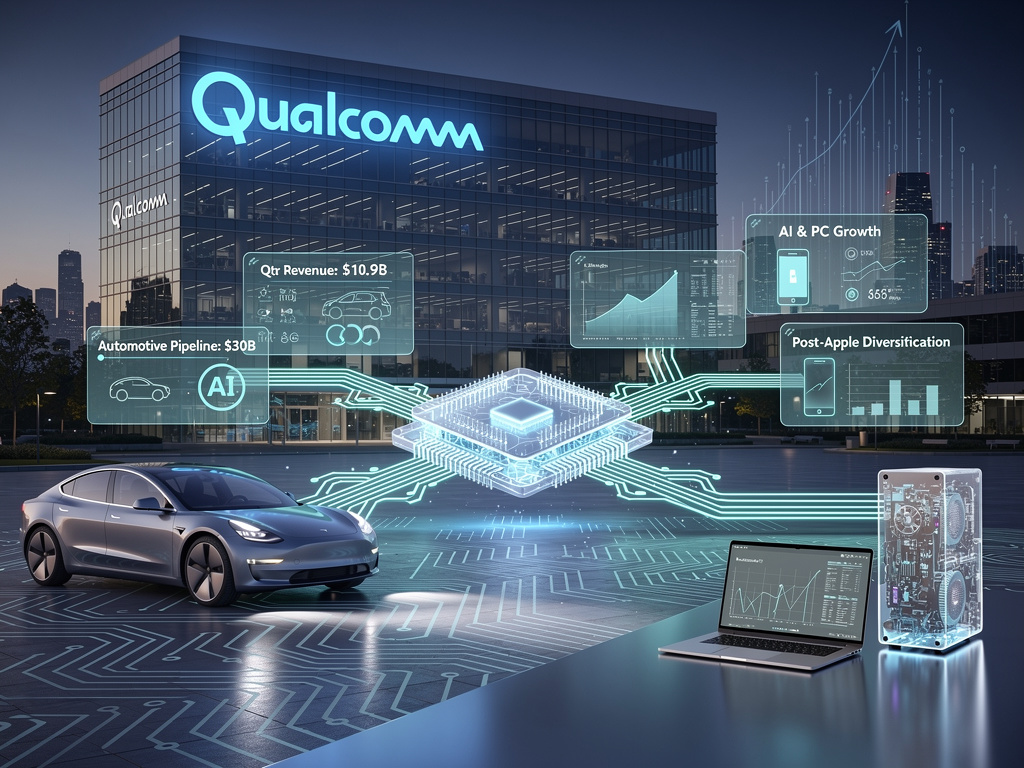
Qualcomm’s fiscal first quarter 2026 earnings revealed a company in the midst of a profound transformation, one that extends far beyond its traditional smartphone chip business into automotive, industrial IoT, and AI-powered computing. The San Diego-based semiconductor giant reported revenues that exceeded Wall Street expectations while simultaneously demonstrating how strategic diversification can offset the loss of a major client—in this case, Apple’s continued transition away from Qualcomm modems.
According to Android Central, Qualcomm posted quarterly revenue of $10.9 billion, representing a 9% year-over-year increase that surpassed analyst expectations. The company’s handset chip business, while still its largest revenue generator, now operates alongside rapidly growing segments that collectively represent Qualcomm’s vision for a post-smartphone-centric future. This diversification strategy has become increasingly critical as the company faces headwinds from Apple’s multi-year effort to develop proprietary modem technology, a transition that has progressively reduced Qualcomm’s share of iPhone component sales.
The earnings report painted a picture of a company successfully executing on CEO Cristiano Amon’s long-term vision to transform Qualcomm from a mobile-first company into a diversified technology platform provider. The Snapdragon brand, once synonymous exclusively with smartphone processors, now encompasses automotive computing platforms, PC processors competing directly with Intel and AMD, and extended reality headset chips powering the next generation of mixed reality devices.
Automotive and IoT Segments Accelerate Beyond Expectations
Perhaps the most striking aspect of Qualcomm’s quarterly performance was the continued acceleration of its automotive business, which has emerged as the company’s fastest-growing segment. The automotive division generated revenues that exceeded $899 million, marking a substantial increase from the previous year and validating Qualcomm’s aggressive push into the connected car market. This growth comes as traditional automakers and electric vehicle startups alike increasingly view vehicles as computers on wheels, requiring sophisticated processors for everything from advanced driver assistance systems to in-cabin entertainment and connectivity.
Qualcomm’s automotive pipeline now exceeds $30 billion in future design wins, according to company executives, representing commitments from automakers to integrate Qualcomm technology into future vehicle platforms. These design wins span multiple vehicle systems, including digital cockpits, telematics, and autonomous driving capabilities. The long development cycles in automotive—typically five to seven years from design win to production—mean that much of this revenue will materialize over the coming decade, providing Qualcomm with unprecedented revenue visibility in a segment that barely existed for the company a decade ago.
The Internet of Things segment, which Qualcomm groups together with automotive under its “QCT diversification” category, also demonstrated robust growth. Industrial IoT applications, edge networking equipment, and handheld computing devices for enterprise customers all contributed to this expansion. The company’s success in these markets reflects a broader industry trend toward edge computing, where processing power moves closer to where data is generated rather than relying exclusively on cloud-based computation.
Smartphone Business Demonstrates Resilience Amid Market Maturation
Despite the ongoing maturation of the global smartphone market, Qualcomm’s handset chip business showed surprising resilience. The company reported that its Snapdragon processors powered a significant percentage of premium Android smartphones launched during the quarter, maintaining Qualcomm’s dominant position in the high-end Android ecosystem. The introduction of Snapdragon 8 Elite, the company’s latest flagship mobile processor, has been particularly well-received by smartphone manufacturers seeking to differentiate their devices through AI capabilities and improved performance.
The premium smartphone segment has become increasingly important to Qualcomm’s mobile strategy as the company focuses on higher-margin products rather than competing aggressively in the budget and mid-range segments where Chinese competitors like MediaTek have gained ground. This strategic positioning allows Qualcomm to maintain profitability even as overall smartphone unit volumes remain relatively flat globally. The company’s average selling prices for mobile chips have increased year-over-year, reflecting this shift toward premium products and the integration of more sophisticated AI processing capabilities.
Qualcomm’s relationship with Samsung, its largest smartphone customer, remains strong, with the Korean electronics giant continuing to use Snapdragon processors in most of its flagship Galaxy devices sold in key markets. The company also maintains important relationships with Chinese smartphone manufacturers including Xiaomi, Oppo, and Vivo, though geopolitical tensions and export restrictions continue to create uncertainty in this critical market.
AI Integration Becomes Central to Product Strategy Across Segments
Artificial intelligence capabilities have emerged as the unifying theme across Qualcomm’s product portfolio, from smartphones to automotive to PC processors. The company’s emphasis on “on-device AI” processing—running AI models directly on local hardware rather than relying on cloud services—positions Qualcomm advantageously as privacy concerns and latency requirements make edge-based AI increasingly attractive to device manufacturers and end users.
Qualcomm’s AI strategy centers on its Hexagon neural processing unit (NPU) architecture, which the company has integrated across its product lines. In smartphones, these AI capabilities enable features like computational photography, real-time language translation, and personalized user experiences. In automotive applications, AI powers advanced driver assistance features and natural language interfaces for vehicle control. In PC processors, Qualcomm’s AI capabilities compete directly with offerings from Intel, AMD, and Apple, particularly for applications like video conferencing enhancement and content creation.
The company has invested heavily in software tools and development frameworks that make it easier for application developers to leverage Qualcomm’s AI hardware capabilities. This ecosystem approach mirrors strategies employed successfully by companies like NVIDIA in the data center market, recognizing that hardware alone is insufficient—developers need accessible tools to create applications that showcase the hardware’s capabilities.
PC Market Entry Shows Early Promise Despite Intense Competition
Qualcomm’s entry into the PC processor market through its Snapdragon X Elite and X Plus platforms represents one of the company’s most ambitious diversification efforts. While still a relatively small revenue contributor, the PC segment showed encouraging early traction with major computer manufacturers including Microsoft, Lenovo, Dell, and HP all launching Windows laptops powered by Qualcomm processors.
The PC initiative leverages Qualcomm’s expertise in power-efficient ARM-based processor design, promising laptops with significantly longer battery life than traditional x86-based systems while maintaining competitive performance. The company faces formidable competition from established players Intel and AMD, as well as Apple’s highly successful M-series processors, which have set new standards for performance-per-watt in laptop computing. However, Qualcomm executives expressed confidence that the company’s AI capabilities and 5G connectivity integration provide meaningful differentiation.
Software compatibility remains a challenge for ARM-based Windows PCs, as many applications were originally developed for x86 processors and require emulation to run on ARM architecture. Microsoft has invested substantially in improving emulation performance and encouraging developers to create native ARM versions of their applications, but the transition remains incomplete. Qualcomm’s success in this market will likely depend on whether the benefits of battery life and AI performance prove compelling enough to overcome occasional compatibility issues.
Financial Performance Reflects Strategic Investments and Market Positioning
From a financial perspective, Qualcomm’s quarterly results demonstrated healthy profit margins despite significant investments in research and development across multiple new product categories. The company’s operating margin remained above 30%, reflecting the high-value nature of its technology and its strong intellectual property position. Qualcomm continues to generate substantial revenue from patent licensing, though this segment has faced periodic challenges from disputes with device manufacturers and regulatory scrutiny in various jurisdictions.
The company returned significant capital to shareholders through both dividends and share repurchases, a practice that has characterized Qualcomm’s capital allocation strategy for years. Management emphasized its commitment to maintaining this shareholder-friendly approach while simultaneously investing in growth opportunities across automotive, IoT, and PC markets. The balance between rewarding current shareholders and funding future growth initiatives remains a key consideration for investors evaluating Qualcomm’s long-term prospects.
Looking ahead, Qualcomm provided guidance for the next quarter that suggested continued growth, though at a more moderate pace than recent quarters. The company cited typical seasonal patterns in smartphone demand, ongoing macroeconomic uncertainties in key markets, and the timing of new product launches as factors influencing near-term revenue expectations. Despite these short-term considerations, management expressed confidence in the company’s long-term growth trajectory driven by diversification into new markets and the increasing semiconductor content across all connected devices.
Geopolitical Considerations Shape Future Strategy and Risk Profile
Geopolitical factors continue to play an outsized role in Qualcomm’s strategic planning and risk management. The company derives a substantial portion of its revenue from China, both through direct sales to Chinese smartphone manufacturers and through the broader electronics supply chain concentrated in the region. Ongoing tensions between the United States and China create uncertainty around export restrictions, market access, and intellectual property protection.
Qualcomm has navigated these challenges by maintaining relationships across the geopolitical spectrum while carefully adhering to export control regulations. The company received extensions to licenses allowing it to supply certain technologies to Chinese customers, though these licenses remain subject to government review and potential modification. Management has emphasized the importance of the Chinese market not only for current revenue but also for the scale necessary to justify investments in cutting-edge semiconductor manufacturing processes.
The company’s diversification strategy serves a secondary purpose beyond revenue growth—it reduces concentration risk associated with any single geographic market or customer relationship. By expanding into automotive, industrial IoT, and PC markets with different customer bases and geographic distributions, Qualcomm creates a more resilient business model less vulnerable to disruption from geopolitical events or the loss of individual customers.
Manufacturing Strategy Balances Fabless Model With Supply Chain Security
As a fabless semiconductor company, Qualcomm depends on third-party foundries, primarily Taiwan Semiconductor Manufacturing Company (TSMC), to manufacture its chip designs. This relationship has generally served Qualcomm well, providing access to leading-edge manufacturing processes without the capital intensity of owning fabrication facilities. However, recent supply chain disruptions and geopolitical concerns around Taiwan have prompted Qualcomm to diversify its manufacturing partnerships.
The company has expanded its relationships with Samsung Foundry and explored potential partnerships with Intel’s foundry services as the latter works to establish itself as a credible alternative to TSMC. These diversification efforts aim to reduce risk while maintaining access to the most advanced manufacturing nodes necessary for competitive products. Qualcomm executives have indicated that manufacturing strategy will continue to evolve based on geopolitical developments, technological capabilities of various foundries, and cost considerations.
The global push for semiconductor manufacturing capacity in the United States and Europe, supported by government subsidies and incentives, may create additional manufacturing options for Qualcomm in the coming years. However, the company has emphasized that manufacturing decisions will be driven primarily by technical capability and economic viability rather than purely by geographic considerations, though national security and supply chain resilience factors clearly influence these assessments.
Patent Portfolio Remains Valuable Asset Amid Licensing Challenges
Qualcomm’s extensive patent portfolio, particularly in wireless communications technologies, continues to generate substantial licensing revenue even as this business segment faces ongoing challenges. The company’s pioneering work in CDMA, 3G, 4G, and 5G technologies created intellectual property that remains fundamental to modern wireless communications. Device manufacturers worldwide pay Qualcomm licensing fees to use these patented technologies, creating a recurring revenue stream that complements the company’s chip sales.
However, the licensing business has faced pressure from disputes with device manufacturers seeking to reduce royalty payments and from regulatory authorities in various jurisdictions questioning Qualcomm’s licensing practices. The company has engaged in extended legal battles with major customers and settled disputes that resulted in modified licensing terms. Despite these challenges, licensing revenue remains highly profitable and provides Qualcomm with financial resources to invest in next-generation technologies.
The transition to 5G technology has created new licensing opportunities as Qualcomm’s patents cover essential aspects of 5G standards. As 5G deployment continues globally and extends beyond smartphones into automotive, industrial, and fixed wireless applications, Qualcomm’s licensing revenue base may expand. The company has also begun developing intellectual property related to AI processing and other emerging technologies that could create future licensing opportunities beyond traditional wireless communications.
Industry Position Strengthens as Competitors Face Their Own Challenges
Qualcomm’s competitive position has been strengthened by challenges facing several key rivals. Intel’s struggles in mobile processors and delays in advanced manufacturing processes have reduced competitive pressure in several markets where the companies compete. MediaTek, while successful in mid-range smartphone chips, has not significantly penetrated the premium segment where Qualcomm maintains dominance. Huawei’s HiSilicon chip division, once a formidable competitor in China, has been severely constrained by U.S. export restrictions limiting its access to advanced manufacturing processes.
In the automotive sector, traditional semiconductor suppliers like NXP and Infineon possess strong positions in specific vehicle systems, but Qualcomm’s comprehensive platform approach and expertise in connectivity and AI processing provide differentiation. NVIDIA has emerged as a significant competitor in automotive computing, particularly for autonomous driving applications, though the two companies address somewhat different aspects of vehicle electrification and autonomy. The automotive semiconductor market appears large enough to support multiple successful players, with different manufacturers choosing different technology partners based on specific requirements and existing relationships.
The competitive dynamics in the PC processor market differ substantially from Qualcomm’s traditional markets. Here, the company enters as a challenger to deeply entrenched incumbents with decades of market presence and extensive software ecosystems. Success in this market requires not just competitive hardware but also ecosystem development, manufacturer relationships, and sustained investment over multiple product generations. Qualcomm’s long-term commitment to this market will be tested as it navigates the challenges of competing against Intel, AMD, and Apple’s formidable M-series processors.


 WebProNews is an iEntry Publication